Parents say mental health and belonging are as vital to school safety as building security
National polls finds nearly 60% of parents support teacher training to identify struggling students; fewer prioritize traditional security measures
5:00 AM
Author |

When parents think about school safety, most are just as concerned about students' mental health and sense of belonging as they are about locks, cameras and drills, suggests a national poll.
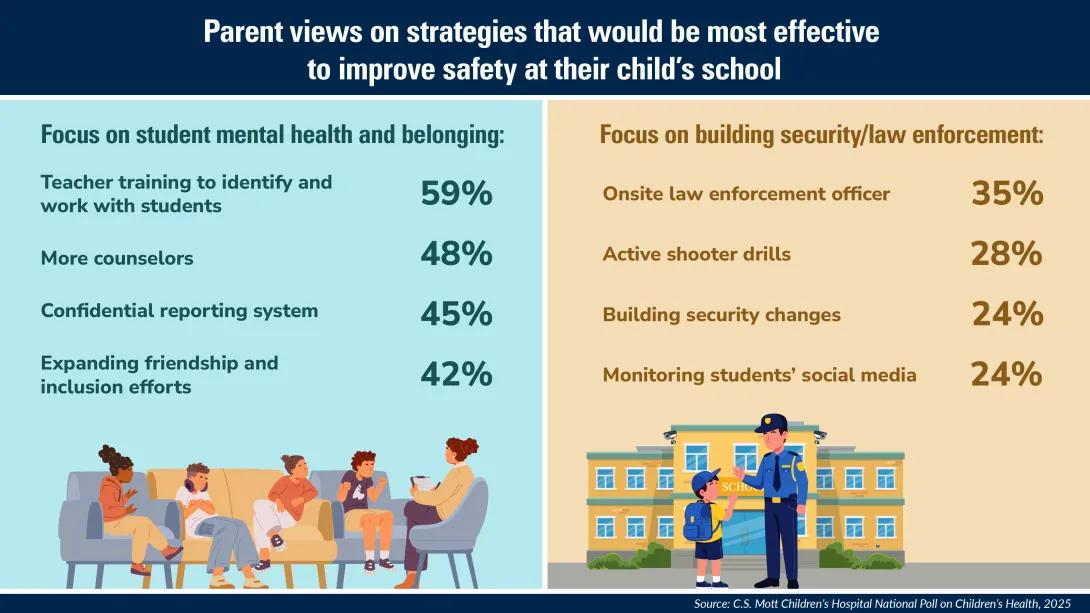
Nearly 60% of parents of elementary and middle schoolers say teacher training to identify and support students with emotional or behavioral problems would make schools safer, according to the University of Michigan Health C.S. Mott Children’s Hospital National Poll on Children’s Health.
Almost half support hiring more school counselors, while four in ten endorse confidential reporting systems and programs to promote inclusion and friendship among students.
Meanwhile, traditional security measures—such as on-site law enforcement, active shooter drills or reinforced building security—garnered support from about a third of parents.
Our report suggests parents view safety more broadly. They see it as protecting children from the everyday harm caused by bullying, exclusion and emotional distress.”
-Sarah Clark, M.P.H.
“Many people equate school safety with preventing tragic shootings,” said Mott Poll Co-Director Sarah Clark, M.P.H.
“But our report suggests parents view safety more broadly. They see it as protecting children from the everyday harm caused by bullying, exclusion and emotional distress.”
A focus on mental health
The nationally representative survey of 1,000 parents of children ages 6–12, conducted in August, found that one in six parents are extremely or very concerned about their child’s safety at school.
Parents’ top priorities center on equipping teachers and schools to respond to students’ emotional and social needs.
Many said they want teachers trained to recognize when a child is struggling and to connect them to timely support.
“Teachers see kids every day and are often the first to notice when something’s wrong,” Clark said. “With the right training, teachers may be able to step in early and help a student in distress before problems escalate.”
Parents also voiced strong support for increasing the number of school counselors, ensuring students get prompt attention when referred.
They emphasized the importance of initiatives that help children form and sustain friendships as well, which are key to fostering a sense of belonging.
What parents see as root causes of safety concerns
When asked what contributes most to safety problems at school, parents pointed to lack of parental supervision, student access to weapons, insufficient services for struggling children, mental health challenges among students, inadequate security on school grounds and inconsistent or ineffective discipline.
One in four parents also said their child’s school does too little to hold parents accountable when their children cause safety problems.
“Accountability can be a tough balance,” Clark said.
“Schools want to keep families engaged and participating in counseling or behavior plans but parents also expect clear consequences for ongoing issues.”
Experts agree that children learn best when they feel safe and connected at school, Clark added.
“While high profile threats are often what grab headlines, many parents seem to agree that real safety starts with relationships, belonging and early mental health support,” she said.
Sign up for Health Lab newsletters today. Get medical tips from top experts and learn about new scientific discoveries every week.
Sign up for the Health Lab Podcast. Add us wherever you listen to your favorite shows.

Health Lab
Explore thousands of health news & research stories by visiting the Health Lab homepage for more.
Media Contact

Public Relations
Department of Communication at Michigan Medicine
In This Story

Sarah J Clark
Research Scientist
Stay Informed
Want top health & research news weekly? Sign up for Health Lab’s newsletters today!
Featured News & Stories

U-M-led consortium to receive up to $52 million in NIH funding to study why viral respiratory infections affect children differently

Comprehensive DNA sequencing reveals hidden drivers of cancer

Many older adults make Medicare decisions quickly and most don’t change plans, poll finds
4 in 5 parents say having a baby is too expensive

‘Molecular glue’ stabilizes protein that inhibits development of non-small cell lung cancer and uterine cancer