Parents of kids with health conditions less confident about a positive school year
1 in 4 parents in national poll say their child has a medical or behavioral issue that requires assistance at school
12:00 PM
Author |

As the new school year begins, some parents may be feeling more nervous than excited — especially those whose children have different health needs.
One in four parents in a new national poll say their school-aged child has a medical or behavioral condition that might require assistance at school.
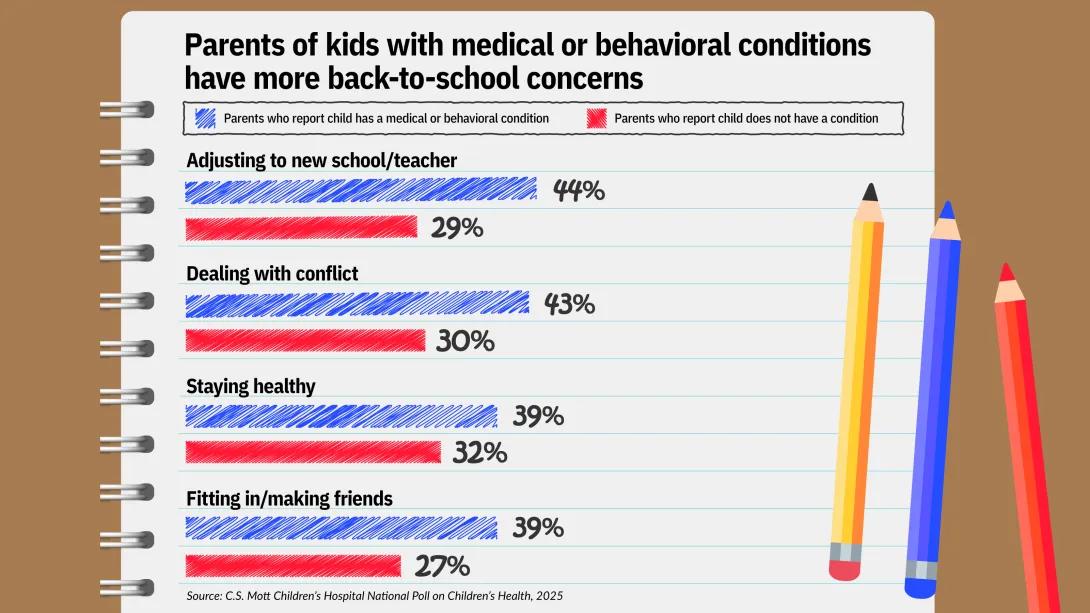
And these parents are more likely to be concerned about their child adjusting to a new school or teacher, dealing with conflict, staying healthy, keeping up with homework and fitting in or making friends, according to the University of Michigan Health C.S. Mott Children’s Hospital National Poll on Children’s Health.
They’re also less confident they can help their child have a positive school year – and more likely to say their child feels nervous as well.
“It’s completely natural for parents to feel uneasy at the start of the school year, especially when their child has a health condition that adds another layer of complexity,” said Mott Poll Co-Director and Mott pediatrician Susan Woolford, M.D.
“These parents are not only thinking about academics. They’re also juggling concerns about safety, social connection, and whether their child’s needs will be understood and supported by school staff.”
The nationally representative poll, conducted in August, is based on responses from 1,101 parents of children ages 6–12.
Health conditions create a range of school needs
Children’s health conditions may include chronic medical issues such as asthma, epilepsy, or food allergies, conditions that often require clear plans for emergency responses.
Others may have behavioral or developmental health conditions, such as attention deficit hyperactivity disorder, anxiety, autism, or depression, that affect classroom engagement and social interaction.
According to the poll, parents of children with these conditions report needing classroom modifications, in-school health services or medication administration, plans for frequent absences due to appointments, emergency action plans, dietary restrictions or activity limitations.
More than half of these parents said they’ve met with teachers or school staff to set up accommodations for their child.
About half have created a formal plan with the school, while fewer have received guidance from their child’s healthcare provider or submitted written emergency instructions.
“At the start of the school year, it is essential to build strong communication between families and schools to ensure children with health needs are supported and avoid letting them fall behind,” Woolford said.
Academic concerns go hand-in-hand with health management
For many families, the school year brings concerns beyond daily health management.
Children may miss class due to appointments, for example, which may affect academic performance and social integration.
“Parents often play a vital role by fostering collaboration between the home, school and heath care providers to create strategies that keep their child on track,” Woolford said.
In some cases, that may mean discussing eligibility for special education services or creating an Individualized Education Plan, or IEP, that details specific academic and social support, she notes.
Even children who don’t qualify for special education may be eligible for a 504 Accommodation Plan, she adds, which ensures equitable access to opportunities and removes barriers to learning.
These plans may include modifications such as adjusted seating or class schedules, medication access protocols, staff training on emergency procedures and safety measures during physical activity.
Emotional readiness and social worries
Despite the added challenges, parents of children with health conditions are just as likely to report that their child is excited about the start of school.
But they are also less likely to describe their child as confident compared to parents whose children do not have health conditions.
These parents are not only thinking about academics. They’re also juggling concerns about safety, social connection, and whether their child’s needs will be understood and supported by school staff.”
-Susan Woolford
Woolford recommends tools like age-appropriate books that teachers can read to the class, or even a parent-and-child “show and tell” session to help demystify the child’s condition and build peer understanding.
“Typically, a new school year means new classmates, and some children have a harder time making friends or worry about being excluded because of a health condition,” Woolford said.
“These conversations help classmates learn about differences in a positive way and present an opportunity to learn about accepting differences and showing friendship and support.”
What parents want from schools
Many parents polled would like school programs to help them learn how to support their child’s well being, such as how to help children deal with conflict, support their mental health and limit the impact of social media.
Parents of children with medical or behavioral conditions are especially eager for mental health support, with over 60% saying they want schools to provide it, compared to less than half of parents whose children do not have such conditions.
Schools that proactively support mental health and social-emotional learning can make a big difference, Woolford says.
“These programs benefit all students, but they’re especially important for children facing additional health or behavioral challenges,” she said.
She recommends that parents schedule meetings with teachers, school nurses, counselors, and other key staff early in the year to create a unified plan for supporting their child. Parent-teacher conferences are also a valuable opportunity to check in, share observations from home, and adjust supports as needed.
“Parents don’t need to figure it all out alone,” Woolford said. “By building strong relationships with school teams and keeping healthcare providers in the loop, families can make sure their child feels safe, supported, and set up for success.”
Sign up for Health Lab newsletters today. Get medical tips from top experts and learn about new scientific discoveries every week
Sign up for the Health Lab Podcast. Add us wherever you listen to your favorite shows

Health Lab
Explore thousands of health news & research stories by visiting the Health Lab homepage for more.
Media Contact

Public Relations
Department of Communication at Michigan Medicine
In This Story

Susan J Woolford, MD, MPH
Associate Professor
Stay Informed
Want top health & research news weekly? Sign up for Health Lab’s newsletters today!
Featured News & Stories
4 in 5 parents say having a baby is too expensive

Many older adults make Medicare decisions quickly and most don’t change plans, poll finds

What’s the latest on 7-OH and kratom availability and addiction care?

A pediatric epilepsy fundraiser that changes lives

Better prenatal care data could help prevent maternal complications, experts say