Paralympic dreams and the growth of adaptive sports
The wheelchair basketball star is one of several high-level athletes to elevate the young adaptive athletics program at University of Michigan.
10:52 AM
Author |
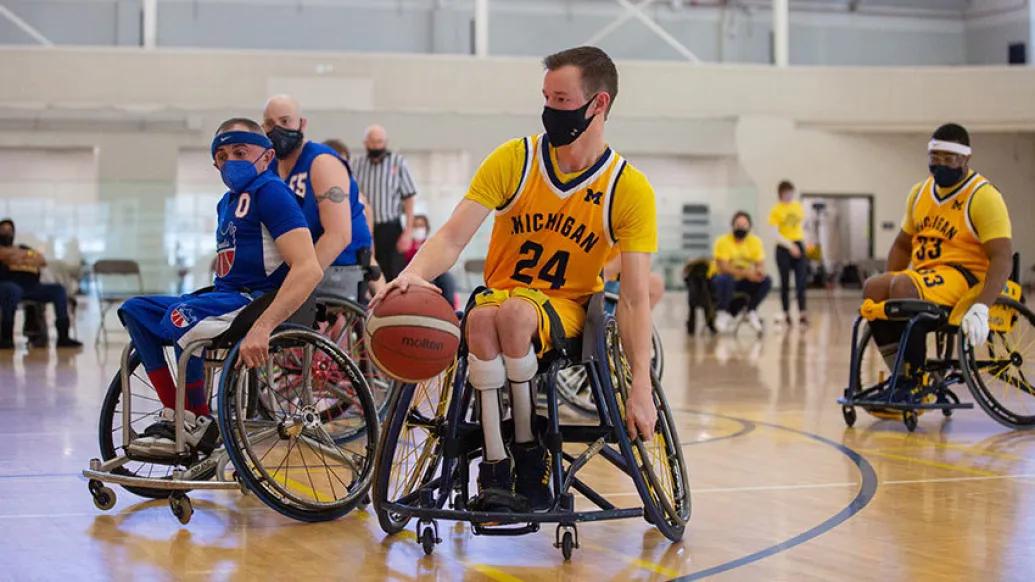
At a hotel surrounded by teammates, he got the email.
"Dear Spencer Heslop," it read. "You have been invited to participate in the Selection Camp for the U.S. Men's National Team for the 2022 calendar year."
The Utah native, and recent graduate from University of Michigan School of Public Health, dreamed of the opportunity to play for the United States since he was seven years old. After being diagnosed with spina bifida, a neural tube defect that often results in damage to the spinal cord and nerves, Heslop's parents pushed him to try wheelchair basketball.
"They wanted me to be active and not limit myself even though it could have been very easy to be done with it all," Heslop said. "When they took me to my first practice, I refused to get on the court. They wouldn't leave until I tried, and after that, it was hard to get me off the court."
By high school, Heslop played wheelchair basketball on a competitive travel team through the National Wheelchair Basketball Association. The experience opened his eyes to the world of adaptive sports; he had no idea how many opportunities existed.
While he was never the biggest or strongest player, Heslop had a feel for the game and a desire to take it further. He worked tirelessly to develop chair skills and conditioning that made him more explosive – it led to an awards-laden college career at the University of Illinois and a spot on the NWBA's Utah Wheelin' Jazz.
Like Podcasts? Add the Michigan Medicine News Break on Spotify, Apple Podcasts or anywhere you listen to podcasts.
"As I applied to grad school, I knew I would play wherever I was planning to go," Heslop said. "Michigan was near the top of my list academically, but I also heard rumors that they were trying to get an adaptive sports program going, and that helped me make my choice."
University of Michigan Adaptive Sports and Fitness was formed in 2018 to address the inequitable access to physical activity opportunities, competitive and recreational, for students with disabilities at U-M. It's led by Oluwaferanmi Okanlami, M.D., M.S., director of student accessibility and accommodation services in the U-M Division of Student Life and a U-M Health physician with several appointments, including the Department of Physical Medicine and Rehabilitation.
"When I met Spencer, we had competitive tennis but not a lot of basketball, mostly just drop-in activity," Okanlami said. "Spencer has been an integral part of the basketball program here and a leader on the team. He has a passion for growing the sport, and it's been an honor to have him."
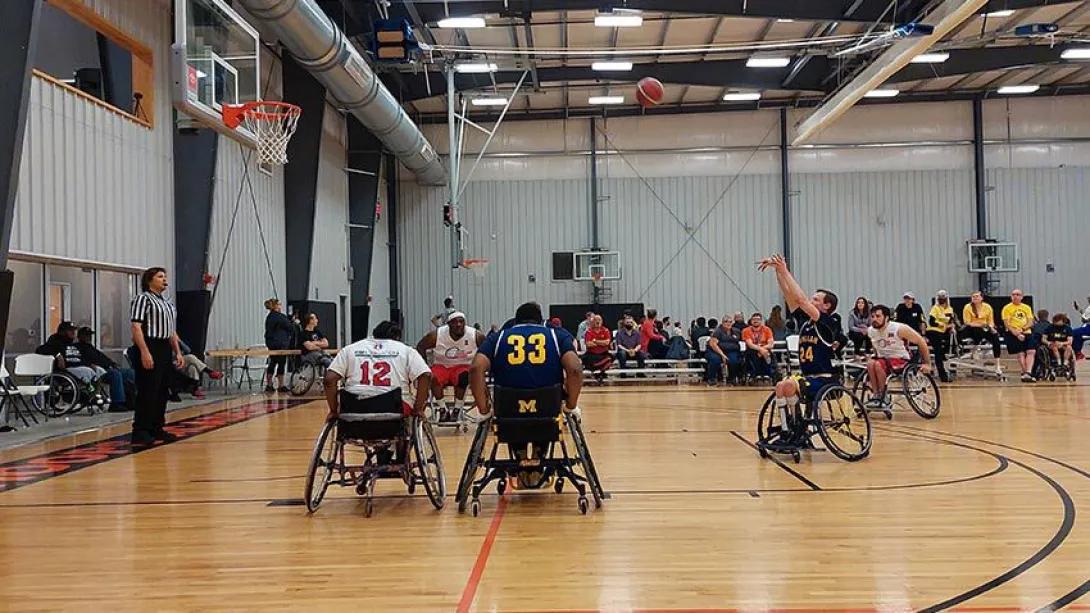
Since Heslop joined the program in the fall of 2020, U-M's wheelchair basketball team became part of the NWBA's Division II. After leading the team to an 8th place finish at the NWBA nationals in April 2022, Heslop traveled to Colorado for the U.S. Men's National Team selection camp.
Pitted against 30 of the nation's premier athletes, Heslop made the final twelve-man roster and will play in the 2022 International Wheelchair Basketball Federation's Americas Cup. Making this roster gives the recently graduated epidemiologist a better shot at his ultimate goal: playing for Team USA in the Paralympic Games.
"This is an opportunity to represent the country and everyone who has been a part of my journey to this point – and I'll never take it for granted," Heslop said. "It's a culmination of the support my family has given me in sacrificing to let me travel to tournaments all these years, the coaches who taught me how to play and the teammates I've had who have pushed me to become a better player."
The growth of adaptive sports
When Heslop considered coming to Michigan, several other schools boasted more robust basketball programs. Playing was not the only draw.
"Wheelchair basketball has given me so much, and I felt like Michigan provided me the opportunity to give back and pave a path for others in the community who either didn't have opportunities to play in the past or didn't know it was available," he said. "I wanted to be a part of something that built that for other people."
While Heslop scores an average of around 20 points per game, he serves as the team's nucleus, helping other players excel both with his play and off-court leadership.
"The growth and success of wheelchair basketball at the University of Michigan is going to depend on the acquisition of foundational technical and tactical knowledge by our core members – and, in turn, being able to share that knowledge with future members of the wheelchair basketball community," said Erik Robeznieks, M.B.A., assistant director of Adaptive Sports & Fitness.
SEE ALSO: Adapting Common Fall Sports for People with Disabilities
"Spencer has been essential in his contributions to growth of the sport at U-M by sharing his expertise and insight, whether that is teaching one-on-one skills at practice or coming up with in-game adjustments in a high-stakes game. Importantly, Spencer has contributed to establishing a culture with our wheelchair basketball program that values learning and understanding while still holding people accountable to attainable expectations."
Heslop is one of several elite athletes who has helped develop adaptive sports at Michigan, which also includes programming for wheelchair tennis, track and field and para-equestrian activities.
Chris Kelley, winner of the 2019 USTA Wheelchair National Championships, is now a fulltime staff member in U-M adaptive sports. He has coached the tennis team, on which Heslop also plays, to multiple top finishes in national tournaments.
The track and field teams are bolstered by Paralympic gold medalist high jumper Sam Grewe and All-American javelin and discus athlete Cathryn Gray.
"These athletes had decorated careers before coming to U-M, but they saw what we were building and could offer," Okanlami said. "Having them provide us with their expertise, experience and name can lead other people to look at bringing their talents here. And I think they will because the academic programs that we have at Michigan combined with the opportunities in adaptive sports are unparalleled to any other institution."
In addition to competitive programming, U-M Adaptive Sports and Fitness hosts weekly drop-in events, like wheelchair tennis and basketball, that are open to community members with and without disabilities. In some instances, the drop-in program has led to athletes joining competitive teams.
SEE ALSO: The Power of Adaptive Sports: Getting in the Game
At U-M Health, the Department of Physical Medicine and Rehabilitation also plans to relaunch its adaptive sports medicine clinic in August. The program, led by Melissa Tinney, M.D., will offer evaluation for pre-participation in adaptive sports, provide support for athletes including treatment and injury prevention, and provide education to prospective athletes.
Expanding an adaptive sports program, however, hasn't come without challenges. Okanlami and leaders in adaptive sports have struggled to find funding for facilities, equipment and trips.
"Getting people aware of the fact that adaptive sports exist and should be provided to people is a challenge, so getting them to buy in after trying to introduce them to a new concept is difficult," Okanlami said. "And if you don't have consistent programming or resources, it's hard to get consistent participation and commitment from athletes to play here."
While seeing athletes like Heslop achieve greatness is a perk for the adaptive sports team in Ann Arbor, the goal is much larger: creating an environment where people with disabilities are seen and valued at a program seen as a national leader in adaptive athletics.
"We're not looking at just one thing; we want Michigan to be the leader and best in the adaptive sports arena," Okanlami said.
"We don't just want to train the world's next great adaptive sports athletes. We want to train the next great adaptive sports medicine practitioners, physical therapists, orthopaedic surgeons and more. We want to be conducting research and development for equipment and technologies to optimize sport performance. We could have a Paralympic training center. All of these types of programs exist across the country, but there is not one single place that exists with them all, and I know we can do that here in Michigan."
Live your healthiest life: Get tips from top experts weekly. Subscribe to the Michigan Health blog newsletter
Headlines from the frontlines: The power of scientific discovery harnessed and delivered to your inbox every week. Subscribe to the Michigan Health Lab blog newsletter

Health Lab
Explore a variety of health care news & stories by visiting the Health Lab home page for more articles.
Media Contact

Public Relations
Department of Communication at Michigan Medicine
Stay Informed
Want top health & research news weekly? Sign up for Health Lab’s newsletters today!
Featured News & Stories
Expanding camp adventure for all
A method to prevent falls before they happen
Giving with gratitude: planned gifts support nursing, research, and patient care

A smarter helmet for the smallest patients
To reduce chronic pain, a new digital program could help