Older adults and AI: Poll suggests a wary welcome
Over half have used AI technologies and 14% have used AI to get health information
8:00 AM
Author |

The artificial intelligence revolution hasn’t passed older adults by, a poll suggests.
But the data show that people over 50 have both curiosity and skepticism about AI, depending on how much they’ve used it, the data show.
No matter what their level of experience with AI, nearly all people over 50 (92%) say they want to know when the information they read, see or hear is AI-generated, according to the findings from the University of Michigan National Poll on Healthy Aging.
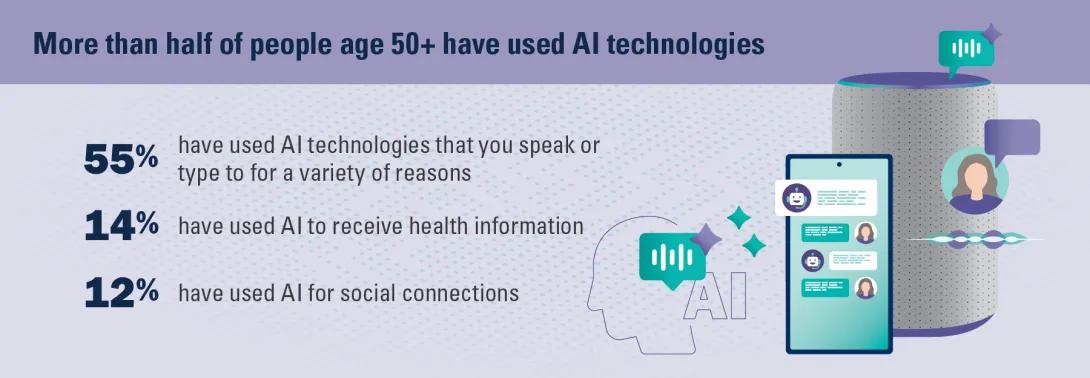
In all, just over half (55%) of people age 50 and older have ever used an AI technology that they spoke or typed messages to for a variety of purposes on a variety of devices.
Of those who used voice assistants like Amazon Alexa, Apple’s Siri, or Google Nest in the past year, 80% said these devices are beneficial for helping them live independently and safely in their home, including 28% who said they’re very beneficial for this purpose.
In addition, 35% have used AI-enhanced home security devices; nearly all who had done so said they found them beneficial for helping them live independently and safely in their home.
Overall, 14% of older adults polled said they have used AI technologies to receive health-related information.
AI is here to stay. Many older adults seem to know about its benefits, yet most want more information about potential risks when using AI technologies."
-Robin Brewer, Ph.D., M.S.
Among those who had, nearly half (47%) said a human interaction in person or by phone would be better for that purpose, with 26% saying AI and human interaction are about the same.
The poll is based at the U-M Institute for Healthcare Policy and Innovation, and supported by Michigan Medicine, U-M’s academic medical center.
The poll team also analyzed data from adults age 50 and older in Michigan, with support from the Michigan Health Endowment Fund (those findings are at https://michmed.org/KDBJR and an interactive data dashboard.)
“AI is here to stay. Many older adults seem to know about its benefits, yet most want more information about potential risks when using AI technologies,” said Robin Brewer, Ph.D., M.S., an assistant professor in the U-M School of Information and a health AI researcher who worked with the poll team on the report.
“The near-universal interest in clear labeling of AI-generated information should also be heeded by policymakers and the AI industry.”
She notes that many state legislatures have passed bipartisan bills to regulate AI use in recent years, including in political advertising and mental health care.
AI-related interest, attitudes and confidence levels
In addition to asking about their AI experiences to date, the poll also asked older adults about their interest in using AI and learning about its risks, their trust level in AI-generated information, and their confidence in spotting incorrect information generated by AI.
Just over a third of adults aged 50 and older (35%) said they’re interested in using AI in their day-to-day lives.
Over half (58%) would like to know more about the potential benefits of using AI, but a much greater percentage (81%) said they want to know more about the risks.
Older adults are split on whether they think AI will do more harm or good, with 53% saying more harm than good and the rest saying the opposite.
Nearly half of those polled said they had some trust in AI-generated information (49%) but only 4% said they had a lot of trust in it, and the rest (47% said they had little or no trust. Those who had used AI were more likely to express some level of trust.)
Also, half of older adults said they weren’t confident they could detect when information generated by AI is incorrect.
Prominent examples include “hallucinations”, when an AI application makes something up that sounds correct but isn’t true, or the “deepfake” videos and images that have proliferated in the past year.
Scammers using AI-driven voice technology have also been known to attempt to swindle older adults over the phone.
"This inability to tell verified information from false information, whether in the form of text, image, video or audio, is especially important when it comes to health information,” said poll director Jeffrey Kullgren, M.D., M.P.H., M.S., a primary care physician at the VA Ann Arbor Healthcare System and associate professor of internal medicine at U-M.
“Our new data show that people who report that their physical health or mental health are fair or poor were more likely to lack confidence in their ability to spot incorrect AI-generated information and were less likely to trust AI-generated health information, than those in good to excellent health,” he said.
“Clinicians, aging-focused organizations and health care organizations should all take notice.”
More outreach and education efforts by those organizations and government agencies could help, said Brewer, who studies how technology can be designed to support the needs of older adults and people with vision issues.
“These findings present opportunities for older adults and their families to learn about ‘healthy’ AI use, including when to use AI instead of a search engine, or how to use AI to support healthy aging, such as accessing non-urgent health information,” she said.
The University of Michigan’s Michigan Online platform offers free and paid online learning opportunities about artificial intelligence, including free mini-courses about generative AI and ChatGPT. More online learning about AI is in development; anyone can sign up to be notified of updates.
Learn more about healthcare AI research and innovation by U-M faculty who are members of IHPI.
The poll findings come from a nationally representative survey conducted by NORC at the University of Chicago for IHPI and administered online and via phone in February 2025 among 2,883 adults ages 50 to 97 across the U.S. The sample was subsequently weighted to reflect the U.S. population. Read past National Poll on Healthy Aging reports and about the poll methodology.
Sign up for Health Lab newsletters today. Get medical tips from top experts and learn about new scientific discoveries every week.
Sign up for the Health Lab Podcast. Add us wherever you listen to your favorite shows.

Health Lab
Explore thousands of health news & research stories by visiting the Health Lab homepage for more.
Media Contact

Public Relations
Department of Communication at Michigan Medicine
In This Story

Jeffrey Todd Kullgren, MD, MS, MPH
Professor
Related
People want to know if AI is used in their health care

Adults don’t trust health care to use AI responsibly and without harm
Stay Informed
Want top health & research news weekly? Sign up for Health Lab’s newsletters today!
Featured News & Stories

What’s the latest on 7-OH and kratom availability and addiction care?

A metabolic “switch” that could help reset scar-producing cells in scleroderma

Depression in OBGYN residents needs more attention, study suggests

Emergency room intervention pairs smartphone, telehealth counseling to reduce risky firearm behavior

Better prenatal care data could help prevent maternal complications, experts say