Novel measuring tool reduces severe allergic reactions during food allergy challenges
The results from the pilot study could significantly improve in-office food allergy challenges
11:00 AM
Author |
If you suspect you have a food allergy, one of the only ways doctors can positively confirm the suspicion is through something called a food allergy challenge.
You give a child, or an adult, the food they might be allergic to in a controlled office setting and see if they react.
“It’s unpleasant, doesn’t feel good, it’s potentially risky and it’s very expensive,” explained Charles Schuler, M.D., an allergist at Michigan Medicine.
“They take a lot of time to set up and they require a lot of logistical support, too."
For years now, Schuler and his team have been investigating ways to make the food allergy testing process easier, safer and cheaper to do.
And now they may have figured it out.
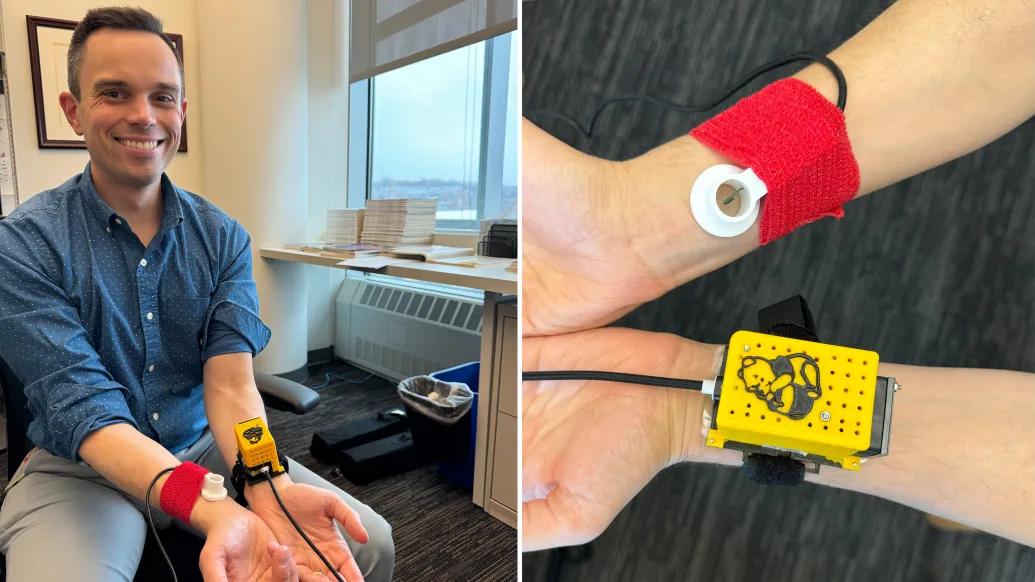
In a previous paper, the team detailed their development of a novel device they called TEWL, short for transepidermal water loss, which accurately measures water loss in the skin during an allergic reaction.
Now, in their published pilot study featured in JAMA Open Network, the team found that by using TEWL’s reported measurements, along with one other symptom of an allergic reaction, it can accurately be used as a stopping criteria during a live food allergy challenge to prevent the onset of a severe allergic reaction or anaphylaxis.
Using TEWL during food allergy challenges
“Overall, the best way to evaluate a food allergy is with an in-office food challenge. However, kids and parents are sometimes hesitant to perform food challenges because they're scared about a reaction,” said George Freigeh, M.D., M.A., the first author on the paper and a clinical assistant professor of internal medicine and of pediatrics at U-M.
“Anything that we can do to reduce the severity of a food challenge reaction is welcome because it may make these procedures more accessible to people that are concerned.”
Two years ago, in a previous study, the group saw transepidermal water loss numbers dramatically shoot up immediately during food anaphylaxis.
“After those findings we wanted to evaluate whether or not, when that number rose, could we accurately act on it or not?,” said Schuler.
The question became that, if they stopped the food allergy challenge based on those numbers and one additional allergic reaction symptom (i.e., sneezing, runny nose, itchy mouth, etc.), could that change the outcome of reaction severity while still preserving an accurate diagnosis?
The non-invasive monitor is placed hallway up the forearm, doesn’t hurt the patient and requires no needle to measure the leakiness of the skin barrier.
“The device sits on the skin and measures water loss as a flux or rate (grams/square meter/hour of water lost) via humidity and temperature sensors,” explained Schuler, also an assistant professor in internal medicine at the Mary H. Weiser Food Allergy Center at U-M.
“When the rate of water loss goes up, a reaction is likely imminent. When we paired that finding with a single objective symptom, we could stop challenges at a point where anaphylaxis was avoidable in many cases.”
The pilot clinical trial enrolled children 5 and under to test out the technology, noting young children as a particularly key group to test the device with since it’s harder for them to express what they’re feeling, making oral food allergy challenges tricky.
“For young children, their expressive language is limited – it makes it hard for parents and allergists alike to understand what their symptoms are," said Schuler.
"We needed something like this as an objective and external way to observe what’s happening inside their bodies during a food challenge.”
Not only did the team find children happily wore the device, but upon observation, they saw that if they took a measurement two minutes before food dosing and then compared it to another one taken two minutes after the patient ate the food (which were peanuts), there was a distinct difference in the water retention measurements found in the skin during that time if the patient was headed towards a reaction.
“What we found in most of the participants was that if they at any time also had one objective symptom of an allergic reaction (i.e., one hive, or runny nose) we could use this monitored change we saw as a surrogate second symptom."
When the team acted on those numbers, most kids didn’t need additional treatment later, avoiding the use of epinephrine, a drug used to stop severe allergic reactions.
Overall, less medicine was needed to intervene.
“What we found was that, by the consortium of food allergy research and world allergy grading criteria, there was a very significant decrease in reaction severity and symptoms experienced and we saw significantly lower reaction rates by multiple scoring guidelines.”
Based on these groundbreaking results, the group is now going to seek funding to develop an evolved version of TEWL that could be wireless, have a friendly user face and be usable in various environments beyond Michigan Medicine.
Paper cited: "Transepidermal Water Loss in Oral Food Challenges in Children With Peanut Allergy," JAMA Open Network. DOI: 10.1001/jamanetworkopen.2025.43371
Funding/disclosures: The Gerber Foundation. James Baker, M.D., Blue Willow Biologics, Inc.; IgGenix; Moderna, Inc.; Moonlight Therapeutics; Stallergenes Greer International AG; Ukko LLC.
Tech transfer(s)/Conflict(s) of interest: The team has a pending patent application, which covers the use of TEWL as a novel anaphylaxis monitoring modality.
Sign up for Health Lab newsletters today. Get medical tips from top experts and learn about new scientific discoveries every week
Sign up for the Health Lab Podcast. Add us wherever you listen to your favorite shows

Health Lab
Explore thousands of health news & research stories by visiting the Health Lab homepage for more.
Media Contact

Public Relations
Department of Communication at Michigan Medicine
In This Story

Charles F Schuler IV, MD, FAAAAI
Assistant Professor
Stay Informed
Want top health & research news weekly? Sign up for Health Lab’s newsletters today!
Featured News & Stories

Emergency room intervention pairs smartphone, telehealth counseling to reduce risky firearm behavior
Better prenatal care data could help prevent maternal complications, experts say

Pain, psychological factors and physical function closely linked in people with systemic sclerosis
Many hospitals still don’t do enough to prevent UTIs from catheters

Digital alerts support timely treatment decisions of critically ill cardiac patients