A new way to measure bipolar disorder
Reducing variation in symptoms over time, not just capturing mood episodes, should be the goal for treatment and clinical trials, long term analysis suggests
9:33 AM
Author |

When Sarah Sperry, Ph.D., meets with her patients who have bipolar disorder, she asks them what aspect of their condition interferes with their lives the most.
Many of them say it’s their lack of control over how strongly they react to events and situations.
But addressing that subtle mood instability and emotional reactivity hasn’t been the usual goal of treatment for people with this condition worldwide.
Rather, there has been an explicit focus on avoiding severe episodes of depression, hypomania or mania.
Part of the issue: it’s not easy to measure instability with standardized questionnaire about recent symptoms, or know how well that variation is responding to medication and psychotherapy.
Now, Sperry and colleagues at the University of Michigan Medical School Department of Psychiatry think they’ve found a way to do it, after studying more than a decade’s worth of data from nearly 400 people with bipolar disorder, and more than 210 people with other mental health conditions or no psychiatric diagnosis.
SEE ALSO: Bipolar disorder linked to early death more than smoking
They’ve published their findings, gleaned from the Prechter Longitudinal Study of Bipolar Disorder, in Nature Mental Health.
Rather than just looking at a person’s self-reported symptoms at a point in time, they find, it’s more valuable to look at trends from those self-reports over time to see how much variation the person has.
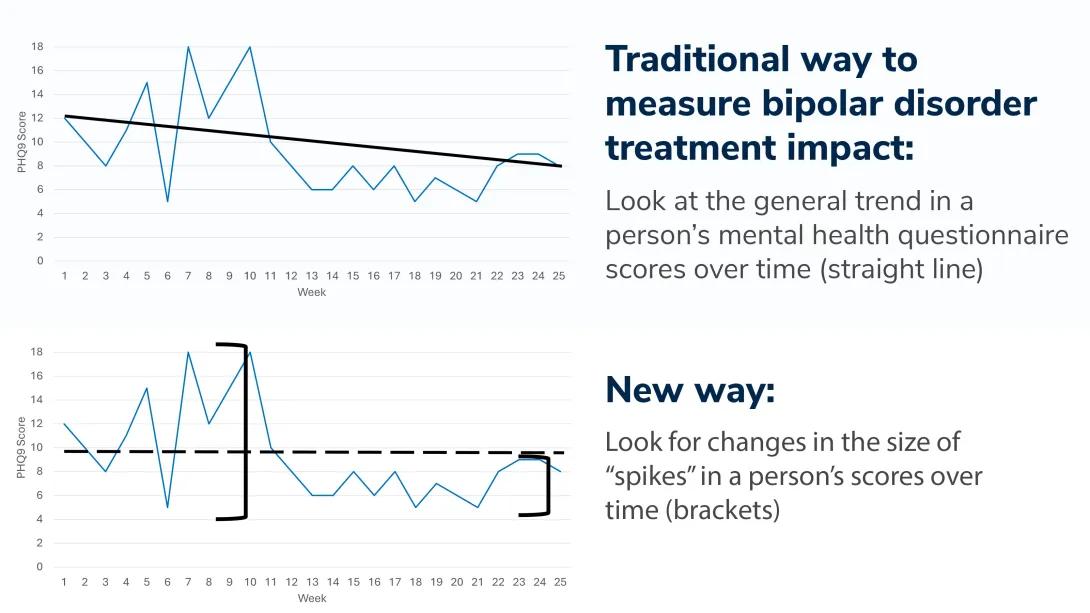
In other words, look at how much they vary from their typical mood, or, how big their “spikes” are, and work to reduce the size of those spikes through established or experimental treatments.
“We suggest that the primary outcome measure used to gauge success of clinical care, or impact of an experimental intervention, may be the wrong one,” said Sperry.
“As patients have tried to tell us, it’s variation, reactivity and instability that seem to matter. Now, we think we have a way to measure that.”
Sperry and her colleagues looked at data from hundreds of questionnaires completed about every two months over 10 or more years by each participant, including the PHQ-9 for depression, the ASRM for mania, the GAD-7 for anxiety and the SF-12 that measures quality of life and includes question about mental and physical health.
They found that the people with bipolar disorder were far more likely to have large variation over time, indicating greater mood instability, in many of these scales, compared with people who had other mental health conditions and people with no psychiatric conditions.
As patients have tried to tell us, it’s variation, reactivity and instability that seem to matter. Now, we think we have a way to measure that."
-Sarah Sperry, Ph.D.
They then analyzed the PHQ-9, ASMR and GAD-7 patterns for each person over time.
They found that the more often and more strongly a person with bipolar disorder varied in these measures, the worse their mental health quality of life was, and often their physical quality of life too, as measured on the SF-12.
By looking at the rolling averages and variation for each person over a year, the team created a scoring system that essentially predicts quality of life based on how much each person deviates from his or her average over time.
And since the questionnaires are short and can be taken quickly via a smartphone app or website, it might be possible to get more frequent data on patients and clinical trial participants in the future, and calculate their scores with less than a year’s data.
Sperry and colleagues hope their scoring system for bipolar symptom variability can be tested in data sets from other studies and large electronic health record datasets. If it holds up, they hope it can help improve how treatment and clinical research impacts are measured, and help patients have a better quality of life.
They have published the code needed to calculate the variability score for individuals.
“This is something that’s easy to calculate, and uses existing well-validated questionnaires,” she said.
“Variability is central to the experience and daily functioning of people with bipolar disorder. We need to measure it, and work to change the intensity of these shifts as a measure of treatment impact.”
In addition to Sperry, the study’s authors are Melvin McInnis, M.D., director of the Heinz C. Prechter Bipolar Research Program where the Prechter Longitiudinal study is based, and Anastasia Yocum, Ph.D., data manager of the research program.
The Prechter Longitudinal Study is enrolling both people with bipolar disorder and people with no mental health conditions or close relatives who have mental health conditions, to act as comparisons. Get more information.
Funding: Original data collection was funded by the Heinz C. Prechter Bipolar Research Fund, the Richard Tam Foundation, and the Eisenberg Family Depression Center. This study was funded by Sperry’s grants from the Brain and Behavior Research Foundation and National Institute of Mental Health.
Paper cited: "Mood instability metrics to stratify individuals and measure outcomes in bipolar disorder," Nature Mental Health. DOI: 10.1038/s44220-024-00291-5
Sign up for Health Lab newsletters today. Get medical tips from top experts and learn about new scientific discoveries every week by subscribing to Health Lab’s two newsletters, Health & Wellness and Research & Innovation.
Sign up for the Health Lab Podcast: Add us on Spotify, Apple Podcasts or wherever you get you listen to your favorite shows.

Health Lab
Explore thousands of health news & research stories by visiting the Health Lab homepage for more.
Media Contact

Public Relations
Department of Communication at Michigan Medicine
In This Story

Sarah H Sperry, PhD
Assistant Professor
Related

Bipolar disorder and alcohol: It’s not as simple as 'self-medication'
Stay Informed
Want top health & research news weekly? Sign up for Health Lab’s newsletters today!
Featured News & Stories

Comprehensive DNA sequencing reveals hidden drivers of cancer

‘Molecular glue’ stabilizes protein that inhibits development of non-small cell lung cancer and uterine cancer

Many older adults make Medicare decisions quickly and most don’t change plans, poll finds

What’s the latest on 7-OH and kratom availability and addiction care?

A metabolic “switch” that could help reset scar-producing cells in scleroderma