New guide aims to tame the chaos of UTI care
In an age of telehealth, portal messages and direct-to-consumer care, experts come together to create testing and treatment algorithms that reduce antibiotic resistance risk
5:00 AM
Author |

Millions of times a year, Americans seek urgent treatment for painful, embarrassing urinary tract infections.
But while you once had to go in person for testing and treatment, now you can type messages to your clinic into your phone, or see a doctor or nurse practitioner by video.
You can also buy a rapid UTI test at the drug store, or fill out an online symptom questionnaire and get an antibiotic prescription from a telehealth service that has no connection to your regular health care provider.
And while these recent innovations might speed up UTI care, they also raise the risk of overusing antibiotics, underusing urine culture tests, and other inappropriate care, especially for women who experience frequent UTIs.
Too much prescribing can also help drive the rise of “superbugs”: bacteria that evolve to resist treatment with common antibiotics.
Enter a new guide for clinicians published in JAMA Network Open by a team from the VA Ann Arbor Healthcare System and the University of Michigan Medical School.
Created by convening experts from around the country, the Ann Arbor Guide to Triaging Adults with Suspected UTI is among the first created for the age of telehealth and direct-to-consumer health care.
It grew out of a patient safety project funded by the VA National Center for Patient Safety and based at the Patient Safety Center of Inquiry at VAAAHS.
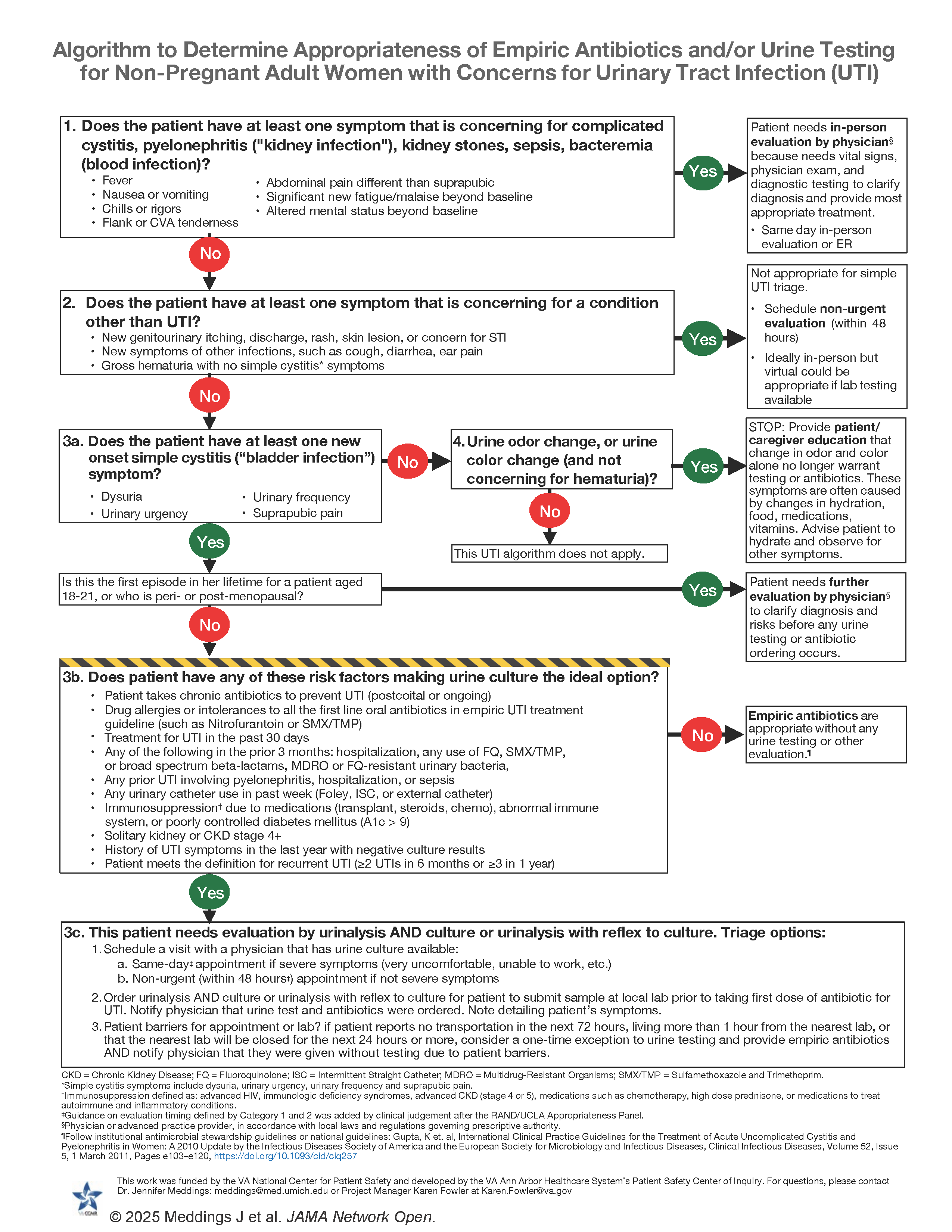
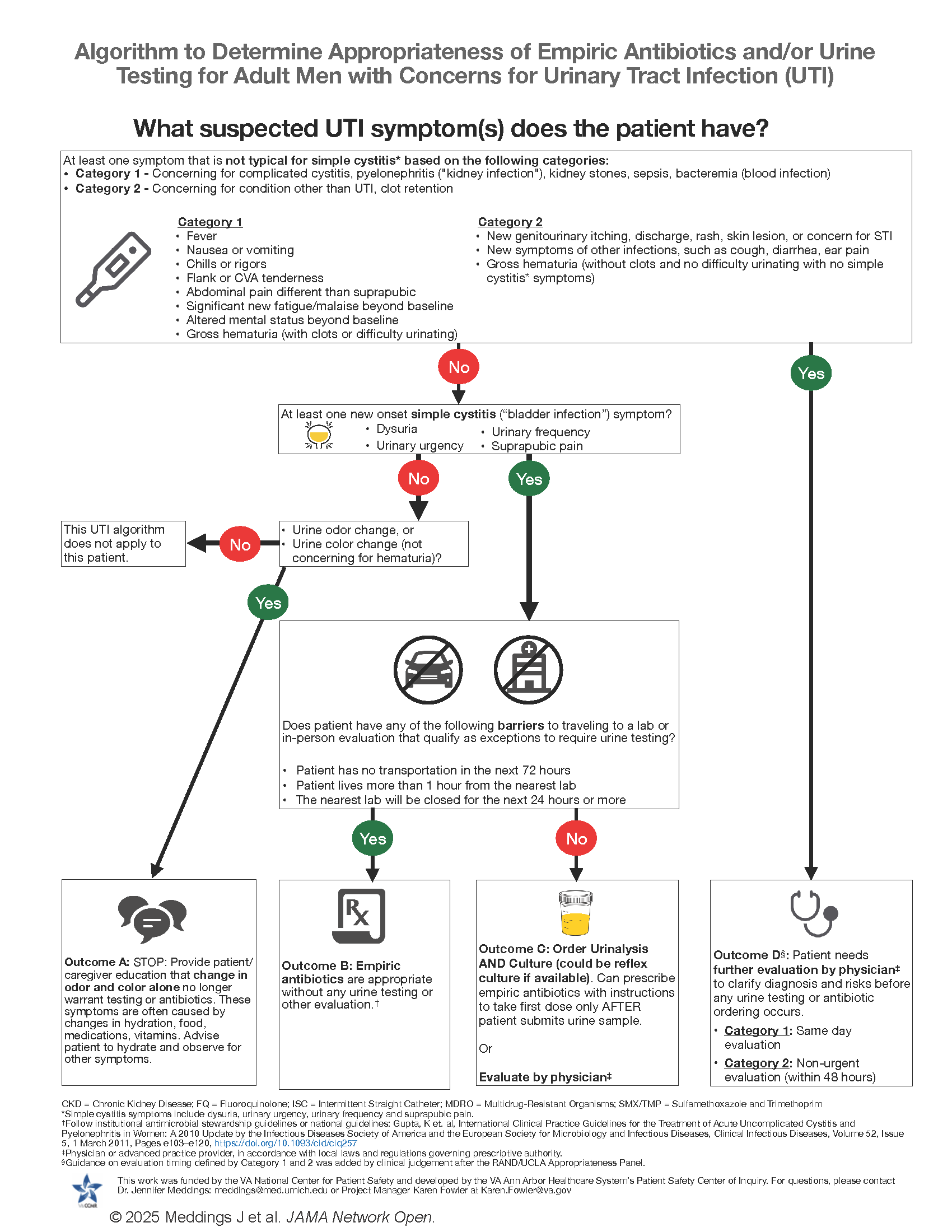
The paper contains two algorithms – one for non-pregnant women and the other for men – that clinicians in any setting can use to decide what tests to order, and when to prescribe antibiotics, for patients experiencing UTI-like symptoms.
Colorful, easy-to-follow guides are available in the paper’s PDF supplement and as images on the website of the U-M Institute for Healthcare Policy and Innovation.
Responding to a rapidly growing issue
Jennifer Meddings, M.D., M.Sc., the first author of the paper, is a primary care clinician and patient safety researcher at the VAAAHS and Michigan Medicine, U-M’s academic medical center.
“Clinics have long had triage systems for uncomplicated UTIs, especially for healthy women, but then virtual care, patient portal messaging and online ‘doc-in-a-box’ services that deliver prescriptions to anyone who answers a questionnaire have really changed things,” said Meddings, a Professor of Internal Medicine and Pediatrics at the U-M Medical School.
“UTIs are one of the most common reasons why American patients are prescribed antibiotics, and we’re seeing more resistant bacteria than ever.”
The shortage of primary care providers and appointments has also contributed to the situation, she says.
"Now, far fewer patients are being seen in person in a setting where a urine sample can be collected, cultured and used by the same provider as the basis for a treatment recommendation a few days later,” she added.
“So it’s more important than ever for providers to know which patients can safely receive antibiotics empirically – that is, without a urine culture and not just a dipstick test or no test.”
Guidance for many scenarios
The Ann Arbor UTI Guide was developed using the RAND/UCLA Appropriateness Method to coalesce expert opinion.
In addition to straightforward cases, it addresses less-common situations involving patients with more complicated health conditions, such as those with a history of organ transplants, chemotherapy, immunosuppression, kidney disease and those with recurrent UTIs who have prescriptions for antibiotics that they take after sex or on an ongoing basis.
Their testing and antibiotic needs are more complex than for those without these situations.
The guide also includes triage instructions based on symptoms that could indicate something more serious than a simple UTI in both men and women, from sexually transmitted infections and kidney infections to sepsis.
Karen Fowler, M.P.H., who helped develop the guide and is a longtime patient safety specialist at the VA Center for Clinical Management Research, notes that the new guideline is now being piloted for use in telehealth visits for Veterans cared for by local VA health centers and VA hospitals.
The team will assess how well providers feel they work for triaging patients seeking emergency and urgent care for UTI-like symptoms through virtual options in these hospitals.
Special attention to testing
In the meantime, the authors note that at-home UTI tests bought over the counter at stores or directly online are not accurate enough to confirm a UTI is present.
And while they do accept the accuracy of a negative clinical urinalysis in most patients as a sign that symptoms aren’t from a UTI, they call for confirmation of UTI by culture wherever possible in cases where a urinalysis is abnormal, because of high levels of false positives.
U-M Health, the clinical arm of Michigan Medicine, has changed its testing strategy to “urinalysis with reflex to culture.”
This means that most patients with UTI symptoms who receive a rapid urine test that comes back negative won’t have their urine cultured to see if UTI-related bacteria are present, but all others will.
“We hope that this guide will help both patients and providers be aware that even though they’re now able to take a questionnaire or interact with a provider completely virtually, that alone may not be enough to get the right diagnosis or treatment,” said Meddings.
“At the same time, we recognize that telehealth has removed barriers to care such as access to transportation, time off from work and caregiving, and more,” she added.
The new algorithms do provide for empiric antibiotic treatment when a patient can’t get transportation in the next three days, lives more than an hour from the nearest testing location or their closest lab is closed for the next 24 hours.
Women who get UTIs often, and most men, should request a urine culture, Meddings notes, even if they’re being seen virtually, using an online-only service, or choosing to seek care at an urgent care center, retail store clinic or emergency department that might be just doing a rapid urinalysis test.
Additional authors: Meddings and Fowler, the guide’s authors are U-M and VA urologist Kristin Chrouser, M.D., M.P.H., VA CCMR research team members Jessica Ameling, M.P.H. and Jason Engle, M.P.H., and U-M/VA internal medicine faculty Sanjay Saint, M.D., M.P.H., and Steven Bernstein, M.D., M.P.H. Saint and Meddings co-direct the Patient Safety Center of Inquiry project that funded this work; they and Chrouser and Bernstein are members of the U-M Institute for Healthcare Policy and Innovation.
Paper cited: "Ann Arbor Guide to Triaging Adults with Suspected Urinary Tract Infection for In-Person and Telehealth Settings," JAMA Network Open. DOI: 10.1001/jamanetworkopen.2025.56135
Sign up for Health Lab newsletters today. Get medical tips from top experts and learn about new scientific discoveries every week.
Sign up for the Health Lab Podcast. Add us wherever you listen to your favorite shows.

Health Lab
Explore thousands of health news & research stories by visiting the Health Lab homepage for more.
Media Contact

Public Relations
Department of Communication at Michigan Medicine
In This Story

Jennifer Meddings, MD, MSc, FACP, FAAP
Professor

Steven Jay Bernstein, MD, MPH
Professor

Kristin Chrouser, MD, MPH
Clinical Professor
Related

Do your UTIs keep returning?

Treating recurrent UTIs without antibiotics
Stay Informed
Want top health & research news weekly? Sign up for Health Lab’s newsletters today!
Featured News & Stories

Top 7 tips for choosing Medicare prescription drug coverage for 2027

Learning Together: Making Space for Growth at Work

Comprehensive DNA sequencing reveals hidden drivers of cancer

Many older adults make Medicare decisions quickly and most don’t change plans, poll finds

‘Molecular glue’ stabilizes protein that inhibits development of non-small cell lung cancer and uterine cancer