Michigan Medicine meets Michigan nature through art at D. Dan and Betty Kahn Health Care Pavilion
Three artists' work being featured in the new hospital
5:00 AM
Author |
From a 36-foot-long mural of layered photographs to scores of prints of Michigan nature scenes, vibrant artwork will fill D. Dan and Betty Kahn Health Care Pavilion.
The newest addition to the medical campus of University of Michigan, which stands 12 stories tall, will feature around 350 pieces from more than 35 artists.
The interior design vision is “Michigan meets Michigan,” which will reflect the state’s regional beauty by pairing natural colors — blues of the lakes, beiges of sand beaches and greens of the forests — with U-M’s legendary maize and blue.
“People who come into this hospital will feel the beauty of Michigan on each floor,” said Renee Cruse, senior business procurement consultant at Michigan Medicine.
“The diverse collection of art for this world-class building will bolster the restorative and healing environment that the pavilion will be for every patient, family member and loved one who comes through its doors.”
The artwork has potential beyond providing a positive environment, says Joel Howell, M.D., Ph.D., professor emeritus of internal medicine at University of Michigan Medical School.
“Art can help decrease patients’ stress and anxiety, as well as reduce pain, promote mental health and decrease length of stay,” Howell said.
“The art can also decrease staff burnout and increase morale.”
The art spans various mediums, from photographs and paintings to textiles and sculptures. It will pair with carefully curated furniture selections that align with the natural theme.
Getting to know the artists
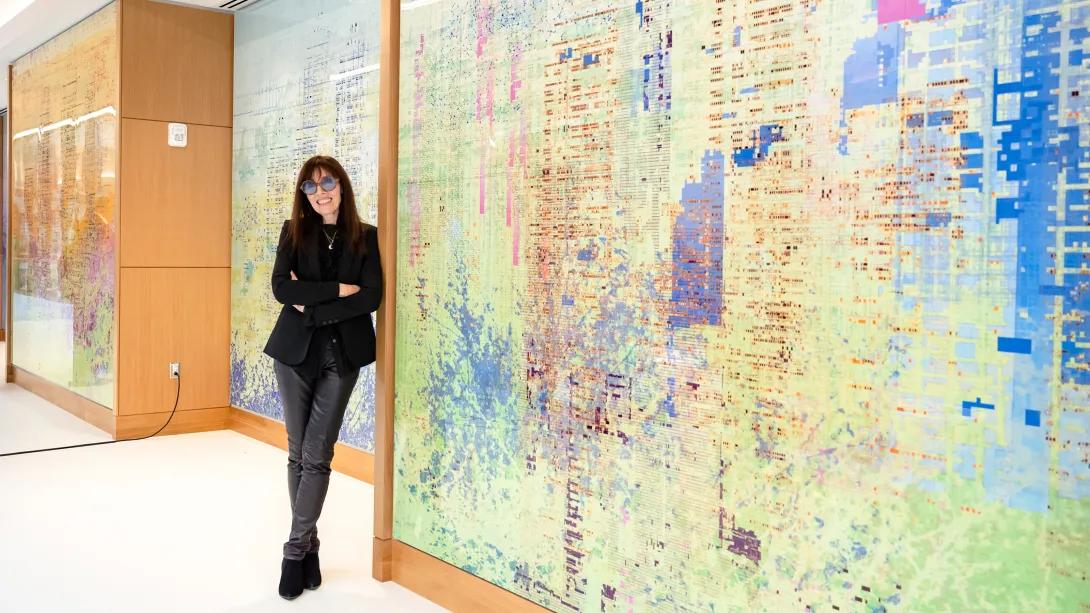
Shuli Sadé (New York) – “Waves.”
Sadé is a New York-based artist known for fusing art and technology in interactive public installations.
Her data-driven practice maps urban memory and shifting identities in the built environment.
She's a multi-disciplinary artist who works in a variety of mediums, including photography, video, sculpture, installation and augmented reality.
“I like to mix mediums to bring out the highest potential of an artwork,” Sadé said.
“The base of each of my projects starts with photography. The design then evolves through digital work that combines several elements that come together into a singular piece.”
Sadé’s mural in the Kahn Pavilion will be the largest installation in the hospital at 36 feet-long and seven feet-tall.
The piece will be displayed in the main lobby on the third floor near the reception desk. It may be, Sadé says, one of the first things people see as they enter.
“The goal of the piece is to offer respite and create a positive ambience for all those who pass through,” she said.
The mural will weave together local architectural icons, scientific imagery and brain-wave patterns layered over ocean swells.
With a meditative palette, the artwork symbolically eases stress, merging science and nature into a restorative experience.
In addition to photos of well-known U-M buildings, the final design will also incorporate images of famous buildings from across the state.
Rather than canvas, the mural will be printed on aluminum. With such a large piece, Sadé had to split the digital design into panels.
“I’m excited to see how ‘Waves’ creates a site-specific experience within the space,” Sadé said.
“It draws on familiar local architecture to connect viewers to their surroundings while introducing a new visual landscape.”
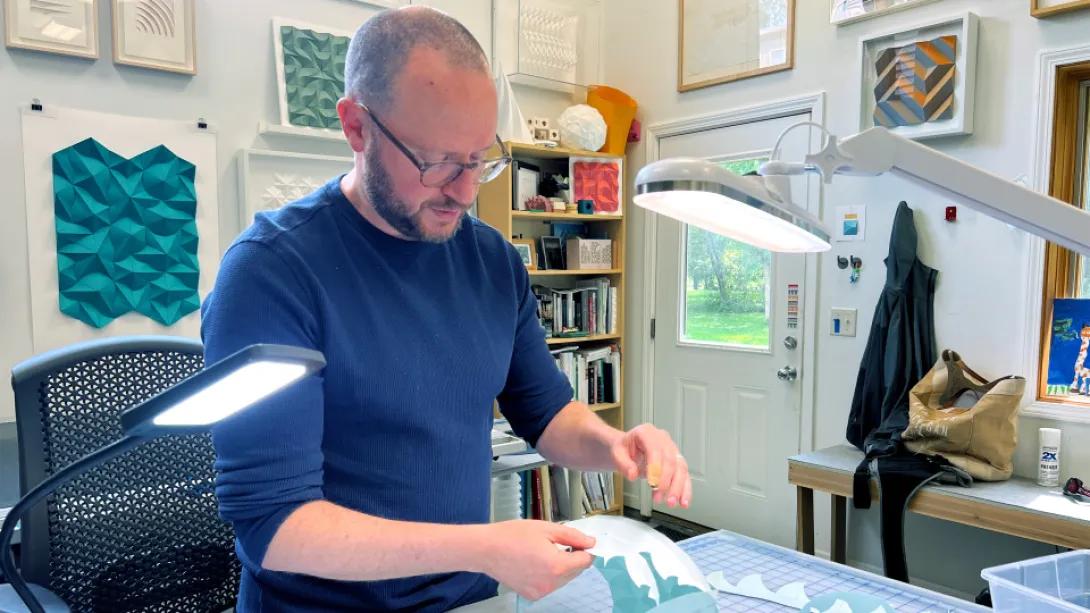
Matt Shlian (Ann Arbor)
As a kid, Shlian didn’t think he liked math and science.
The Connecticut native tried a little bit of everything in art school, including printmaking, glass blowing and ceramics.
After graduating, he found himself as a paper engineer designing pop-up books and greeting cards.
In 2010, Shlian started his own studio, using his paper engineering skills to create dynamic, geometric sculptures that have graced galleries across the United States and Canada.
“It took me years to think that I am a math person — geometry, visual math,” Shlian said.
“The work I do is really informed by mathematics and very much informed by science. Cutting-edge math and science are curious and artistic.”
Unlike origami, his work is not rooted in single folds or a sheet of paper. He uses flatbed cutters, lasers, bone folders, tweezers and more.
“I’m not necessarily interested in constraints on my work,” Shlian said. “The easiest thing is usually for me to bring someone to my studio and just show them what I do.”
In Ann Arbor, Shlian has worked with scientists and engineers, using art as a tool to illustrate scientific principles and research concepts.
He has been a co-author on several scientific papers, including investigations of solar tracking and elasticity in nanocomposites.
Shlian’s art will adorn nine elevator lobbies. Each piece will have a different style — unique shapes, gradients, shadows — and color matching the specific floor.
“In a hospital if you’re waiting for an elevator, you get to have a moment to spend with this thing,” Shlian said.
“It could make you think: here is a piece that was considered to a sixty-fourth of an inch, and that level of detail and care is important. Perhaps that same level of care is something that the doctors and staff are also doing in this hospital. You are in a place you don’t really want to be, and this piece can take you out of why you're here, even momentarily. That is a win. I want that.”
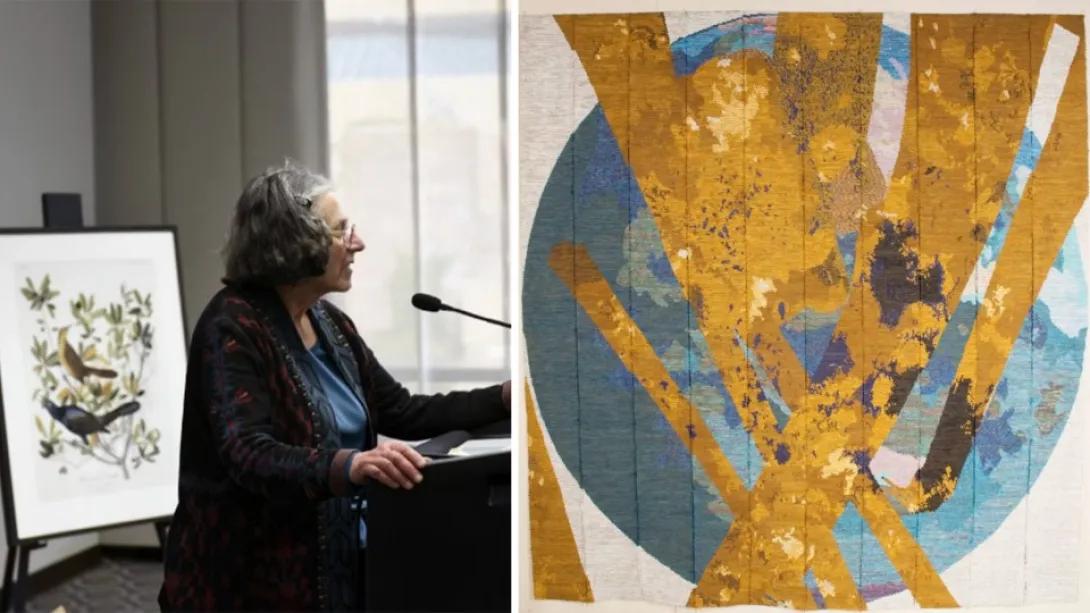
Sherri Smith (Ann Arbor) – “Star Cluster”
In 1974, Smith joined the faculty at U-M’s School of Art and Design, where she developed its fibers program.
She rose to prominence in 1969 when one of her pieces was exhibited at the Museum of Modern Art in New York.
The “Wall Hangings” exhibit is credited with launching the field of fibers as an art form.
She works on a loom, utilizing a traditional strip weaving technique to create pieces inspired by astronomy and math.
“I like using ancient technology to depict something achieved with modern imagery,” Smith said.
“Once I find an image I like, I try to keep it as-is. I enlarge it to the size I want for the piece and mirror it, because I have to weave with the back side up. Then I put it together by weaving long, thin strips.”
Several of Smith’s pieces have been displayed at U-M Health facilities over the years.
Her piece, “Star Cluster,” is a 36-inch by 36-inch textile that bursts with different colors and patterns. It will be displayed in the hospital’s family lounge.
“It’s exciting to look at, particularly from a distance,” Smith said.
“Most of the work that I have done is not placed anywhere near me. So, it will be nice to have people I know see it.”
Sign up for Health Lab newsletters today. Get medical tips from top experts and learn about new scientific discoveries every week.
Sign up for the Health Lab Podcast. Add us wherever you listen to your favorite shows.

Health Lab
Explore thousands of health news & research stories by visiting the Health Lab homepage for more.
Media Contact

Public Relations
Department of Communication at Michigan Medicine
Related

Teen turns EKG heart readings into art
Stay Informed
Want top health & research news weekly? Sign up for Health Lab’s newsletters today!
Featured News & Stories
What’s the latest on 7-OH and kratom availability and addiction care?

Depression in OBGYN residents needs more attention, study suggests

Emergency room intervention pairs smartphone, telehealth counseling to reduce risky firearm behavior

Better prenatal care data could help prevent maternal complications, experts say
Pain, psychological factors and physical function closely linked in people with systemic sclerosis