Michigan Medicine doctor gains new perspective as a stroke patient
Experience gave him a new appreciation for interprofessional patient care
12:20 PM
Author |
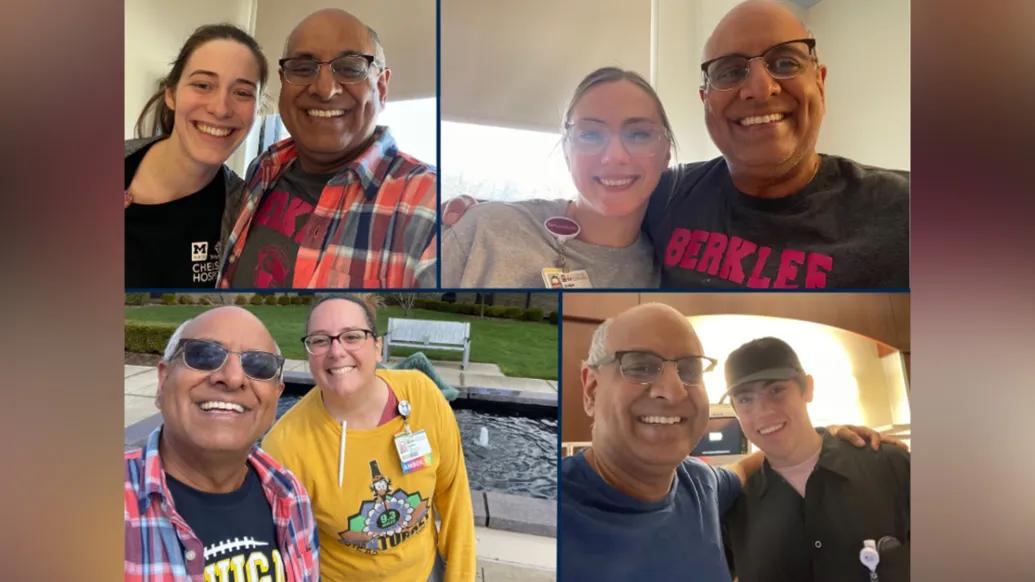
When Rajesh Mangrulkar, M.D. experienced a stroke that left him unable to walk, his leg and right arm weak and his face becoming numb, he admitted to feeling as much panic, anxiety, anger and fear as many other patients often experience when entering a hospital for treatment.
Despite Manrgulkar’s experience in health care as a member of the Michigan Medicine faculty and its complex health care system for 25 years, receiving treatment for his stroke gave him a new appreciation for the patient experience as well as all the staff and faculty playing an instrumental role in treating patients.
A community of care
In April 2023, Mangrulkar, who is a professor of internal medicine and director of the Michigan Center for Interprofessional Education, entered the University of Michigan-Health emergency department and was admitted to the stroke unit. Five days later, he was transferred to the inpatient rehabilitation unit at nearby Chelsea Hospital.
Through it all, what helped to ease his mind and comfort his spirit was how supportive, caring and friendly the staff were toward him, and the seamless teamwork and collaboration he experienced throughout his 20-day stay.
“As a physician I hadn’t thought about how little face to face time we spend with our patients, compared with all the other members of the team, and how critical it is that the entire team truly collaborates to care for each patient,” Mangrulkar said.
“It was a learning experience for me, to see this from the patient’s perspective,” he added.
“The patient is the only one who connects with all the people involved in the care process from beginning to end and can see how good teamwork makes a difference.
“The patient meets with the person that delivers the food tray, the phlebotomist, the social worker, the physical and occupational therapists, everyone. Only the patient sees every single person on the team, and every step it takes to make the patient experience exceptional and healing.”
The experience was certainly memorable for Mangrulkar, who wrote down the name of every staff member he met during his stay. In the end, he had a list of 125 people in 25 different roles.
He was particularly impressed with how seamless the transition was from the hospital to inpatient rehabilitation, and how the providers, nurses, therapists and social workers included him as a partner in his treatment plans.
“I felt like a team member, not like a recipient of the service,” he said.
“I remember that each nurse made sure to include me in the discussion of my care, even in their conversations during their shift changes.”
He also noticed how kindness and caring seemed to be a core value for every team member he met.
“I suppose it was natural that I was not always in a good mood, so if I was low they would sit with me and express understanding,” Mangrulkar said. “And then they would explain to me other options I might have.”
“One day, instead of pushing me to do the same exercises, they took me on an art tour of the hospital in my wheelchair to brighten my spirits. Another time, they substituted karaoke singing instead of my usual voice therapy, because they knew I love music.
“I realized that they were also tired and exhausted but they never showed me any hint of frustration,” he continued. “I sensed it was because their goal to care for me was a central mission to what they did.”
He felt that caring spirit all the way to discharge day when 15 people gathered in his room with his wife and clapped for him as he was wheeled down the hall to his car, a common ritual on the rehab unit.
“That community-focused culture was built into the stroke and the rehabilitation units at both hospitals,” he said.
The patient is the only one who connects with all the people involved in the care process from beginning to end and can see how good teamwork makes a difference. Rajesh Mangrulkar, M.D.
Sharing his perspective
Mangrulkar suffered his stroke just before he was scheduled to speak at U-M’s School of Dentistry annual commencement at Hill Auditorium. Just released from the hospital and still recovering, he felt exhausted and worn out, but he wanted to share what he had learned.
Using a walker, he stepped up to the podium to tell the graduates and their loved ones the story of people involved in his recovery and rehabilitation.
“As I sat and thought about what they did to lift me up during these 20 days, it became clear that their magic was that they included me as a partner on these teams, and they showed me love … a love for my humanity, for how I heal, and for what makes me a whole person,” said Mangrulkar.
“I felt it from every single one of those 125 individuals. They worked together with me as a partner on their teams, including me in all decisions, asking for my goals and what I thought was possible, curious about the challenges that I saw ahead of me. And through all of this, I felt loved, and for me, that may be the most inspiring part of this chapter of my life.”
Mangrulkar uses his personal story to emphasize the importance of teamwork in health care as he has resumed his role as director of the U-M Center for Interprofessional Education, a joint partnership between U-M’s Provost’s Office and the 10 health science schools on the Ann Arbor, Flint and Dearborn campuses.
“In our profession,” he continued in his address, “the reason teams matter is quite simply because great teams improve health. Period. For any of the health professions…it is not about the solo virtuoso. It’s about the orchestra, with each performer doing their part, bringing their best, listening to each other, adjusting along the way, and always keeping in mind the singular purpose of the team: the music, or in our case, health.”
Chelsea Hospital is a joint venture between U-M Health and Trinity Health. Its inpatient rehabilitation unit is staffed by an integrated team of award-winning U-M Health physicians and Chelsea Hospital therapists, nurses and specialists, who collaborate seamlessly to create personalized treatment plans designed to maximize patient recovery and achieve optimal functional independence.
Plans are underway to expand the inpatient rehabilitation program at Chelsea Hospital, which will allow U-M Health to consolidate its adult acute rehab services into one location and optimize access of 40 inpatient beds for complex rehab cases.

Health Lab
Explore thousands of health news & research stories by visiting the Health Lab homepage for more.
Media Contact

Public Relations
Department of Communication at Michigan Medicine
Stay Informed
Want top health & research news weekly? Sign up for Health Lab’s newsletters today!
Featured News & Stories
Reducing infections after heart surgery could save Medicare $441 million per year
University of Michigan Health Liver Transplant Program Earns Top Five National Ranking for Transplant Access

University of Michigan Health named Michigan’s top hospital, earns spot on U.S. News honor roll
Doctors in the house: History of medical interns and residents at Michigan Medicine
How new care models, within a new building launch, are helping optimize patient care