Michigan fan saved after wife recognizes stroke at football game
Timely recognition and response are critical to saving lives and preserving brain function
5:00 AM
Author |
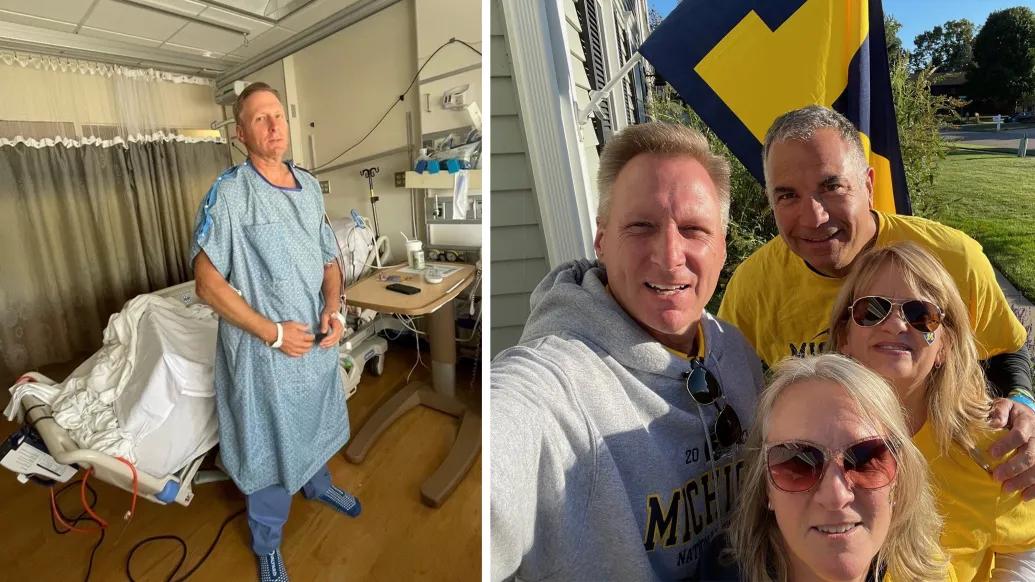
A fan who suffered a stroke while cheering at a University of Michigan football game is celebrating a full recovery thanks to a comprehensive response that began with his wife.
During the fourth quarter of the Wolverines’ Aug. 31 season opener against Fresno State, U-M star cornerback Will Johnson intercepted a pass for a touchdown to seal a victory.
As the crowd roared, Scott Everett, 60, stood to give another spectator a two-handed high five. The longtime resident of Portage, Mich., is a self-proclaimed diehard U-M fan who has attended nearly every home football game for the last decade.
Everett’s wife, Kathy, 58, noticed something wrong with the gesture.
Scott’s left hand started to drop.
“He hesitated, and it caught my eye,” she said. “I asked him what was wrong. He said, ‘I don’t know — nothing.’”
Kathy Everett recognized the limp arm and facial droop as telltale signs of stroke. She ran up the steps of Michigan Stadium and alerted staff to the emergency.
Responders from the medical team, staffed by doctors from the U-M Health Department of Emergency Medicine’s EMS Division and paramedics and nurses from Huron Valley Ambulance, arrived to find that Scott could not stand without the support of his friends.
They placed him onto a stretcher before loading him into an ambulance.
Everett’s symptoms started around 10:30 p.m., and he arrived at University of Michigan Health’s emergency department just after 11 p.m.
Imaging showed a clot in his brain’s middle cerebral artery, a major vessel that supplies blood to parts of the frontal, temporal and parietal lobes. It is the most common artery involved in acute ischemic stroke.
Stroke response
The health care team deemed Everett to be a candidate for the clot-busting medication Tenecteplase and thrombectomy, a minimally invasive procedure to remove the obstruction.
“Five years ago, these therapies were not widely available and this would have been a major disabling stroke,” said Tarun Singh, MBBS, a neurocritical care physician at University of Michigan Health who specializes in acute neurological diseases including stroke.
“He likely would not have been able to eat, walk or remain independent. But the recognition and response were as fast as possible and got Mr. Everett here early enough to get these time-sensitive treatments.”
For every stroke, U-M Health Comprehensive Stroke Center activates a multidisciplinary response involving emergency medicine, neurology, neurointerventional radiology and neurosurgery.
Just after midnight, neurointerventionalist Zachary Wilseck, M.D., threaded a catheter from an artery in Scott Everett’s leg all the way to his brain to remove the clot.
“Even before being moved off the table, Mr. Everett was already demonstrating improving strength in his left arm and leg,” Wilseck said.
“The procedure went exactly as we’d hoped. All members of the team worked together to efficiently evaluate, diagnose and treat him.”
A life renewed
Twelve hours after the operation, Scott Everett was walking the hospital halls. He also talked about attending the next Michigan football game.
This came as a relief to Kathy Everett, who made the decision for the team to go through with the Tenecteplase and thrombectomy.
“I was a little hesitant at first as they described it until they said this is the best combination for him to have a full recovery,” she said.
“Scott is very athletic and on-the-go. The worst thing would be to not have him at all, but any form of paralysis would be very difficult for him.”
He continued with light walking after being discharged from the hospital on Sept. 3. The couple returned to the Big House to hugs and cheers from their tailgating friends the following weekend as U-M took on Texas.
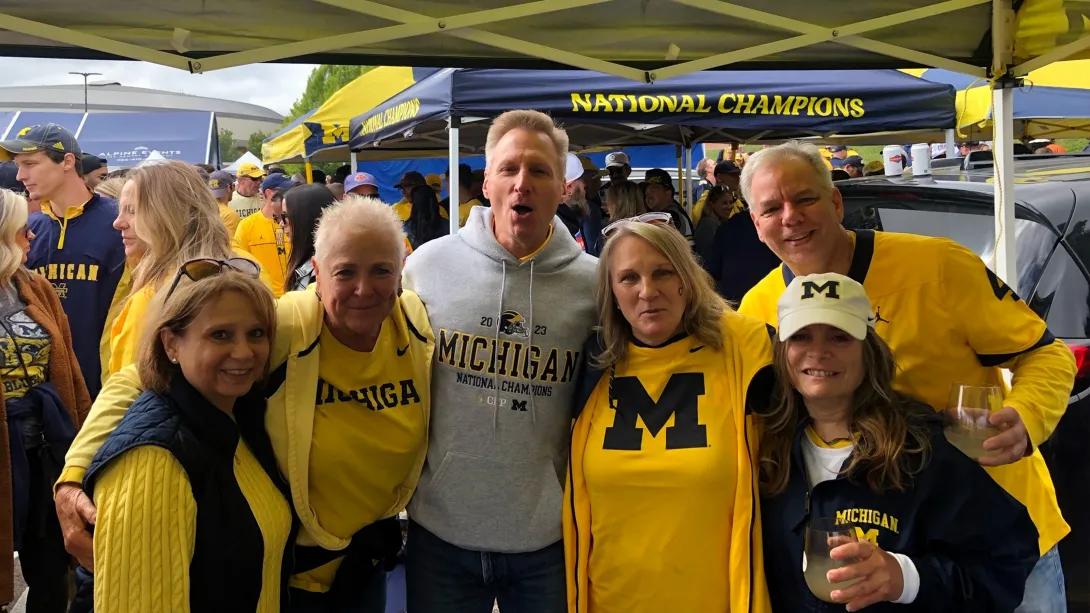
Everett has continued to ramp up his physical activity. He regularly rides a stationary bike and has done some kayaking. True to their fandom, he and Kathy have not missed another U-M home game.
Still, the Everetts remain stunned by Scott’s stroke. None of his medical visits to his home providers indicated any risk for it.
Which is why, Scott says, the ability to recognize the symptoms of stroke as quickly as his wife did is so essential.
“We’ve been to so many football games and seen the medical team in action, which is always so impressive,” he said. “I was so active and felt somewhat invincible. As surprised as we were, it can happen to anyone. And I wouldn’t be here if it wasn’t for Kathy.”
To identify signs of a stroke, remember the acronym B.E. F.A.S.T.:
Balance issues
Eyesight changes/vision loss
Facial droop
Arm weakness
Speech difficulty
Time to call 911
Sign up for Health Lab newsletters today. Get medical tips from top experts and learn about new scientific discoveries every week.
Sign up for the Health Lab Podcast. Add us wherever you listen to your favorite shows.

Health Lab
Explore thousands of health news & research stories by visiting the Health Lab homepage for more.
Media Contact

Public Relations
Department of Communication at Michigan Medicine
Related
Timely response leads to complete recovery for young stroke survivor
Black stroke patients arrive later to hospitals, EMS less likely to notify
Stay Informed
Want top health & research news weekly? Sign up for Health Lab’s newsletters today!
Featured News & Stories
Many older adults make Medicare decisions quickly and most don’t change plans, poll finds
Better prenatal care data could help prevent maternal complications, experts say
Many hospitals still don’t do enough to prevent UTIs from catheters
Digital alerts support timely treatment decisions of critically ill cardiac patients
What’s changing in Medicaid and what can you do?