Medical student’s invention aims to help infants with jaundice
Called the BiliRoo, the low-cost, non-electric device is designed to treat jaundice in newborns
5:00 AM
Author |
Daniel John’s dorm room was unlike most undergrad’s: littered with baby carriers and sewing kits.
Even with 10 chances, no one could guess that they were looking at medical device research and development.
“Relatives that knew how to sew taught me some of the basics, and those were some of the first devices that we iterated,” John said.
“For the clinical trials, I'm now working with manufacturers in South Asia.”
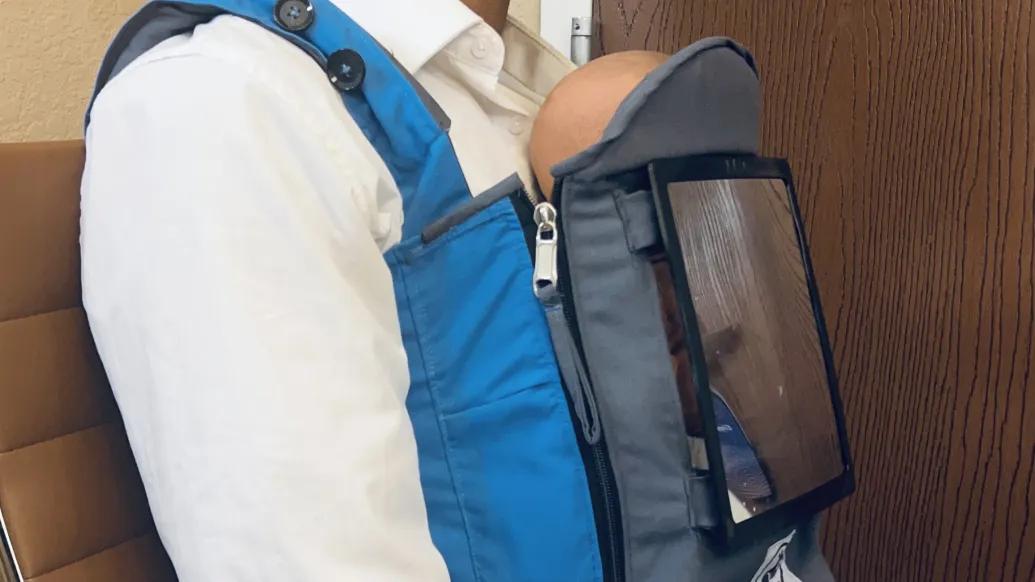
Daniel, now a student at the University of Michigan Medical School, is the inventor of BiliRoo, a potential low cost, non-electric device to treat jaundice in newborns.
Hyperbilirubinemia, the underlying cause of jaundice, affects tens of millions of newborns around the world every year.
BiliRoo is a wearable infant sling with a filter over the infant’s back, designed to allow therapeutic blue light to reach the baby while blocking harmful UV radiation.
The intention is that blue sunlight lowers high bilirubin levels, while the design of the infant sling enables the physiological benefits of “kangaroo care” (skin-to-skin contact) — hence the name, BiliRoo.
Typically, babies with hyperbilirubinemia are placed under an artificial blue light source.
John hopes BiliRoo can help infants in places where access to electricity or specialized medical equipment is limited.
John was born in Nepal and developed a passion for developing simple, inexpensive, easy-to-use medical devices.
“Growing up there, I saw a need for health care access — which is what made me interested in medicine in the first place — but then also a need for medical devices that are designed specifically for limited-resource settings that don't require electricity,” John said.
While still an undergraduate in mechanical engineering at Calvin University, John reached out to doctors from around the world and kept hearing about the neonatal jaundice problem.
After getting started on his prototype, John contacted Tina Slusher, M.D., Professor of Pediatric Critical Care Medicine at the University of Minnesota and an expert in the field.
She partnered with John on a feasibility study of BiliRoo published in Pediatric Research.
Next, BiliRoo will be tested in a clinical trial this summer.
In the meantime, the device has won design prizes and pitch competitions, including first place at the 2026 Michigan Business Challenge.
BiliRoo was additionally recognized as one of the top undergraduate inventions of 2025 by the National Inventors Hall of Fame & USPTO and as the top hardware of 2025 by the American Society of Mechanical Engineers.
Recently, BiliRoo won the Southwest Pediatric Device Consortium Prize at the Rice Business Plan Competition.
At U-M Medical School, John has joined the Global Health & Disparities Path of Excellence under the mentorship of Shane C. Quinonez, M.D., Clinical Associate Professor of Pediatrics at U-M Medical School.
He has also been working with Karl C. Desch, M.D., Clinical Associate Professor of Pediatrics.
“I plan to continue developing BiliRoo until it gets to the infants that need it the most,” John said.
“After BiliRoo, I would love to continue working on medical devices as a practicing physician. I know some physicians do a combination of clinical care and research. I would love to do something similar with medical device research and development."
Sign up for Health Lab newsletters today. Get medical tips from top experts and learn about new scientific discoveries every week.
Sign up for the Health Lab Podcast. Add us wherever you listen to your favorite shows.

Health Lab
Explore thousands of health news & research stories by visiting the Health Lab homepage for more.
Media Contact

Public Relations
Department of Communication at Michigan Medicine
In This Story

Shane Quinonez, MD
Clinical Associate Professor
Stay Informed
Want top health & research news weekly? Sign up for Health Lab’s newsletters today!
Featured News & Stories

4 ways to teach your teen safe driving habits

U-M-led consortium to receive up to $52 million in NIH funding to study why viral respiratory infections affect children differently

Depression in OBGYN residents needs more attention, study suggests

Emergency room intervention pairs smartphone, telehealth counseling to reduce risky firearm behavior

Better prenatal care data could help prevent maternal complications, experts say