
Many older adults make Medicare decisions quickly and most don’t change plans, poll finds
As 69 million enter Open Enrollment for 2027, data from 2026 enrollees suggests a need for more people to review all options and seek reliable information
6:01 AM
Author |

It’s one of the biggest decisions they might make all year, affecting their wallets and their healthcare for the full year to come.
They may have many options to choose from, depending on where they live.
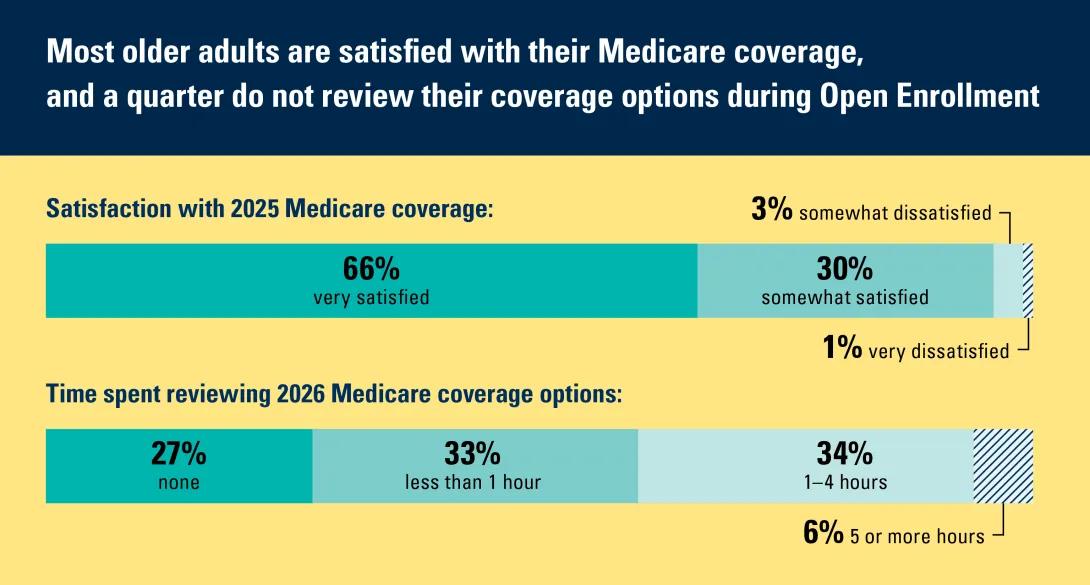
But 60% of older adults spend less than an hour choosing their Medicare coverage during Open Enrollment, a new poll finds.
That includes 27% who said they didn’t take any time to review their options, and 33% who reviewed them but spent less than an hour doing so, according to new findings from the National Poll on Healthy Aging based at the University of Michigan Institute for Healthcare Policy and Innovation.
In all, 80% stuck with their Medicare coverage from the previous year, the poll finds.
The U-M team gathered the data just after last year’s Medicare Open Enrollment by surveying Medicare enrollees aged 65 and older who were drawn from a nationally representative sample of older adults.
Of those who did take time to review what’s available in their area, 25% said the most important source they consulted was one offered by Medicare itself, either the plan-finding tool on the Medicare website or the Medicare hotline.
Only 5% said their most important source was a free local counselor, such as one from the federally funded State Health Insurance Assistance Program that’s available in every state and called SHIP for short.
Meanwhile, 26% said the most important source of information they used in their Medicare decision was an insurance broker, and 21% said it was a health plan website.
Even so, virtually all those surveyed (92%) say they’re somewhat confident or very confident about making decisions about their Medicare coverage.
Implications for 2027 Open Enrollment
This year, the Open Enrollment period for all forms of 2027 Medicare coverage runs from October 15 to December 7.
The new findings suggest a strong need for older adults – particularly those who are dissatisfied with their current coverage, but also others – to take more time to thoroughly review their options, says Geoffrey Hoffman, Ph.D., an Associate Professor at the U-M School of Nursing and IHPI member who studies Medicare and worked with the poll team.
“It’s easy to ‘set it and forget it’ with Medicare, especially if you have coverage that you like and assume is the best that’s out there,” he said.
“The number of choices, and the tools for navigating them, can also be confusing, but there may be coverage that better suits your needs and wallet. It’s important to ask for help if you need it, including the SHIP counselors in your area who many people don’t realize are available and do not have a financial stake in what you choose.”
Hoffman and Lianlian Lei, Ph.D., an Assistant Professor in the U-M Medical School who also worked on the poll, have done multiple studies on Medicare enrollees’ decision-making about plan choices and switching Medicare Advantage plans.
Lei notes that just as someone would take time before buying a car or a major appliance, it’s important to do the same for Medicare options.
The best choice will depend on the health conditions or goals that a person has, the doctors they want to see, the hospitals they prefer to go to, and the medications their doctors have prescribed them.
She also notes that the best plan for one member of a couple may not be the best one for their partner.
Awareness of policy changes affecting Medicare enrollees
The poll also gauged how many Medicare enrollees had heard about major changes that federal lawmakers, and the agency that runs Medicare, had made for 2026.
The one generating the most awareness was lower prices for 10 high cost drugs, a change which resulted from Medicare’s new ability to negotiate what it pays drugmakers for some prescription medications.
But just 38% of all poll respondents had heard of it.
The impact of this change on individual enrollees depends on the Part D prescription drug plan in which they enroll. Fifteen more drugs added to the list for 2027 will be included in the drug coverage on the Medicare Plan Finder.
Another key change for 2026 that will continue into 2027 relates to the total amounts that Medicare enrollees pay out of pocket for drugs covered by their plan.
Just 29% were aware of two changes that could increase their exposure to prescription drug costs: first, an increase in the total amount that they could be asked to pay for prescription drugs before Medicare or their Medicare Advantage plan would start paying (called a deductible); and, second, an increase in the maximum total drug costs (the cap) that Medicare enrollees will have to pay for all their prescription drugs in a year.
Only 15% had heard of another change added during the Open Enrollment for 2026: the ability to use the Plan Finder to see which doctors and other health care professionals would be considered “in network” by a chosen Medicare Advantage plan.
This information had been hard to find in previous years, even though going to an out-of-network provider or hospital can be very costly.
Poll director Jeffrey Kullgren, M.D., M.P.H., M.S., has studied how out-of-pocket costs influence how people make health decisions, especially if they have chronic conditions.
“When we asked our poll respondents to choose from a list of factors that mattered most to them when making their Medicare choices, the top choice was out-of-pocket costs, chosen by 69%, followed closely by medication coverage at 63%, and network coverage of their healthcare providers at 62%,” said Kullgren.
Just because a plan was available one year doesn’t mean it will be available for 2027, he adds.
“We know that Medicare Advantage and prescription drug plan options are changing across the country as insurance companies make business decisions about what they offer and where they offer it,” he said.
“That makes it especially important to check all options carefully every year.”
Michigan-specific findings
The poll team also analyzed data from a sample of Michigan adults enrolled in Medicare, using funding from the Michigan Health Endowment Fund as part of the Michigan Poll on Healthy Aging.
In general, there were no major differences between the Michigan and national samples. The Michigan poll also gauged awareness of the MI Options call center, which includes Medicare counseling and launched in summer 2025.
A summary of all Michigan findings and an interactive data dashboard is available.
What options do people with Medicare coverage have?
Depending on where someone lives, their Medicare plan options always include traditional Medicare that’s accepted by nearly all doctors and hospitals, and might include one or more (or as many as 80) Medicare Advantage plans, each with their own networks of doctors and hospitals.
In some areas, a program called PACE may be available to Medicare-eligible people who need nursing home-level care but want to remain in their home.
Then there are optional “Medigap” plans to supplement traditional Medicare coverage. However, Hoffman notes, states vary in their laws about whether enrollees with major health issues can be charged more or denied completely if they want to buy a Medigap plan after moving from Medicare Advantage coverage to traditional Medicare.
Medicare Advantage plans can offer benefits that traditional Medicare cannot, such as transportation, food programs, and caregiver support.
Some plans have reduced these offerings in recent years.
And then there are multiple Part D prescription plans to choose from for those with traditional Medicare.
There are also varying prescription drug benefits that are part of Medicare Advantage plans.
Each of these plans has its own list of drugs it will cover, called a formulary, as well as a deductible amount, and the co-pay due each time a prescription is filled.
In 2027, Part D plans can set a deductible as high as $700, or as low as $0.
Since 2025, there is a cap on the total amount any Medicare enrollee must pay out of pocket for all prescriptions covered by Part D or Medicare Advantage in a year, no matter what type of coverage they have.
The cap will rise to $2,400 in 2027, up from $2,100 in 2026 and $2,000 in 2025. The cap closed the “donut hole” in prescription coverage that formerly caused some Medicare enrollees to pay thousands more in drug costs.
With so many choices for Medicare coverage, particularly among Medicare Advantage plans, older adults face a barrage of marketing mail, phone calls, advertisements, and even offers of free dinners with information sessions every fall.
These come from insurance companies and from brokers who earn commissions from insurance companies based on how many people they sign up.
The federal Medicare website offers a wealth of information for free, and Medicare staff can be reached through a toll-free phone number. Information is available in different languages and interpreters and services for the deaf and hard of hearing are available.
The Medicare Plan Finder lets users compare costs and coverage lists of Medicare Advantage, Part D prescription drug plans and Medigap plans in their area, down to the specific drugs they take and the doctors they see.
There is also a separate tool for finding PACE plans in the states where they are offered.
Free state-run SHIPs and programs such as Michigan’s MI Options offer staff and trained volunteers who can help individuals go over their options over the phone and at in-person sessions such as those held at public libraries and senior centers. These sources have no financial interest in what plan a person chooses.
NPHA data from 2024 showed that only 25% of people over 50 were familiar with SHIPs.
If someone chooses a Medicare Advantage plan during Open Enrollment and then decides it is not right for them, there is a second chance to switch after their coverage begins January 1. They can switch to another Medicare Advantage plan, or to traditional Medicare, if they do it before March 31. There are also other special enrollment periods.
About the poll
The poll findings come from a nationally representative survey conducted by NORC at the University of Chicago for IHPI and administered online and via phone in December 2025 and January 2026. The survey questions on Medicare went to 1,796 community-dwelling U.S. adults age 65 to 98 from the AmeriSpeak panel. The Michigan-focused analysis includes 608 community-dwelling Michigan adults age 65 to 93, including a non-probability oversample. Results are weighted to reflect each respective population. Read past National Poll on Healthy Aging reports and Michigan findings, and learn about the poll methodology.

Health Lab
Explore thousands of health news & research stories by visiting the Health Lab homepage for more.
Media Contact

Public Relations
Department of Communication at Michigan Medicine
In This Story

Jeffrey Todd Kullgren, MD, MS, MPH
Professor

Lianlian Lei, PhD
Assistant Professor
Related

What makes someone leave a Medicare Advantage plan?

In sickness and in health, older couples mostly make Medicare moves together
Stay Informed
Want top health & research news weekly? Sign up for Health Lab’s newsletters today!
Featured News & Stories

What’s the latest on 7-OH and kratom availability and addiction care?

A metabolic “switch” that could help reset scar-producing cells in scleroderma

Depression in OBGYN residents needs more attention, study suggests

Emergency room intervention pairs smartphone, telehealth counseling to reduce risky firearm behavior

Exceptional response to immunotherapy gives patient with liver cancer more milestones to celebrate

