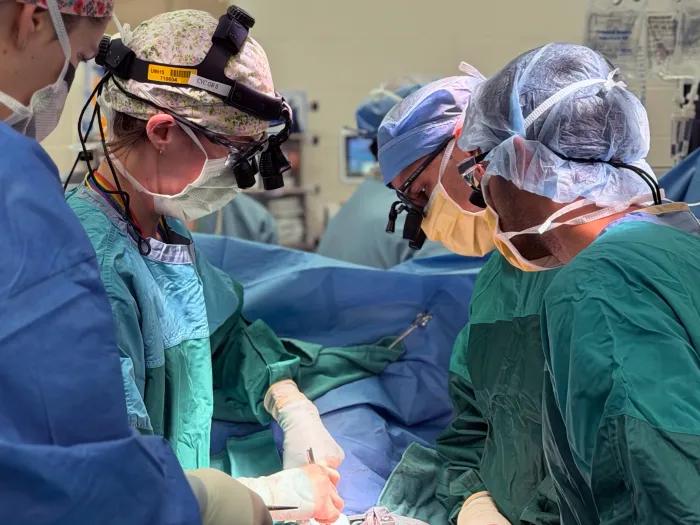
Lifesaving option for heart patients at risk for sudden cardiac arrest, abnormal heart rhythms
Implantation of new, innovative implantable defibrillator is first in Michigan
11:18 AM
Author |
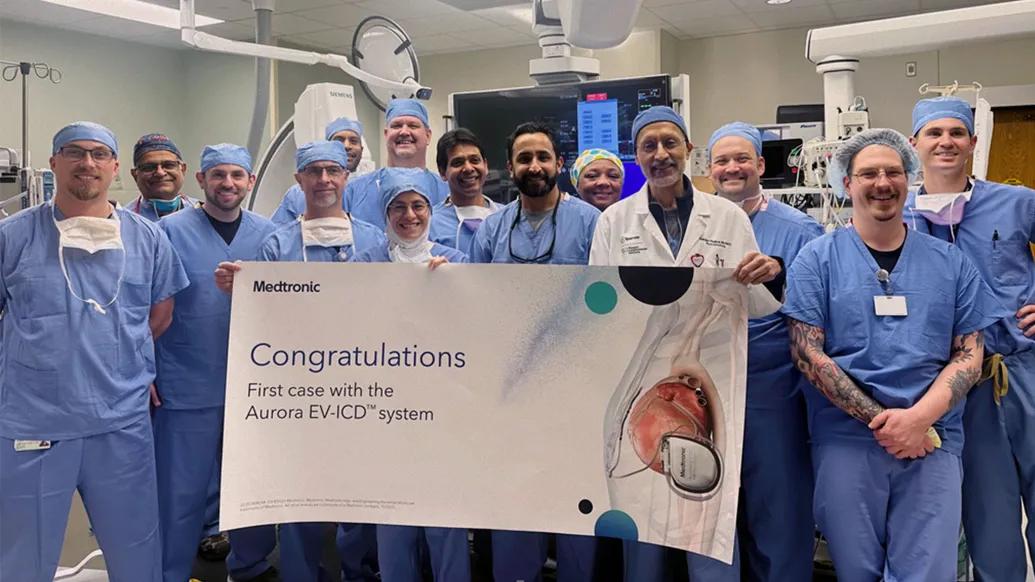
A 55-year-old Mid-Michigan man with a life-threatening irregular heartbeat recently received a new implantable defibrillator at E.W. Sparrow Hospital in Lansing, part of University of Michigan Health, the first in Michigan to receive the innovative device.
Ali Sheikh, D.O., a cardiac electrophysiologist with Sparrow Thoracic and Cardiovascular Institute, along with the help of a highly skilled team of physicians, nurses and caregivers, implanted the Aurora EV-ICD device to improve his quality of life. The procedure took about 90 minutes to complete.
What makes this device different?
The first of its kind, single lead implant developed by Medtronic was approved by the FDA in October 2023 and aims to treat patients at risk of dangerously fast heart beats that can lead to sudden cardiac arrest. Unlike devices already on the market that deliver timely electrical shocks to restore normal heart rhythms, the groundbreaking defibrillator is smaller, is placed beneath the breastbone and does not require a wire going into the heart or veins to avoid heart scarring and infection.
"For younger patients that may have two, three, four or more decades of their life, I believe this would be a better option because if you do not have a lead dwelling inside the heart, it minimizes risk in the long run,” Sheikh said.
Electrophysiologist Ryan Cunnane, M.D., from the U-M Health Frankel Cardiovascular Center, is also trained to implant the device. He believes there are now more options for protecting patients without needing to put hardware in the bloodstream.
“While traditional defibrillators have been, and continue to be, remarkably reliable — the leads can be a point of weakness susceptible to breaking, infection or dislodgement,” Cunnane said.
The 55-year-old patient who received the implant at Sparrow has risk factors that increase the chance of blood stream infections that can be catastrophic, Sheikh says, so the device was ideal for him. He’s now doing well and is thankful for the care he received at Sparrow.
Personalized lifesaving care
Implantable defibrillators are effective at providing lifesaving therapy for patients at risk of ventricular tachycardia (VT), an unusually fast and lethal heartbeat that starts in the lower part of the heart. If not treated quickly, VT can be deadly.
Although medications can be prescribed, Sheikh says, it does not cure the problem. The Aurora’s innovative technology, antitachycardia pacing (ATP), treats dangerous rhythms without receiving an electric shock. Both Sheikh and Cunnane believe this is its biggest advantage over traditional devices.
“With the introduction of the EV-ICD, patients now have three types of internal defibrillator options,” Sheikh said. “We can now tailor our leading-edge treatment to what better serves a specific patient.”
Ideal candidates
Sheikh and Cunnane say the Aurora EV-ICD is for anybody at increased risk for ventricular arrhythmias who does not need a pacemaker as well. Those with a history of monomorphic ventricular tachycardia will get the most benefit from the ATP feature.
The device is currently not indicated for those who have previously had open-heart surgery.
Disclosure: Cunnane has advised companies including Medtronic, Inc., the maker of the Aurora EV-ICD, along with Biotronic, Boston Scientific Corp., and Abbott Laboratories, on medical devices for electrophysiology patients.

Health Lab
Explore thousands of health news & research stories by visiting the Health Lab homepage for more.
Media Contact

Public Relations
Department of Communication at Michigan Medicine
Related
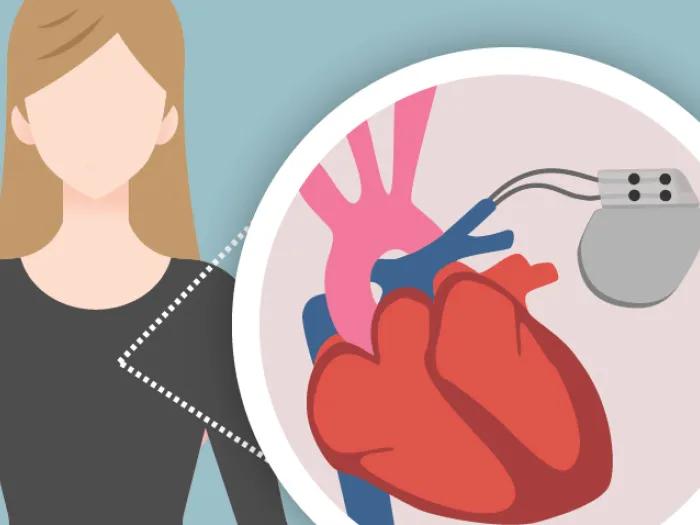
Health Advice for Women with Defibrillators
Stay Informed
Want top health & research news weekly? Sign up for Health Lab’s newsletters today!
Featured News & Stories
Tap dancer’s foot rescued after lifesaving heart surgery

Heart failure ‘polypill’ improves cardiac function, cuts hospitalization risk
How a temporary heart pump can support high risk cardiac surgery

Treating a rare coronary artery aneurysm without open heart surgery
Fighting rejection antibodies to make heart transplant possible