Leukemia drug secures FDA approval
The drug, developed at Michigan Medicine, has been approved for patients with acute myeloid leukemia caused by the NPM1 gene mutation
5:00 AM
Author |
Komzifti (ziftomenib) has received approval from the United States Food and Drug Administration for acute myeloid leukemias with the NPM1 mutation.
The mutation makes AML, already an aggressive disease, more difficult to treat and affects 30% of all AML cases.
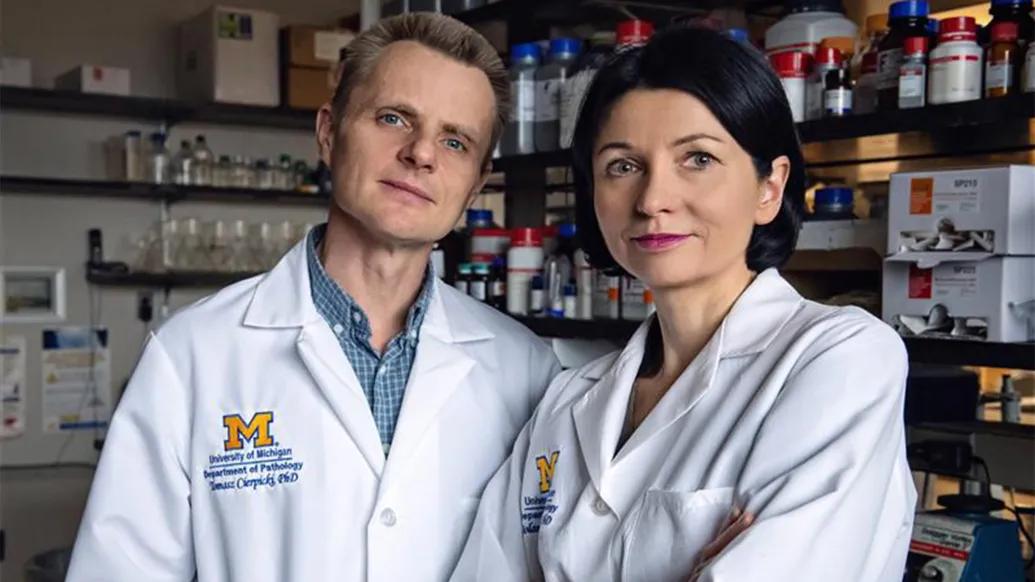
The drug was discovered and developed by researchers at the University of Michigan Health Rogel Cancer Center and Department of Pathology. Jolanta Grembecka, Ph.D., professor of pathology and Richard and Susan Rogel Professor in Cancer Therapeutics, and Tomasz Cierpicki, Ph.D., professor of pathology, began the research to develop this drug, which inhibits the protein menin, in 2007.
The University of Michigan licensed this project to Kura Oncology in 2014.
Grembecka and Cierpicki’s collaboration with Kura Oncology led to the development of ziftomenib, which was commercialized by Kura Oncology along with Kyowa Kirin.
Cierpicki, Grembecka and U-M have a financial interest in Kura Oncology. The technology was licensed to Kura Oncology by Innovation Partnerships.
Here, Grembecka explains her and Cierpicki’s almost 20-year journey to FDA approval, the significance for patients, and what they’d tell other drug discovery researchers.
How does ziftomenib work?
Grembecka: There is a protein called menin which has a binding pocket that interacts with another protein called MLL1.
The drugs binds to the same pocket to displace MLL1 from menin.
If the interaction between menin and MLL1 is blocked, the proliferation of leukemic cells is disrupted.
Those cancerous cells then differentiate and resemble normal blood cells and eventually die.
We pioneered this field because there were no small molecule menin inhibitors blocking this protein-protein interaction when we started this project.
How and when did the research for this drug originate?
Grembecka: The very initial work for this project began around 2007 when Dr. Cierpicki and I were research assistant professors at the University of Virginia.
This drug is based on a previous study that validated that menin is a critical oncogenic cofactor in certain leukemia subtypes.
At the time, no menin inhibitors were known and its crystal structure wasn’t available, so we decided to pursue it as a new drug target for leukemia.
We started from the very beginning, characterizing the protein-protein interaction involving menin and MLL1, using a collection of biochemical, biophysical and structural biology approaches.
Later, we were also able to solve the crystal structure of menin.
In 2009, we moved our work to U-M.
The crystal structure showed us the opportunity to develop small molecules that can bind to the protein and inhibit the oncogenic interaction.
We also developed biochemical assays to screen for small molecule inhibitors that would block this protein-protein interaction.
When we came to U-M, our main project was to advance the compounds identified by the screen.
Once we identified some initial compounds, we started to develop menin inhibitors through extensive medicinal chemistry optimization.
Successful progress of this project was possible thank to the support from both federal and foundation grants.
We also collaborated with the Pharmacokinetics Core at U-M with Duxin Sun, Ph.D. to identify orally bioavailable menin inhibitors.
We published our findings of the very first menin inhibitors in Nature Chemical Biology in 2012.
It was a summary of our initial discoveries, demonstrating that we can drug this target and that it's possible to develop inhibitors to block the menin-MLL1 interaction.
We put a lot of resources into improving the properties of the compounds and make them drug-like.
The second key publication was in Cancer Cell in 2015, which demonstrated for the first time the in vivo activity of our menin inhibitors in mouse models of leukemia.
We developed orally bioavailable compounds, which not only were able to kill or reduce proliferation of leukemic cells in cell culture, but also slowed down the progression of leukemia in mouse models.
This was a breakthrough and it was a critical piece of data to allow us to partner with industry.
When did the drug go to clinical trial?
Grembecka: In late 2014, we partnered with Kura Oncology.
We had an orally bioavailable compound, but we felt we needed to make some final tweaks around that molecule.
We worked for three years in collaboration with Kura Oncology.
Together, we were able to further advance these compounds, making relatively small but very valuable modifications to improve drug-like properties.
The majority of the biological studies with these compounds were done at U-M.
Kura Oncology filed IND (Investigational New Drug) application with the FDA to initiate clinical trials in 2019 in refractory and relapse AML patients.
Although this program was successful pre-clinically, you never know what’s going to happen in the clinic because there are so many variables and unknowns.
But we were very optimistic and hopeful that AML patients would truly benefit from our menin inhibitor.
You just had to keep going.
Grembecka: Exactly. Plus, we were fortunate to be supported by the Leukemia and Lymphoma Society (currently Blood Cancer United).
Again, without their support, I don't think we would have been able to accomplish what we did. In drug discovery, you have to make and test multiple compounds.
It's a repetitive process and requires making additional molecules and we are not always able to predict whether the new molecule would be better or not.
Finally identifying the compound with the appropriate properties and good activity is a multi-dimensional problem to solve.
The chances of compounds entering clinical trials receiving FDA approval in oncology is about 3%.
Compounds fail for multiple reasons. But we remained optimistic based on strong pre-clinical data and encouraging results from clinical trials.
What does FDA approval and access to the drug mean for patients?
Grembecka: The drug has been approved for refractory or relapsed leukemia patients, so those who didn't respond to chemotherapy, or they initially responded but the leukemia came back within three years.
That's why we say that five-year survival in this subtype of leukemia is only about 30-35%, because the disease comes back. Then, when it comes back, chemotherapy is no longer effective because all the sensitive cells were killed by the previous treatment.
That's why new therapies like menin inhibitors are critical for patients who have stopped responding to the available treatments.
The clinical trials were only for patients for whom there's no other line of therapy available.
Now, with FDA approval, any oncologist who sees a patient not responding to other therapies is capable of prescribing this drug to patients. Now, it's available to anyone.
What’s next for the drug? Are there ongoing studies or new applications being tested?
Grembecka: There are multiple clinical trials going on because acute leukemias are very aggressive diseases.
While it’s helping some patients, we would like to increase the drug’s effectiveness through combination treatments.
For example, one of the interesting studies is combining zeftominib with induction chemotherapy as a frontline therapy.
We expect there will be a much better chance of both chemotherapy and this drug being successful when combined rather than administered sequentially when the disease comes back.
Based on what you've learned over the last 18 years, what advice would you tell researchers who are at the start of this process? What wisdom have you gleaned?
Grembecka: My key advice would be if you really believe in the project and you have the scientific rationale to believe that it is a valuable target, or if you have promising molecule, to be persistent.
Don't get discouraged by multiple failures or slowdowns. Persistence is the most important quality.
I think that's what I have learned from this project and that's what I'm trying to apply to the other drug discovery projects we have in the lab.
Get deeply engaged and try to keep moving forward.
What's the significance of this FDA approval for you, both professionally and also personally?
Grembecka: Both professionally and personally, it's highly, highly rewarding. It really feels that we are doing something truly valuable.
It’s been a long process and is amazing to have this drug now available to patients who need it.
Myself and Dr. Cierpicki, we pioneered this field at a time when big pharma and biotech companies didn’t even want to tackle these challenging targets like blocking protein-protein interaction.
The drug companies were very skeptical that these are druggable targets, and we decided to take on the challenge.
This is not only a first-in-class inhibitor for this target, but also shows that blocking protein-protein interaction, which is a very challenging target, is possible.
The field has changed and our work has contributed to that.
Sometimes people will say there’s no drug discovery in academia. I would argue that we’re a good example.
People shouldn’t give up on academic drug discovery, especially for targets like ours that don’t have much interest from industry.
Once industry sees success, they’ll have more interest.
Working on new challenging targets is my philosophy for academic drug discovery.
Our menin inhibitor program illustrates that success is possible and can translate into new therapeutic options for cancer patients.
It is truly rewarding and deeply inspiring to see our laboratory research directly benefiting leukemia patients.
Sign up for Health Lab newsletters today. Get medical tips from top experts and learn about new scientific discoveries every week.
Sign up for the Health Lab Podcast. Add us wherever you listen to your favorite shows.

Health Lab
Explore thousands of health news & research stories by visiting the Health Lab homepage for more.
Media Contact

Public Relations
Department of Communication at Michigan Medicine
Stay Informed
Want top health & research news weekly? Sign up for Health Lab’s newsletters today!
Featured News & Stories

A metabolic “switch” that could help reset scar-producing cells in scleroderma

Emergency room intervention pairs smartphone, telehealth counseling to reduce risky firearm behavior

Exceptional response to immunotherapy gives patient with liver cancer more milestones to celebrate

Better prenatal care data could help prevent maternal complications, experts say

Pain, psychological factors and physical function closely linked in people with systemic sclerosis