For kidney disease, screening early is vital
A nephrologist explains risk factors to know
5:00 AM
Author |

This piece was written by Rajiv Saran, MBBS, M.D., MRCP, M.S. Saran is a Michigan Medicine nephrologist and epidemiologist. He has served as the project director for the Kidney Disease Surveillance System, funded by the United States Centers for Disease Control and Prevention, since 2006.
You may make the mistake of assuming you're unlikely to develop something like chronic kidney disease if you're not experiencing any notable symptoms.
However, what you may not realize is that symptoms appear much later in the disease’s development, leaving those in the medical field to label kidney disease as a ‘silent killer’.
More than one in seven adults in the United States have CKD, but disturbingly, as many as 9 in 10 adults with the condition aren’t even aware they have it; even those with more severe CKD, only 1 in 3 are aware of its presence.
Given my professional roles both as a clinical nephrologist and an epidemiologist leading the Kidney Disease Surveillance System, which is overseen by the Centers for Disease Control and Prevention, I have become increasingly passionate about preventing kidney disease and making people aware of their risk factors.
From decades of working with patients suffering from advanced kidney failure, and in examining population-level data looking for patterns and geographic hot spots of kidney disease, I’ve noticed a consistent theme emerge: the importance of getting tested early for CKD.
Risk factors of CKD
Getting tested to detect kidney disease in its earliest possible form is the best way to prevent its later consequences, which includes premature cardiovascular disease, kidney failure, acute kidney injury and more.
Important risk factors include:
Being over 60 years old (although no age is exempt)
Diabetes mellitus
Hypertension
Obesity
Pre-diabetes
A history of acute kidney injury
A family history of kidney disease
Kidney stones
A history of pregnancy induced hypertension (pre-eclampsia or eclampsia)
Autoimmune disease
Prolonged use of non-steroidal anti-inflammatory drugs or NSAIDs
Low birth weight
If you have even one of the risk factors listed above, getting screened for kidney disease is critical.
It’s never too young to be tested, and for people with a family history of CKD, screening earlier in life may be necessary.
The timing and frequency of screening and subsequent monitoring is an important decision that should be made in consultation with your family physician or nephrologist.
Tests include a simple blood test (for serum creatinine or cystatin C) and a urine test for urine albumin-creatinine ratio.
Fortunately, there are many options available for treatment and prevention of CKD's many later potential complications.
Studying testing rates of CKD
This past year, our Kidney Disease Surveillance team published the rates of testing for albuminuria (i.e., albumin in the urine - an early warning sign of kidney disease) among U.S. Veterans on the Surveillance System website.
Though testing has somewhat improved in that population from the trends in the graph above, it’s still low even among those who have an obvious risk factor such as diabetes, where annual testing is recommended.
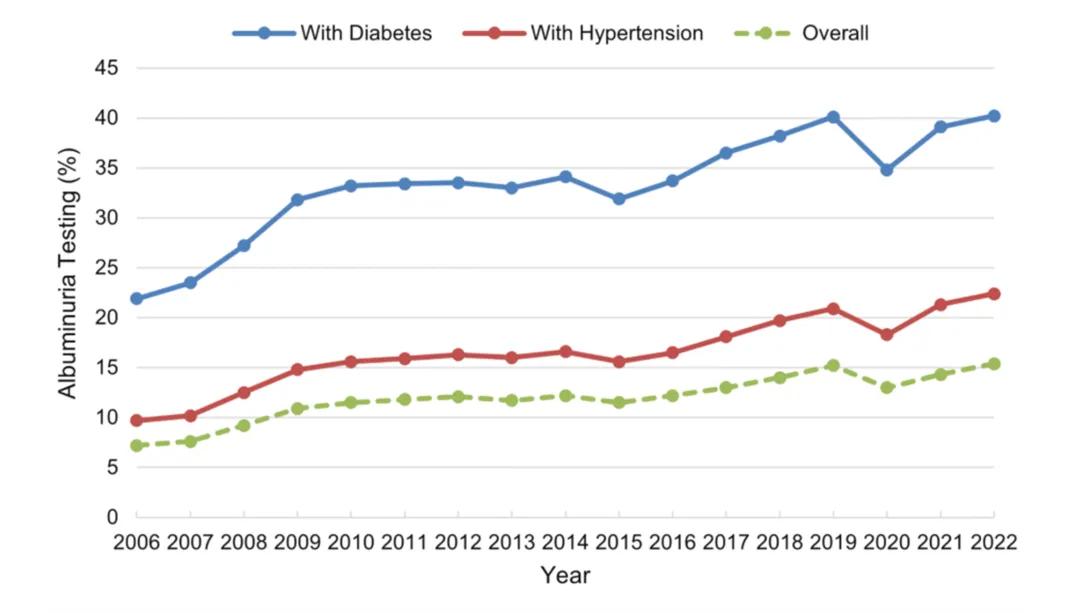
The reasons for low rates of testing included a lack of provider awareness of the importance of testing and logistical barriers to testing in a health system setting.
These findings highlight a practice gap that reflects low screening rates for kidney disease especially with respect to the urine protein test (specifically, a urine albumin to urine creatinine ratio test) among U.S. Veterans.
Similar findings have been observed in other health systems settings as well.
The other test required for the assessment of your kidney health is a serum creatinine, usually referred to as cystatin C, that can be utilized to calculate an estimate of your kidney function (glomerular filtration rate or GFR.)
While this test is performed frequently, since it’s part of routine blood panels, by itself can be an incomplete assessment of kidney health in the absence of a urine albumin to creatinine ratio test.
The presence of even a small amount of albumin in the urine is not only an indicator of kidney damage, but based on multiple studies, is also highly predictive of the risk of progression of both kidney and cardiovascular disease.
If you or someone you know is diagnosed with and/or have a family history of kidney disease, diabetes, hypertension, and/or cardiovascular disease, getting the recommended kidney disease related screening tests done, at the appropriate time, is crucial towards early detection, prevention and treatment of kidney disease.
Specific therapies to reduce cardiovascular complications and kidney disease progression include lifestyle changes (e.g., attention to diet, physical activity, adequate sleep and achievement of healthy weight) as well as the appropriate use of kidney and cardioprotective medications, which there are now many to choose from.

Health Lab
Explore thousands of health news & research stories by visiting the Health Lab homepage for more.
Media Contact

Public Relations
Department of Communication at Michigan Medicine
In This Story

Rajiv Saran, MBBS, DTCD, MD, MRCP (UK), MS
Professor
Stay Informed
Want top health & research news weekly? Sign up for Health Lab’s newsletters today!
Featured News & Stories

Kidney transplant recipient celebrates 10 year anniversary at Transplant Games
Immune protein suPAR links viral infection as possible cause of kidney disease

How disparities in kidney care happen, and what to do about it
Kidney disease is a problem for cerebral palsy patients. Why are doctors missing it?

Children with Chronic Kidney Disease Have Outsized Health Burden