The importance of language in medical training materials
Difficulty studying laparoscopy in French reflects a larger problem
5:00 AM
Author |

Minimally invasive surgery was pioneered in France, but, ironically, French-language training materials for such procedures are comparatively sparse.
Prior research has indicated that programs in Africa, home to most of the world’s French speakers, have the highest dependence on foreign-language resources in medical education.
These realities motivated a recent editorial in the World Journal of Surgery.
Lead author Callie K. VanWinkle, a University of Michigan Medical School student, became interested in the topic while working in the lab of Grace J. Kim, M.D., a clinical professor of surgery.
Here, VanWinkle discussed the findings that influenced her recent editorial and her work with Kim on ALL-SAFE, a surgical training platform that aims to help bridge this language gap.
What are the effects of global medical training materials only being produced in certain languages?
VanWinkle: As someone who grew up in a mixed-ethnicity family with non-native English speakers, I have a deep appreciation for how powerful language can be, both logistically and symbolically.
When you have materials only available in only one language, learning is restricted to those who speak that language. Inevitably, this leads to inequities and imbalanced power dynamics.
In addition to limiting access to opportunities, you're also sending a message about who you're prioritizing in that space.
Does English’s status of the de facto language of the internet contribute to this problem?
VanWinkle: Absolutely. In studying this subject, we looked at not only physical textbooks, but also websites containing both written and video materials.
One thing that surprised me was to see that even for materials that advertised as being available in French the overall language accessibility was still low. For example, the website might be in French, but the surgical videos on the website are in English.
Interestingly, France is the birthplace of minimally invasive surgery. I think that's so fascinating, and in some ways ironic.
You studied availability of French-language training materials for laparoscopic surgery. Why did you choose French?
VanWinkle: We chose to study the limitations of training materials in French after hearing from our French-speaking colleagues in Africa about their challenges with language inaccessibility in laparoscopy training.
Having also studied French for several years at Stanford University and abroad in France, I was intrigued to study the language in a surgical context.
You looked specifically at French-language training materials for laparoscopic surgery. Is there a reason laparoscopy specifically lacks translated materials?
VanWinkle: Laparoscopy is newer than some other surgical techniques, especially in low resource settings. So perhaps one part of this problem is just that it hasn’t had time to catch up yet.
Importantly, there are implications outside of surgery and outside of laparoscopy. At the root of this challenge is this question: When there are new developments in technology and new advancements, how do you equitably and effectively globalize them?
Laparoscopy is one of these opportunities to globalize a potentially life-saving advancement. But it's not the first one, and it won’t be the last one.
I feel strongly that there are lessons and strategies to be learned from this work with laparoscopy training that can be applied to other technological advancements.
How does the language of training materials contribute to brain drain?
VanWinkle: We felt it was important to address “brain drain,” the concept of losing high value talent and skill to other countries, particularly to high income countries from low income countries.
It’s been a long discussed theory in global health.
In reading recent literature about the role of this phenomenon in Africa, there's less concern for this effect.
Firstly, because it appears that low income countries in Africa are retaining more of their surgical trainees than previously thought. And secondly, there is acknowledgement that the idea of brain drain, as it's been described in prior literature, is perhaps not a very complete description of emigration.
Economists and academics cite a number of different benefits potentially conferred to an emigrating individual’s country of origin, including influx of wealth and skills upon re-immigration and expansion of professional and financial networks.
But then there's the question of, should people have to leave their country of intended practice if they don't want to or are unable to?
That's where this work fits in. For that group of people who don't want to leave or should not have to leave, how can we provide them with training that might not yet be accessible in their country?
What are the advantages of training materials that were originally produced in French versus translated from English to French?
VanWinkle: I think this is an interesting question, too. And I think it's increasingly important in the age of artificial intelligence and automatically rendered translations.
We know from research that education is more effective when provided in someone's native language, even if that person is bilingual. And so, it's important to have these materials accessible in your native language for optimal training.
In addition to this, you often lose nuance and accuracy if you have materials automatically translated, instead of having someone dedicated to generating materials in a second language.
You’ve worked on ALL-SAFE. What is ALL-SAFE and what is it doing to address these imbalances in training materials?
VanWinkle: ALL-SAFE is an international initiative involving the Michigan Center for Global Surgery.
The ALL-SAFE initiative works to expand access to lifesaving and life-altering minimally invasive care by providing laparoscopic education training to surgeons in low-resource settings.
ALL-SAFE has approximately 1000 users in 25 countries.
It’s an open-source training platform and every single aspect of its curriculum is available in both English and French.
Additional authors: Tchinde Ngueping Marius Jordan, Blessing Ngam, Keir Thelander, Grace J. Kim
Paper cited: “The Language We Use to Teach Surgery: Language Inaccessibility of Minimally Invasive Surgical Training in Francophone Countries,” World Journal of Surgery. DOI: 10.1002/wjs.12656
Sign up for Health Lab newsletters today. Get medical tips from top experts and learn about new scientific discoveries every week.
Sign up for the Health Lab Podcast. Add us wherever you listen to your favorite shows.

Health Lab
Explore thousands of health news & research stories by visiting the Health Lab homepage for more.
Media Contact

Public Relations
Department of Communication at Michigan Medicine
Stay Informed
Want top health & research news weekly? Sign up for Health Lab’s newsletters today!
Featured News & Stories
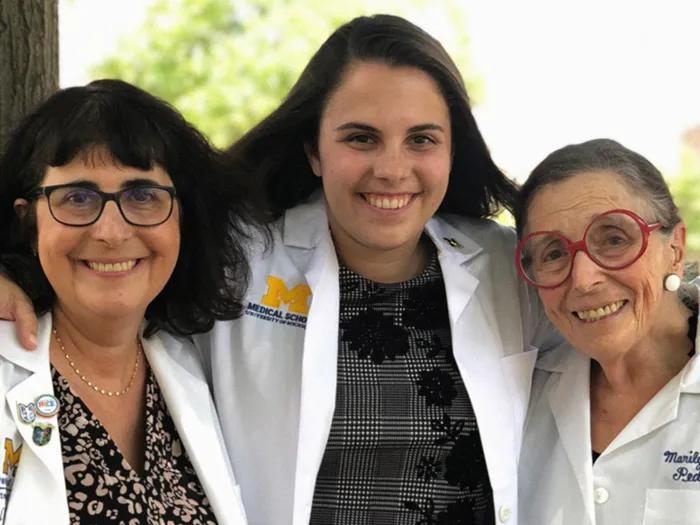
Celebrating three generations of female doctors in one family

Rheumatologist finds contentment and community through family farm

College of Pharmacy alum advances U-M Medical School addiction research
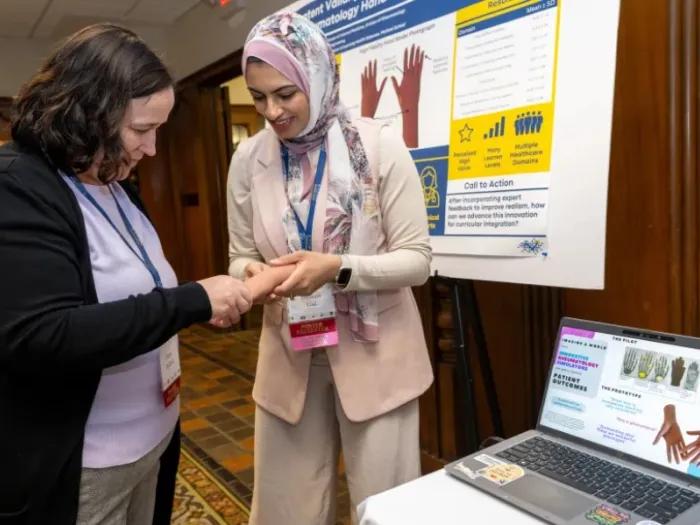
Rethinking how clinicians learn to feel disease
Rethinking care: How ‘de-implementation’ can improve quality and reduce burnout