Human ability to focus on specific sounds not found to originate in auditory nerve, brainstem
Selective attention wasn’t observed in precortical stages
5:00 AM
Author |
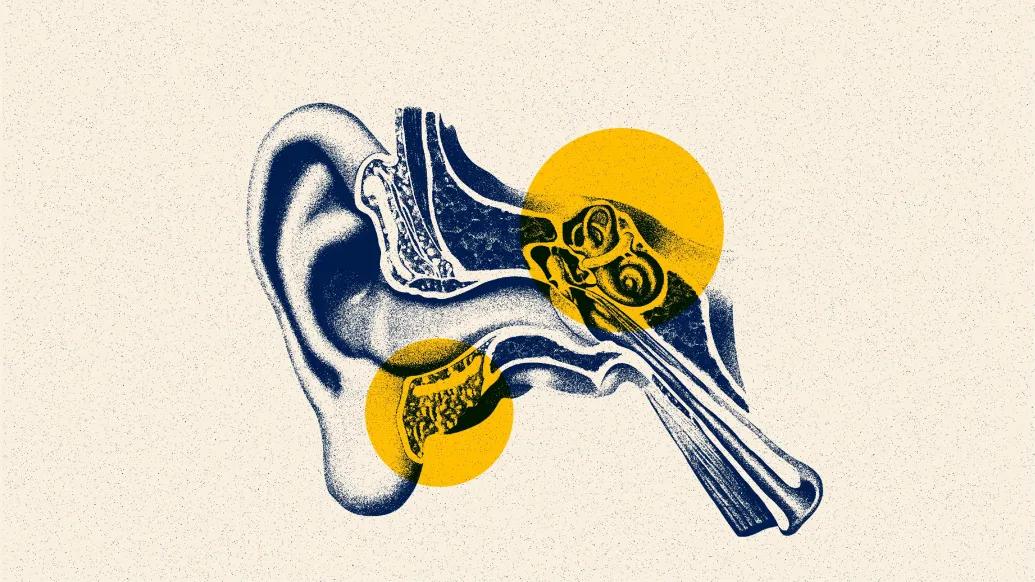
Research led by the University of Michigan’s Kresge Hearing Research Institute and the University of Rochester illuminates the mechanisms through which humans can pick out and focus on single sounds in noisy environments.
Previous studies had established that this ability to filter sound, called “selective attention,” involved the auditory cortex of the brain.
Evidence had been inconclusive, however, as to whether that selective attention involved sound being processed differently at the subcortical level — i.e. in the brainstem or the auditory nerve, which receive the sound signals from the ear and process them before eventually passing them on to the cortex.
Using novel experimental techniques, researchers found no evidence of such subcortical processing.
“What we found is that the subcortical parts of the auditory system respond to speech you’re paying attention to in exactly the same way as the speech you’re ignoring,” said Ross Maddox, Ph.D., associate professor of otolaryngology at the University of Michigan medical school, member of the Kresge Hearing Research Institute, and senior author on the paper.
“This is different from the cortex, which neurally ‘turns up the volume’ on the sound you’re focusing on.”
Most prior research into selective attention relied on artificial sounds. In this study, however, participants listened to segments from two audiobooks read by different narrators, better simulating the “cocktail party” task of focusing on a single speaker.
With responses measured from the auditory nerve, the brainstem and the cortex, subjects showed no subcortical effect when the two audiobooks were played simultaneously in both ears (diotic listening) or when the two audiobooks were played in opposite ears (dichotic listening).
Furthermore, statistical analysis suggested evidence against such subcortical effects.
A strong attention effect was measured in the cortex, replicating previous findings.
Researchers suggest that contradictory findings from one similar prior study may owe to differences in experimental design.
In that earlier research, multiple stories were spoken by each narrator, introducing a possible effect from “uncontrolled acoustic differences.”
An additional experiment detailed in this paper confirmed the possibility of that design influencing results.
Researchers emphasize, however, that the lack of evidence does not preclude the possibility that selective attention utilizes auditory nerve or brainstem in a way that cannot yet be observed.
They speculate that, for instance, certain neurons that are too few to be measured by present techniques could be involved in a related subcortical process.
“I think what we’ve shown here is that for human studies, there is no subcortical attention effect that can be measured with the tools we have available,” Maddox said.
“In fact, we had to develop some new experimental methods for this study to help settle the debate. But it’s always possible that as we and other labs keep pushing on the technology front, new studies will allow us to take a more detailed look at what’s going on inside our auditory brains.”
Additional authors: Thomas J. Stoll, Nathan D. Vandjelovic, Melissa J. Polonenko, Nadja R. S. Li, Adrian K. C. Lee
Paper cited: “The auditory brainstem response to natural speech is not affected by selective attention,” PLOS Biology. https://doi.org/10.1371/journal.pbio.3003407
Sign up for Health Lab newsletters today. Get medical tips from top experts and learn about new scientific discoveries every week.
Sign up for the Health Lab Podcast. Add us wherever you listen to your favorite shows.

Health Lab
Explore thousands of health news & research stories by visiting the Health Lab homepage for more.
Media Contact

Public Relations
Department of Communication at Michigan Medicine
In This Story

Ross K Maddox, PhD
Associate Professor
Stay Informed
Want top health & research news weekly? Sign up for Health Lab’s newsletters today!
Featured News & Stories

A metabolic “switch” that could help reset scar-producing cells in scleroderma

Emergency room intervention pairs smartphone, telehealth counseling to reduce risky firearm behavior

Better prenatal care data could help prevent maternal complications, experts say
Pain, psychological factors and physical function closely linked in people with systemic sclerosis
Many hospitals still don’t do enough to prevent UTIs from catheters