How do spaceflights and long term planetary missions affect vision?
Space exploration exposes astronauts to various stressors that can injure their eyes
1:26 PM
Author |
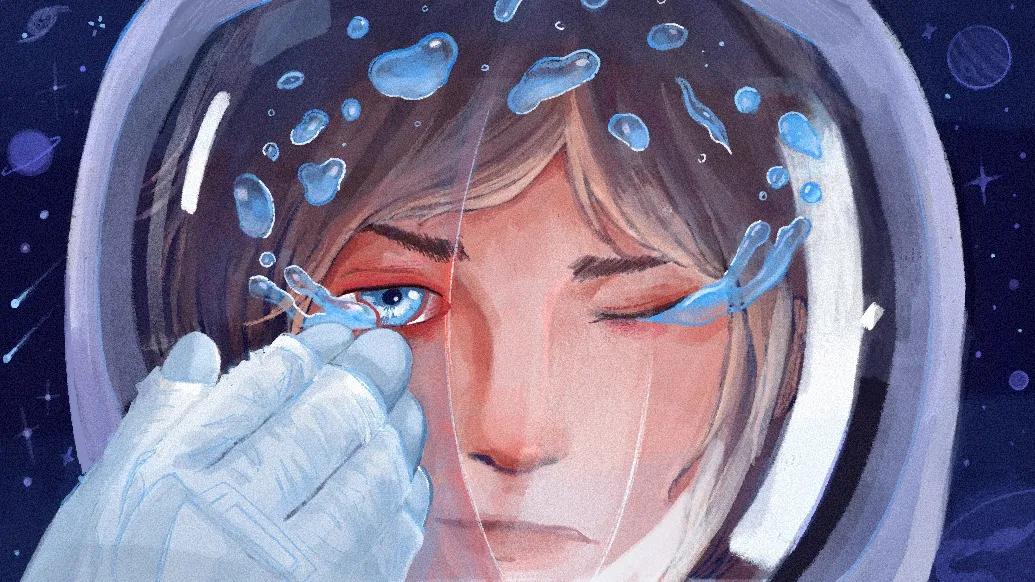
Since the first spaceflight in 1961, space travel has captured the human imagination across the world.
Space missions offer researchers the opportunity to investigate the nature of life in extreme environments that cannot be studied on Earth.
Their work provides further insight into our bodies and how they are influenced by Earth-based medicine.
As these missions proceed to prolonged planetary explorations, the challenges faced by astronauts will intensify.
Joshua Ong, M.D., resident physician at University of Michigan Kellogg Eye Center outlined these problems in Life.
Here, he answers questions about how spaceflight affects vision and what protective measures astronauts use.
What challenges does spaceflight pose to vision?
Ong: There are several unique stressors in space, including cosmic radiation, confined living conditions and microgravity-induced fluid shifts.
The cornea, which is the clear, dome-shaped part of the eye, is particularly sensitive.
It can get damaged from floating debris, which impacts both clear vision and depth perception and can jeopardize the astronaut’s ability to carry out tasks.
The tear film that covers the cornea can also be affected, making astronauts susceptible to dry eye disease and microbial infections.
Spaceflight Associated Neuro-Ocular Syndrome is another microgravity-induced problem that occurs in the back of the eye, and there is no equivalent on Earth.
SANS causes swelling in the optic nerve and flattens the back of the eye, which can lead to visual changes such as blurriness.
Astronauts also face an increased risk of cataract due to cosmic radiation exposure. It’s like how X-ray technicians are more susceptible to earlier cataract formation.
Fortunately, none of the astronauts have reported permanent vision loss so far.
Why do these vision changes occur?
Ong: For SANS, although the underlying causes are not completely understood, we believe elevated pressure within the brain plays a large role.
On Earth, gravity causes the fluid in your body to pool in the legs.
In space, microgravity causes the fluid to shift towards the head. This fluid shift is thought to be a cause of SANS.
The corneal risks, such as foreign bodies to the cornea or eye surface, can alter how light enters the eye, changing vision.
How long does it take for symptoms to manifest?
Ong: In short-duration spaceflights, like the recent Blue Origin spaceflight, SANS is usually not a problem. However, some have observed increased intraocular pressure, which usually normalizes.
In astronauts who go on long-duration spaceflights, which are six months or longer, the pressure in the brain is elevated when they come back down to Earth.
They can, however, have persistent SANS findings.
What precautions can astronauts take to protect their eyes?
Ong: There are specialized eye goggles that are available on the International Space Station.
If an astronaut has debris on the cornea, the goggles have a tubing system that provides a jet stream of sterile water and suctions it out.
This constant irrigation is incredibly important because if you have something corrosive in your eye, you need to get it out immediately.
Astronauts have also brought different prescriptions of glasses, known as space anticipation glasses, to account for changes in their eye shape due to SANS.
Other preventative measures include radiation protection on spacecraft surfaces and rigorous decontamination procedures. This continues to be an area of ongoing research.
What other protective measures are being developed?
Ong: Thinking of all possible countermeasures to deal with microgravity can be challenging.
For example, putting in eye drops is not easy under microgravity: How do you get the eye drop in and is there an increased risk of the bottle tip hitting your eye when you’re floating?
The risks to vision are varied, so countermeasures are diverse.
A countermeasure for SANS that we are excited about is using negative pressure.
It involves a chamber that the astronaut enters, and it decreases the pressure around their lower body to reduce fluid shift to the head.
We are hoping that it will help reduce the risk of developing SANS.
We are also looking into medical and surgical techniques that astronauts can use in emergencies.
For example, cataract surgeries are routine on Earth. Eventually, they will likely happen off Earth, and when that happens, we hope we can make surgeries as safe and effective as possible.
Additional authors: Jainam Shah, Ryung Lee, Alex Suh, Ethan Waisberg, C Robert Gibson, John Berdahl and Thomas H Mader
Paper cited: “Risk of Permanent Corneal Injury in Microgravity: Spaceflight-Associated Hazards, Challenges to Vision Restoration, and Role of Biotechnology in Long-Term Planetary Missions,” Life. DOI: 10.3390/life15040602
Sign up for Health Lab newsletters today. Get medical tips from top experts and learn about new scientific discoveries every week.
Sign up for the Health Lab Podcast. Add us wherever you listen to your favorite shows.

Health Lab
Explore thousands of health news & research stories by visiting the Health Lab homepage for more.
Media Contact

Public Relations
Department of Communication at Michigan Medicine
Related
The Astronaut's Doctor
Stay Informed
Want top health & research news weekly? Sign up for Health Lab’s newsletters today!
Featured News & Stories
A new clue for aging eyes
Susan J. Lane: Gratitude and Giving

Treating a rare eye condition in a 7-year-old

Rare genetic eye disease treated with gene therapy helps 2 children see again
Medical students develop novel technological solutions for unmet patient needs