How AI is helping emergency physicians learn from their patients
“Tell Me What Happens Next” initiative helps clinicians follow up on patient outcomes
5:00 AM
Author |
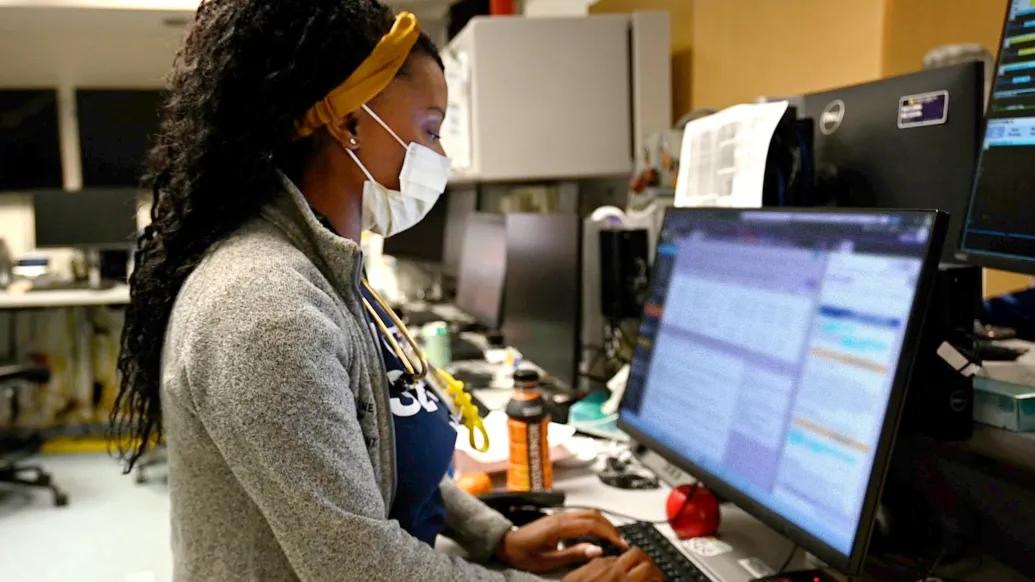
In emergency medicine, clinicians often see patients for only one critical moment in their care journey.
They make decisions quickly, sometimes under life-or-death pressure, and then the patient moves on — home, to a bed upstairs, to the intensive care unit or to another team.
The “Tell Me What Happens Next,” initiative based in the Department of Emergency Medicine’s new Division of Clinical Informatics, is using artificial intelligence to help close that loop.
Developed by Alex Janke, M.D., M.H.S., and Florian Schmitzberger, M.D., M.S., the project allows emergency clinicians to request follow-up on a patient’s outcome that is automatically generated by artificial intelligence.
Using the tool is simple.
While working in the patient chart, clinicians can click a “Tell Me What Happens Next” button embedded within the disposition workflow, choose when they want follow-up information delivered and specify what they want to learn.
Days or weeks later, the system automatically reviews the patient’s chart and emails back an AI-generated summary tailored to the clinician’s request.
“The goal of the project is to give clinicians the feedback that they desire on patients,” said Sara Lin, M.D., a resident in the Department of Emergency Medicine and collaborator on the project.
Before the project was developed, following up on patient outcomes was a manual and often time-consuming process.
Clinicians who wanted to learn what happened after a patient left the emergency department had to keep personal lists, remember to revisit charts days or weeks later and sort through notes, test results and consultant documentation to piece together their patient’s course.
Early in the project, follow up summaries were completed manually by reviewers while the team explored whether AI could accurately automate the process.
“Through our review, we were able to show that a Large Language Model was very accurate, and met the criteria for conciseness, completeness and helpfulness,” Lin said.
The project has since moved into an automated workflow with ongoing quality control.
According to Lin, more than 1,200 requests have been submitted by more than 160 unique users, including attending physicians, residents, physician assistants and rotating residents from other specialties.
For Nik Theyyunni, M.D., Division Chief of Ultrasound and Clinical Associate Professor of Emergency Medicine, and someone who uses the new tool regularly, the project captures something uniquely challenging about emergency medicine.
“The challenging thing about emergency medicine is that you have to make the right decision for people, often in life-or-death circumstances, based on just one scene,” Theyyunni said.
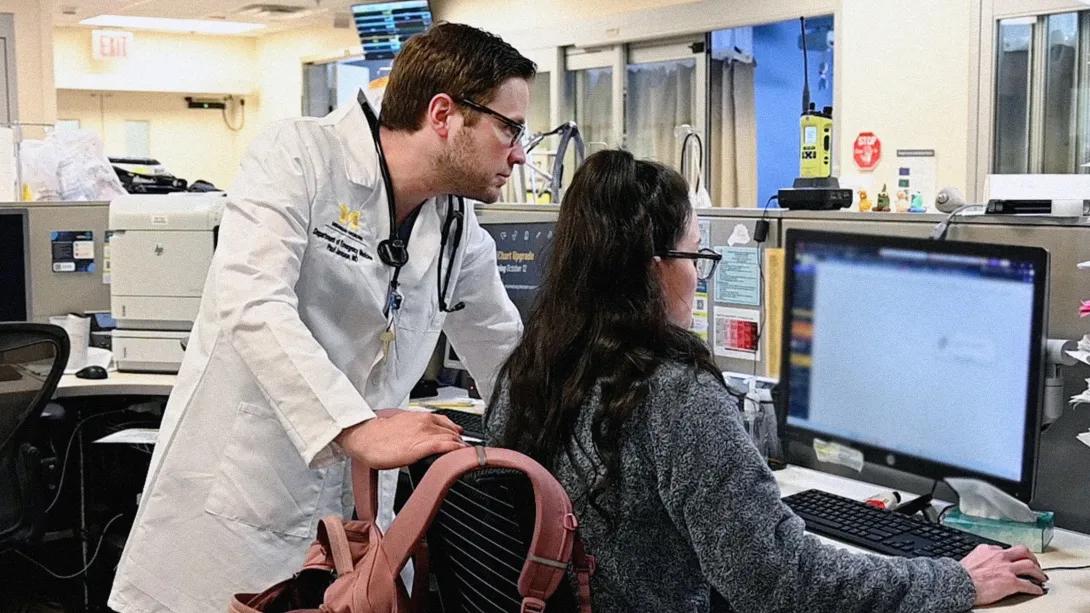
“What's cool about this tool is that it automates our ability to get better at knowing what to do from one scene by playing us back the rest of the movie.”
That feedback can help clinicians understand whether their initial judgment matched what happened later — and where they might improve.
“It's very helpful for our being able to reinforce, did we make the right decision, did we make the wrong decision?” Theyyunni said.
“Did we understand the risks that this person had in front of us?”
The tool also has important implications for medical education.
Many clinicians do not have a formal system for reviewing patient outcomes, even when they want to learn what happened next.
“This is helping to fill that gap,” Lin said.
According to Schmitzberger, the project came from a shared frustration with the difficulty of reliably following up on patients after an emergency department encounter.
“We were both very frustrated with the process, requiring us to put them on a patient list, remembering to look them up, opening the chart, getting back into the mindset and the framing of the patient, and then figuring out what actually happened,” Schmitzberger said.
“Together we decided that this was an opportunity to use technology to improve our follow up.”
The team moved from idea to prototype in just a few months.
The project was launched in Fall 2025 with support from the University of Michigan Medical School Office of Research's Research Scouts program, which helped fund development of the underlying infrastructure and AI-enabled workflow.
The more difficult part, Schmitzberger said, was ensuring the system could be deployed safely, reliably and with the appropriate approvals.
“The more difficult part was getting it both deployed, in a safe and reliable way, and making sure to get all the correct permissions, but also to fine-tune it so it's actually useful for the clinician,” Schmitzberger said.
The project is currently housed outside the chart and uses the U-M GPT Toolkit that allows protected health information to be handled appropriately.
For Schmitzberger, the long term benefit is not just convenience. It’s becoming a better physician over time.
“If you incrementally follow up more of your patients, calibrate your skill set, and calibrate your diagnostics and therapeutics, ultimately, you're just going to make small, tiny, incremental changes for the better,” Schmitzberger said.
Interest in the project is already growing.
Lin presented the work at the Council of Residency Directors in Emergency Medicine conference and the Society for Academic Emergency Medicine conference and said the team received multiple emails from other institutions interested in developing something similar.
The team is working with the University of Michigan’s AI & Digital Health Innovations group to expand further.
Several other U-M clinical departments have also expressed interest.
“Multiple other departments, organically, are seeking integration of the system,” Schmitzberger said. “We're talking to folks from internal medicine, psychiatry, and anesthesiology.”
The team also recently received a $100,000 Graduate Medical Education Innovation Grant to support development of a next-generation version focused on enabling rather than replacing clinical learning.
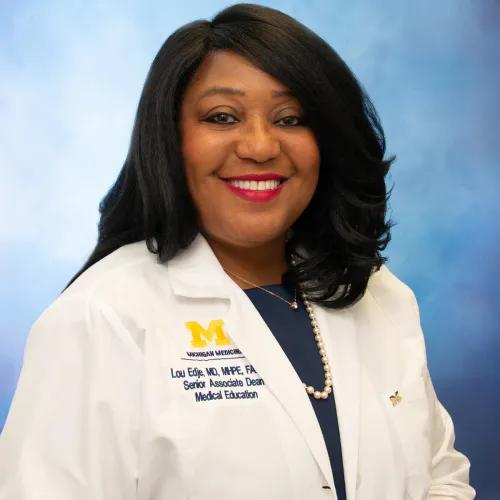
Ongoing project management support has been provided by Lou Edje, M.D., MHPE, FAAP, Senior Associate Dean of Medical Education.
Theyyunni sees even broader potential for similar AI-supported chart review tools in peer review, research, and quality improvement.
“Thinking about all the stuff that we ask people to do manually, and we don't have enough people to do it, I'm excited to see this kind of project expanded into other areas,” Theyyunni said.
At its core, “Tell Me What Happens Next” is designed to help emergency clinicians learn from the patients they may never see again.
“The hard part of being an emergency medicine physician is you only get this one moment to figure out what's going on with the patient,” Theyyunni said.
“And so, everything that can make us better at knowing how to spend that time is invaluable.”

Health Lab
Explore thousands of health news & research stories by visiting the Health Lab homepage for more.
Media Contact

Public Relations
Department of Communication at Michigan Medicine
In This Story

Alexander T Janke, MD, MHS
Assistant Professor
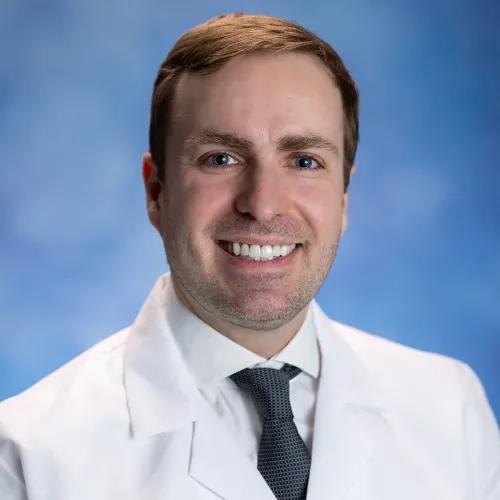
Florian F Schmitzberger, MD, MS
Clinical Assistant Professor
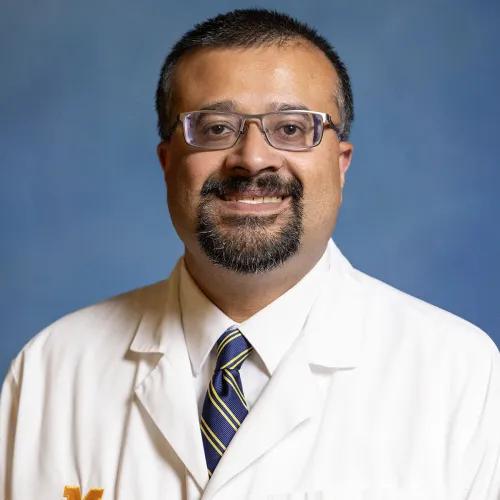
Nik Theyyunni, MD
Clinical Associate Professor
Louito Edje, MD, MHPE, FAAFP
VICE DEAN
Stay Informed
Want top health & research news weekly? Sign up for Health Lab’s newsletters today!
Featured News & Stories
The AI is listening: Implications of machine generated clinical notes on health care
Comprehensive DNA sequencing reveals hidden drivers of cancer
‘Molecular glue’ stabilizes protein that inhibits development of non-small cell lung cancer and uterine cancer
Many older adults make Medicare decisions quickly and most don’t change plans, poll finds
What’s the latest on 7-OH and kratom availability and addiction care?