A Holiday Gift to Primary Care Doctors: Proof of a Time Crunch
A study with a satirical spin drives home a real point about the demands on general practitioners’ time and expectations for shared decision-making in primary care.
12:00 PM
Author |
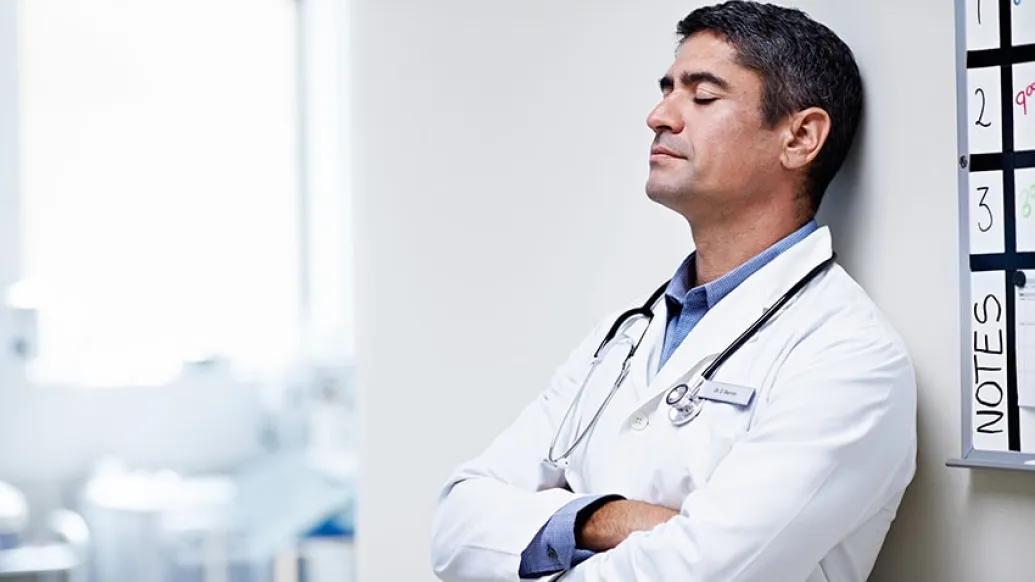
The average primary care doctor needs to work six more hours a day than they already do to make sure their patients get all the preventive and early detection care they want and deserve, a new study finds.
LISTEN UP: Add the new Michigan Medicine News Break to your Alexa-enabled device, or subscribe to our daily audio updates on iTunes, Google Play and Stitcher.
Primary care doctors' sleep, personal hygiene and family time need to take a back seat so they can add 29 minutes to each patient appointment, the study finds.
Fortunately, the new study was written as a parody and is published in the satirical Christmas edition of the journal BMJ by a team from the University of Michigan.
No one is asking doctors to work past midnight every night.
At least, not yet.
Preventive health options
But the study concludes that if they did, it would give primary care doctors just enough time to work with each patient to discuss and decide which preventive health options they should choose based on the risks, benefits and costs.
The study focuses just on the evidence-backed national recommendations from the Preventive Services Task Force — from colonoscopy and proactive lung cancer screening to vaccination and daily aspirin. The researchers built and ran a computer simulation based on real-world data to reach their conclusions.
SEE ALSO: Doctors Who Specialize in Not Specializing: Key to Medicine's Future
Unfortunately, all this shared decision-making about prevention would crowd out any time to discuss the patient's actual medical complaints. And, the researchers conclude, it would lead 17 out of every 100 doctors to take early retirement each year.
But the authors of the paper — two of whom are general practitioners themselves –– say their findings make a clear point: The idea that primary care doctors can engage in detailed shared decision-making with every patient, for every proven form of prevention, is impossible.
"This may be satire, but it actually allows us to make these points more strongly than we otherwise could," says Tanner Caverly, M.D., MPH, the study's lead author and a general practitioner at U-M's academic medical center, Michigan Medicine. "One of primary care's main roles is that we are the ones who absorb everything that our patients need and every demand for improved preventive care. Prevention is just one of the things we do."
Computer model sampling
Caverly worked with fellow U-M primary care physician Rodney Hayward, M.D., and U-M neurologist James Burke, M.D., to create a computer model of the way 1,000 doctors might spend their clinic time if they each had to take care of 2,000 primary care patients. The patients' medical conditions and levels of illness and disability were based on a sample of data from a real collection of patients tracked in a national study. They also varied many aspects such as the patient panel size and annual work hours before drawing conclusions.
Caverly and his colleagues modeled the time needed to address recommendations from the USPSTF, a group of health professionals that examines the body of research around specific preventive services. The USPSTF makes recommendations to guide clinical care nationwide.
These recommendations, which are considered the most rigorous and scientifically based, also help guide insurance coverage of preventive services.
"My colleagues and I care a lot about shared decision-making and how to get preference-sensitive care right, but these data show it's a matter of walking a fine line," Caverly says. "What we call full-share decision-making is not feasible for these types of decisions, so we have to come up with a model of shared decision-making that is more feasible."
MORE FROM MICHIGAN: Sign up for our weekly newsletter
Caverly has studied lung cancer screening and built a tool with colleagues to help physicians understand which patients really have a decision to make about whether to get a CT scan to check for signs of lung cancer.
The USPSTF made a recommendation about such screening. Implementing it in clinical practice can be a challenge, however, because many patients won't get enough benefit from such scans to warrant the worry and potential invasive procedures that they can lead to. But some patients truly could benefit from the scans and need a strong recommendation from their physicians.
"Recommending screening tests and scans is definitely a visible and growing part of the primary care agenda," Caverly says. "But primary care doctors say that one barrier to lung cancer screening, one of the more recent USPSTF recommendations, is they don't feel like they have time to incorporate another big thing to discuss with their patients."
Digital reminders
In the Veterans Affairs healthcare system, where Caverly cares for veterans' primary care needs, the electronic medical record system offers digital reminders to physicians about which preventive services their patients need. But even with this help, they don't have time in routine clinic visits to address all of the potentially valuable services at once.
"We need the entire primary care team to help out on preventive issues and use health information technology to prioritize what we recommend to a particular patient," Caverly says. "We need to use the patient's time in the waiting room and opportunities outside of time-pressured office visits — and perhaps offer incentives."
In addition to illuminating the issue of how primary care clinics should manage preventive services for their patients, Caverly and his colleagues hope their paper makes another point about physician wellness and burnout.
Shared decision-making as a model for clinicians and patients to cooperate on making a medical decision was pioneered in areas of medicine where decisions have high stakes — for instance, decisions about starting chemotherapy for cancer.
But in primary care, the need to have patient-centered care runs up against the time constraints of busy clinics with high demand and short appointment slots.
"We did this as a serious paper written from a humorous standpoint that reinforces the serious issues more sharply," Caverly says. "Now we need to analyze different ways of approaching these discussions with our patients."
He and his colleagues hope many primary care physicians will read their paper during their spare moments after they leave work around midnight. "We wouldn't want them to read it, or this summary of it, during work hours," he hastens to add, "because it would take precious time that they could use to discuss three or four preventive screenings and treatments with a patient."

Health Lab
Explore thousands of health news & research stories by visiting the Health Lab homepage for more.
Media Contact

Public Relations
Department of Communication at Michigan Medicine
Stay Informed
Want top health & research news weekly? Sign up for Health Lab’s newsletters today!
Featured News & Stories

Top 7 tips for choosing Medicare prescription drug coverage for 2027

Many older adults make Medicare decisions quickly and most don’t change plans, poll finds

4 in 5 parents say having a baby is too expensive

What’s the latest on 7-OH and kratom availability and addiction care?
Better prenatal care data could help prevent maternal complications, experts say