High triglycerides drive life threatening aortic aneurysms, study in mice finds
A drug candidate significantly reduced aortic aneurysm development, showing promise of triglyceride-lowering therapy as a treatment target
5:00 AM
Author |

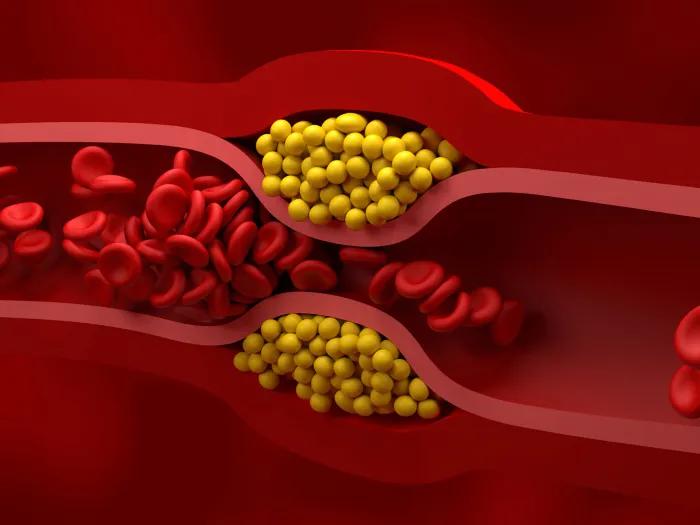
High levels of triglycerides, the most common type of fat in the body and the foods we eat, directly cause abdominal aortic aneurysms, according to a study in mouse models led by Michigan Medicine.
Researchers identified triglyceride-rich lipoproteins and proteins that regulate triglyceride metabolism, including APOC3 and ANGPTL3, as causal drivers of abdominal aortic aneurysm.
The study challenges the long-standing belief that triglycerides are merely biomarkers of vascular disease and instead demonstrates that they play a direct and pathogenic role in aneurysm development, growth and rupture.
The results are published in Circulation, a journal of the American Heart Association.
“We have known that hyperlipidemia is a risk factor for aortic aneurysm, but this multidimensional study pinpoints hypertriglyceridemia as an essential contributor to the development and growth, as well as dissection and rupture, of aortic aneurysms,” said co-senior author Eugene Chen, M.D., Ph.D., Frederick G. L. Huetwell Professor of Cardiovascular Medicine at University of Michigan Medical School.
“Our findings suggest that managing triglycerides could become a powerful therapeutic strategy.”
Using three different mouse models of hypertriglyceridemia, the research team demonstrated a triglyceride dose-dependent effect on aneurysm severity.
Moderate elevations in triglycerides accelerated aneurysm formation, while higher levels led to aortic dissection.
Mice with severely elevated triglyceride concentrations developed more severe complications consistent with aortic rupture.
Further investigation revealed that elevated triglycerides and related fatty acids, particularly palmitate, impaired the maturation and activity of lysyl oxidase, a critical enzyme that maintains the structural integrity of the aortic wall.
This enzyme dysfunction weakened connective tissue and promoted aneurysm progression.
By overexpressing LOX in the aorta, researchers effectively blocked the damaging effects of hypertriglyceridemia in the mouse models, confirming the mechanism.
Standard lipid-lowering therapies, such as niacin, didn't sufficiently reduce triglyceride levels to a protective range.
However, investigators found success with experimental antisense oligonucleotide therapy.
The drug candidate targets the ANGPTL3, which is secreted in the liver and affects how the body breaks down fats.
The treatment dramatically lowered triglyceride levels by up to 50% and prevented aneurysm formation and dissection in multiple mouse models.
“This therapy holds great potential as a treatment for abdominal aortic aneurysm, and our research lays the groundwork for future clinical trials,” said co-senior author Yanhong Guo, M.D., Ph.D., research assistant professor of internal medicine at U-M Medical School and member of the U-M Health Frankel Cardiovascular Center.
“This is an exciting development for a condition that currently has limited options beyond surgical repair. The findings may represent a paradigm shift in how vascular diseases like abdominal aortic aneurysm are understood and treated, offering hope for patients at high risk who currently lack effective pharmacological interventions.”
Additional authors: Yaozhong Liu, M.D., Minzhi Yu, Ph.D., Ying Zhao, Yalun Cheng, M.D., Yongjie Deng, M.D., Yang Zhao, Ph.D., Xiaokang Wu, M.D., Ph.D., Huilun Wang, Ph.D., Guizhen Zhao, Ph.D., Chao Xue, M.D., Ph.D., Hongyu Liu, M.D., Ida Surakka, Ph.D., Anna Schwendeman, Ph.D., Lin Chang, Ph.D., Jifeng Zhang, Ph.D., all of University of Michigan, Lei Cai, Ph.D., Hong S. Lu, Ph.D., Alan Daugherty, Ph.D., Ryan E. Temel, Ph.D., all of Saha Cardiovascular Research Center and the Department of Physiology at University of Kentucky, Haocheng Lu, Ph.D., of Southern University of Science and Technology.
Funding/disclosures: This study was partially supported by the National Heart, Lung, and Blood Institute (HL166203, HL165688, HL109946, HL134569, HL151524, HL153710, HL172832, HL155649) and the National Center for Advancing Translational Sciences (UL1TR001998) of the National Institutes of Health.
The content is solely the responsibility of the authors and does not necessarily represent the official views of the NIH.
The study also received partial support from the American Heart Association.
Paper cited: “Hypertriglyceridemia as a Key Contributor to Abdominal Aortic Aneurysm Development and Rupture: Insights From Genetic and Experimental Models,” Circulation. DOI: 10.1161/CIRCULATIONAHA.125.074737

Health Lab
Explore thousands of health news & research stories by visiting the Health Lab homepage for more.
Media Contact

Public Relations
Department of Communication at Michigan Medicine
In This Story

Yanhong Guo
Research Associate Professor

Yuqing E Chen
Professor
Related
Drug candidate successfully treats atherosclerosis, fatty liver disease in large mammals

Why donor hearts fail in cold storage — and how to prevent it
Stay Informed
Want top health & research news weekly? Sign up for Health Lab’s newsletters today!
Featured News & Stories

Digital alerts support timely treatment decisions of critically ill cardiac patients

15 years of data will help uncover how flu spreads—and how to reduce its impact

$3.9 million NIH grant to fuel U-M effort to develop first targeted therapy for fatal childhood brain disorder

Bigger data reveals the second, third and fourth switches controlling a gene
Study outlines a new framework for direct cell reprogramming