Her heart stopped more than 25 times. ECMO saved her life
After two birthdays in the hospital, she celebrated with a brand-new heart.
9:12 AM
Author |
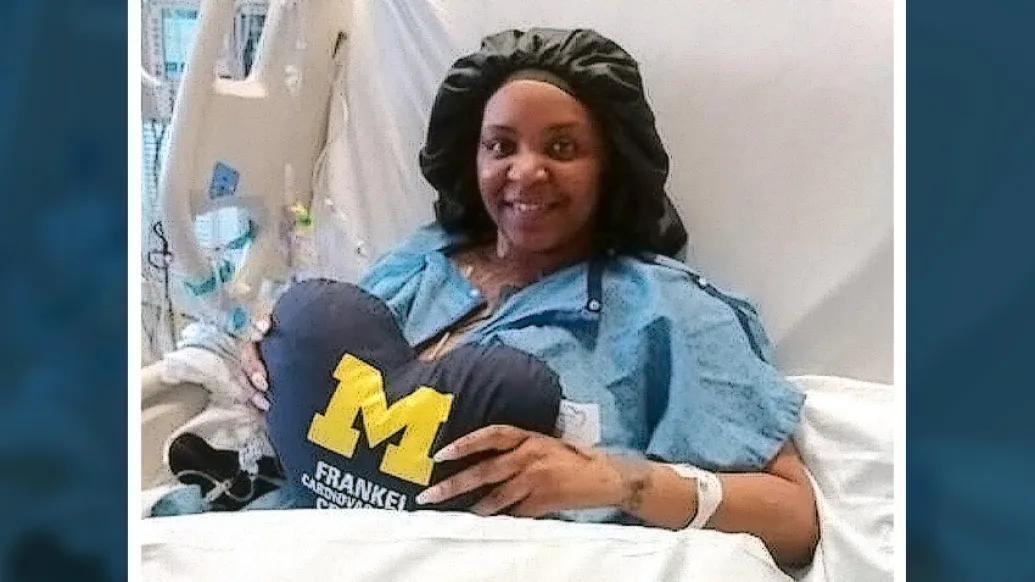
As the ambulance whizzed through traffic in July 2021, a gray Dodge Charger followed at top speed. Andre Smith tailed the emergency vehicle, laser-focused on its lights and the destination.
"They had to stop and tell me that I actually couldn't go through the lights like the ambulance," Smith said. "When they finally took her into the operating room, I tried to go back there, too. But all I could do was wait."
Smith called 9-1-1 when his fiancé, April Hogan, 39, told him something just "didn't feel right." Her heart, which she had learned was failing two months prior, pumped faster than she'd ever felt.
"I went in for shortness of breath thinking it was related to COVID-19," Hogan said. "The doctors told me I had fluid in my lungs and heart failure. They gave me a heart monitoring system and told me to take medications, but I didn't realize how serious it was."
The night of Hogan's transport, doctors approached Smith in the waiting room.
April was clinging to life in every sense. She had nearly died on the operating table – more than 25 times – revived consistently from many cardiac arrests.
"Most drop dead."
When Hogan came to the hospital, her cardiac enzymes were markedly elevated, a sign of a major heart attack. Cardiologists found a clot in the left main coronary artery.
Not only is this a rare finding, but it's remarkable for a patient with acute left main thrombosis to survive long enough to make it to the hospital, says Ashraf Abou el ela, M.D., a cardiothoracic surgeon at the University of Michigan Health Frankel Cardiovascular Center.
SEE ALSO: A constant state of Afib (uofmhealth.org)
"Most patients with this kind of blockage drop dead and we never see them," Abou el ela said. "But one way or another, she made it to the hospital. The team at the referring hospital went through her groin to place an impella device across her aortic valve that assists with pumping blood forward from the left ventricle to the aorta. That helps supply blood to the rest of the body."
Despite the device and high doses of medications, Hogan didn't improve. Doctors at the first hospital told Andre Smith to call her family – her body was shutting down by the minute.
"I called her mother, her sisters, everyone," he said. "Everybody came down to see April. That's when they told me she needed to be taken to Ann Arbor."
Upon her transfer to U-M Health, Hogan was in cardiogenic shock with lactic acidosis. Her heart wasn't pumping enough blood to the brain and vital organs, and her body compensated for the low flow by building up lactic acid. Without quick action, Hogan would suffer another cardiac arrest or multiple organ failure.
ECMO
"When we get someone in this condition, we don't know a lot about them," Abou el ela said. "We are in a kind of salvage mode where it is all about saving the patient."
They decided to start Hogan on extracorporeal membrane oxygenation, or ECMO, an advanced process in which blood is routed to a machine that oxygenates it before pumping it to the rest of the body's vital organs. The technology, which was developed at the University of Michigan by Robert H. Bartlett, M.D., allows failing heart and lungs to "rest" and has kept more than 2,000 patients alive at U-M since 1985.
When Abou el ela's team places someone on ECMO, they do this with one of three intentions: as a bridge to organ transplant, a bridge to recovery, allowing the heart to recuperate after a major injury, or, in Hogan's case, a bridge to decision.
We used every trick we had to save her body and her leg. When you are on ECMO, the clock is ticking, and a decision has to be made.
"When someone goes into cardiac arrest, especially as many times as she had, we have to figure out a lot of things," he said. "Is the brain functioning? Is the kidney going to work? So, once we initiated ECMO and supported the heart, it bought us time to evaluate her for advanced surgical heart failure therapies."
Hogan also did not have enough blood flowing to her leg, known as limb ischemia, which was caused by the impella device. To get blood flowing, interventional cardiologist Michael Grossman, M.D., placed a distal perfusion cannula, a routine practice Abou El Ela has come to know as "leg-mo". When that didn't suffice, they placed extra perfusion cannulas surgically to protect her failing limb. Eventually, vascular surgeon Jonathan Eliason, M.D., had to operate on her leg to remove a blood clot.
SEE ALSO: A new heart brings new hope (uofmhealth.org)
"We used every trick we had to save her body and her leg," Abou el ela said. "When you are on ECMO, the clock is ticking, and a decision has to be made. Only around 65% of shock patients will survive on ECMO, but all patients, including Ms. Hogan, would die without this mechanical support."
When the team was not able to wean Hogan from ECMO, Abou el ela and thoracic surgeon Francis D. Pagani, M.D., implanted a left ventricular assist device, or LVAD, to improve circulation throughout the body.
Like Podcasts? Add the Michigan Medicine News Break on Spotify, Apple Podcasts or anywhere you listen to podcasts.
"I couldn't believe it," Hogan said. "I never knew I had heart problems, so when they first told me I about it, I didn't take it seriously. This drastically changed my life, which I look at so differently now."
Like Podcasts? Add the Michigan Medicine News Break on Spotify, Apple Podcasts or anywhere you listen to podcasts.
Not long after the implantation, Abou el ela got a call from Kevin Knott, PA-C, a U-M Health physician assistant, asking him to come to clinic during one of Hogan's visits. Typically, he says, that means something isn't right.
"I ran down to clinic, and Kevin told me he didn't recognize Ms. Hogan," Abou el ela said. "She looked like a totally healthy human after being beaten up by illness for so long in the ICU. To see her go from having 25 cardiac arrests to walking home…it felt better than a lot of my medical certificates, to be honest."
Heart transplant
Changes to Hogan's life came quickly after her brush with death. She needed a heart transplant but received the LVAD instead due to years of smoking cigarettes. Working with Abbas Bitar, M.D., of the U-M Health transplant team, Hogan signed a contract to quit to be able to receive a heart.
"This actually changed both of our lives," Andre Smith said. "For years, we were both coming home from work, having a drink and smoking a cigarette or two. Seeing this happen to her opened our eyes."
Hogan eventually developed a drive line infection from her LVAD, and the need for transplant became more urgent. In early August, she got a call from the heart transplant team telling her they had a matching heart.
"I almost dropped the phone," Hogan said. "I wasn't expecting it to happen so soon, but I was ecstatic."
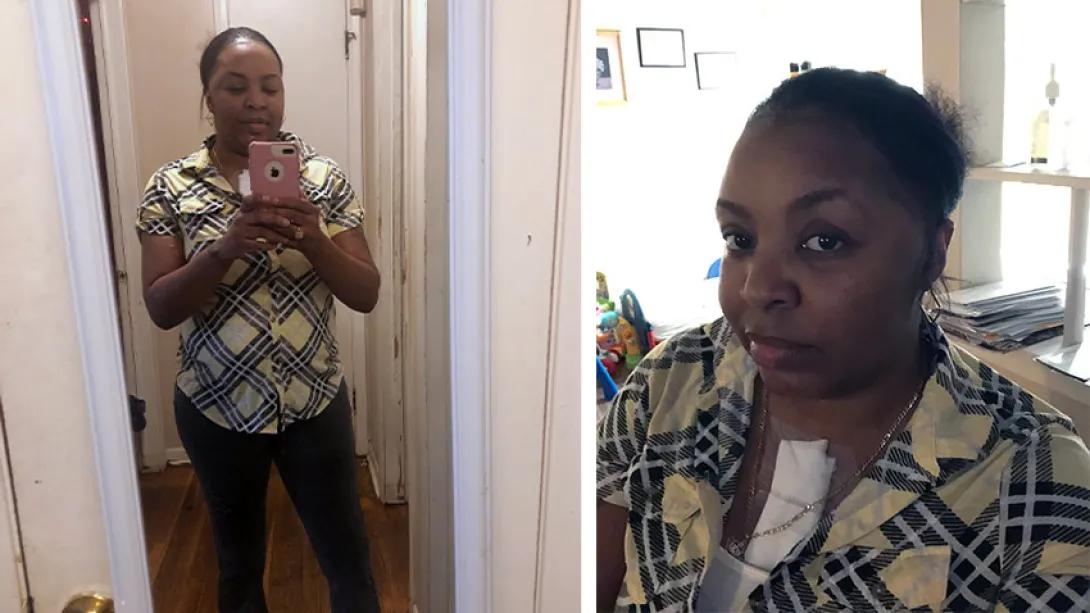
On July 28, Hogan celebrated her 39th birthday – her first outside of a hospital in two years. Two weeks later, her heart transplant was performed by U-M Health cardiothoracic surgeon Jonathan Haft, M.D.
"Getting Ms. Hogan to this point took a village – the organ procurement, ECMO, ICU, LVAD and transplant teams all took part in her care," Abou el ela said. "This type of lifesaving care is a team effort."
Hogan's recovery, Abou el ela says, has been uneventful – the best for which they could ask. Still, there are days when Hogan is down, when she questions why it all happened to her.
"It brings me back to a promise I've made to take better care of my health," she said. "Heart disease is serious, and it can run in families. My sister also has an LVAD and is now on a waiting list for transplant. After everything I've been through and am going through, I will never take life for granted again."
Live your healthiest life: Get tips from top experts weekly. Subscribe to the Michigan Health blog newsletter
Headlines from the frontlines: The power of scientific discovery harnessed and delivered to your inbox every week. Subscribe to the Michigan Health Lab blog newsletter

Health Lab
Explore thousands of health news & research stories by visiting the Health Lab homepage for more.
Media Contact

Public Relations
Department of Communication at Michigan Medicine
Stay Informed
Want top health & research news weekly? Sign up for Health Lab’s newsletters today!
Featured News & Stories
Reducing infections after heart surgery could save Medicare $441 million per year
Young father survives aortic dissection after delayed diagnosis
Weighing TAVR vs. SAVR for aortic stenosis treatment
C.S. Mott Children’s Hospital first in country to implant expandable heart valve during FDA review phase

Born with half a heart, headed to college with a full life