Helping the most medically complex infants navigate care
For Lena Long, the Little Victors League has been ‘invaluable’ as her family works through managing her health
10:15 AM
Author |
It takes a village to raise a child, the saying goes. But for the most medically complex children, that’s even more true.
Enter the Little Victors League, a donor funded support program that helps families with medically complex infants navigate the healthcare system from birth and a newborn intensive care unit stay through the transition to home and toddlerhood. It’s only the second program of its kind in the country, behind the Little Heroes League at Lurie Children’s Hospital of Chicago, which helped fund and champion the program at University of Michigan Health C.S. Mott Children’s Hospital.
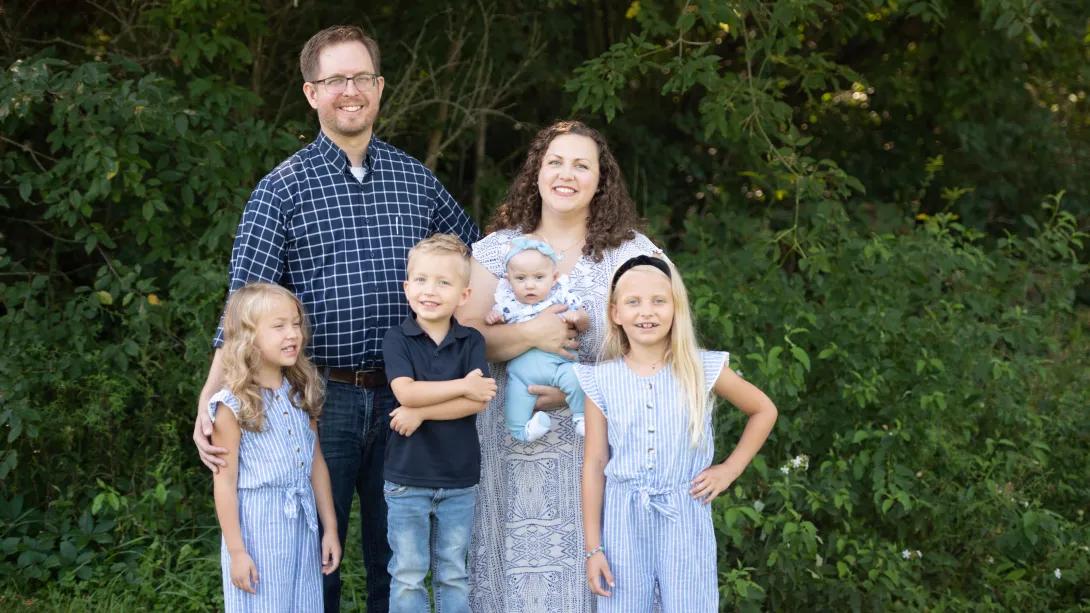
Jenny and Joe Long of Whitmore Lake, Michigan, parents of 1-year-old Carolina Long, nicknamed Lena, said they simply don’t know what they’d do without the Little Victors League and their clinical care coordinator, Kristen Lake-Davison.
“It’s been absolutely invaluable,” Jenny Long said. “We can’t say enough good things.”
Lena is what’s known as a VACTERL baby—an acronym that means she has medical issues in multiple areas. VACTERL stands for:
- V – vertebral defects (for Lena, scoliosis)
- A – anal atresia (luckily, Lena doesn’t have many issues in this area)
- C – cardiac defects (Lena has ventricular septal defect)
- T/E – tracheoesophageal fistula (an abnormal connection of the esophagus to the windpipe, or trachea)
- R – renal anomalies (one of Lena’s kidneys doesn’t function)
- L – limb abnormalities (Lena was born without a tibia and had a lower leg through the knee amputation in January 2023)
Because of this combination of conditions, Lena was born two months early and spent four months in the NICU at Mott. It also meant she qualified for inclusion in the Little Victors League program—which is unique because it marries care coordination in in-patient and outpatient settings and because it starts at birth, said Meera Meerkov, M.D., a neonatologist at Mott and co-medical director of the program.
“For a child to be eligible, at least three of their organ systems need to require additional care outside of general neonatology or pediatrics,” Meerkov said. “That means we expect them to follow up with at least three subspeciality physicians for an extended period of time after discharge from the NICU.”
The Little Victors League team, made up of Meerkov, fellow co-medical director of the program Patricia Keefer, M.D., two clinical care coordinators and a social worker, meet weekly to assess new babies in the NICU and determine eligibility, taking into account social determinants of health and language barriers that could make navigating care more difficult for families. So far, 47 infants have entered the program since its launch in September 2021.
Much of Lena’s time in the NICU was due to the condition tracheoesophageal fistula, a rare, complicated condition where the esophagus and trachea are connected. Lake-Davison said the Longs were amazing advocates for Lena throughout her stay in the NICU. “I was there to be their cheerleader and back them up, and provide emotional support,” she said.
When Lena was finally ready to go home and join her three older siblings, Tessa (8), Vanna (6) and Matt (4), she still required a gastrostomy tube, also known as a G-tube, which is a surgically placed tube that provides direct access to the stomach for feeding. Lake-Davison made sure the feeding tube was at the Long’s house, ready to go, before they arrived home from the hospital. The program has connected the family with home nursing service for Lena, and the program’s social worker connected Jenny with other moms who have children with limb deficiencies like Lena’s.
“It’s helped me know we’re not alone and realize how many people are going through this,” Jenny Long said of her connections with other moms.
‘An extra set of eyes and ears’
Today, Lena requires follow up from a variety of specialties—cardiology, orthopedics, nephrology, and more. Physical medicine and rehabilitation will be added to the rotation as Lena will soon get fitted for a prosthetic.
“When we’re at home and something is happening with Lena, the first person we call is Kristen,” Joe Long said. “She helps us navigate this complex system because sometimes you’re not sure who to call.”
Lake-Davison will even accompany the family to appointments with Lena’s care team and spends time with Lena pre- and post-op when she returns to Mott for surgeries.
“This has been a crash course in medicine for us. When something is over our heads, Kristin is able to say ‘yes, this is normal,’ and she’s an extra set of eyes and ears for Lena in our appointments,” Jenny Long said. “She thinks of questions that I wouldn’t know to ask.”
Jenny said what attracts patient families to University of Michigan Health is the size of the system and breadth of expertise. But sometimes the size can feel overwhelming. The Little Victors League helps it feel a little smaller and closer.
“If we’ve ever been concerned there’s a gap in communication, the Little Victors League has been johnny on the spot,” Joe Long said. “They’re very proactive, asking questions. They have the right connections across Michigan Medicine—if they don’t have an answer, they will find it for us.”
Lake-Davison said this echoes feedback she hears from other families. “We can help families get more efficient care and get needed medications and supplies,” she said. “This helps the parents focus on parenting rather than complex care coordination.”
‘Our little miracle’
Today, Lena is doing well and has hit several milestones. She’s breastfeeding now and doesn’t use a G-tube unless she’s sick or needs medicine.
“She’s passed so many milestones we didn’t know she would get to,” Jenny Long said. “She’s babbling, moving around; she says ‘Dada.’ Now that she’s had her lower leg amputation, we think she’s really going to fly.”
Lena has no known cognitive difficulties. She loves talking to people and playing peekaboo. “Unless something is wrong, she is usually smiling and laughing,” Joe Long said.
Lena still has challenges ahead of her. Her immune system is compromised so colds or the flu can land her back in the hospital on oxygen and an IV. But so far, her parents are thrilled with her progress.
“She’s really our little miracle,” said Jenny Long.
What’s next for the Little Victors League
The foundation behind Chicago’s Little Heroes League is still the primary financial supporter of the Little Victors League. But the program received a grant from the Michigan Health Endowment Foundation to study its efficacy. It’s in the midst of a two-year study that aims to demonstrate that patients who have support through the Little Victors League have better outcomes, such as fewer readmissions and emergency room visits, as well as positive metrics associated with parent wellness and family cohesiveness.
Meerkov said they hope to be able to demonstrate these findings at the end of 2023.
To support the Little Victors League, you can make a donation to Mott Care Coordination Program Fund.

Health Lab
Explore a variety of health care news & stories by visiting the Health Lab home page for more articles.
Media Contact

Public Relations
Department of Communication at Michigan Medicine
Stay Informed
Want top health & research news weekly? Sign up for Health Lab’s newsletters today!
Featured News & Stories

Expanding camp adventure for all
A method to prevent falls before they happen
Giving with gratitude: planned gifts support nursing, research, and patient care

A smarter helmet for the smallest patients
Treating a rare coronary artery aneurysm without open heart surgery