Excelling in kidney training
Nephrologists discuss the importance of a robust nephrology fellowship
5:00 AM
Author |
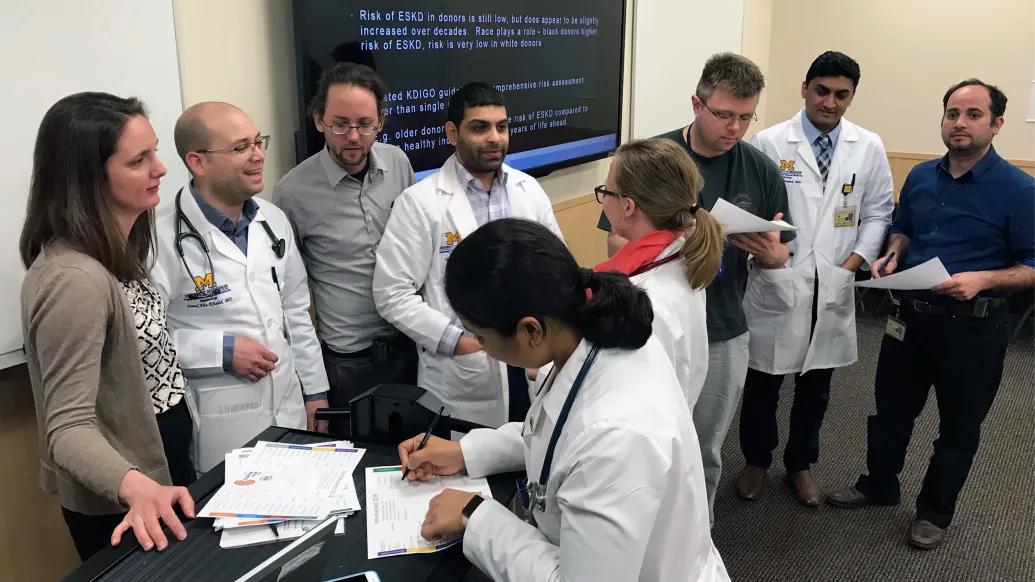
When preparing to become a kidney doctor, it’s critical for residents and fellows in training to be exposed to a broad patient population while under the supervision of a seasoned physician.
The more exposures you get to complicated cases, the better, notes Panduranga Rao, M.D.
And that's considered a priority for the division of nephrology at Michigan Medicine, the University of Michigan’s academic medical center, when structuring their fellowship program.
“We want to ensure trainees get exposure to a variety of specialty clinics,” said Rao, a nephrologist himself and the nephrology fellowship director.
“The field of nephrology is wide. It spans outpatient medicine and inpatient medicine, from the ER to the ICU,” said Laura Mariani, M.D., the associate program director of the nephrology fellowship program.
“We take care of the sickest patients in the hospital and follow people for decades in the outpatient practice. We treat kidney disease from common things like diabetes and high blood pressure, but also ultra rare genetic conditions. As a result, at Michigan, our faculty have a wide range of sub-specializations which benefit our fellows.”
At Michigan, fellows round in all the hospital's specialty clinics, and those specialty clinics run the gamut for kidney care: home dialysis, interventional nephrology, kidney stones, Glomerular disease, onco-nephrology, inherited disease, lupus and transplant care.
With a nephrology fellowship only 24 months long, that type of exposure is essential, notes Pandu.
“It’s crucial that within those years you get exposed to as many complex and rare diseases as possible. Otherwise, when you graduate, you may not be comfortable handling uncommon diseases. Given the opportunity to train in these clinics gets you comfortable with the spectrum of kidney diseases and how to manage and diagnose them."
At U-M specifically, nephrology fellows have the unique opportunity to shadow alongside faculty members within these niche interest areas, like Rao’s kidney-lupus practice.
“To learn from people with a subspecialty focus, like Pandu, who oversees our kidney-lupus team, it’s really unique. That’s what I love most about our specialty clinics,” said Mariani.
“Same on inpatient side. One of the best parts of nephrology here is the breadth of expertise that you gain; we take care of the sickest people on the floor, in all different settings. Michigan’s approach to that is done really well. It’s a real strength.”
Confidently practicing kidney care
Because of all this, past and present fellows feel prepared for the "real world", explains Kunal Bailoor, M.D., a current nephrology fellow.
“Most people who leave here feel very well prepared. For instance, I haven’t heard someone not encountering something they haven’t seen before.”
An example of this is U-M being a national leader in a specific type of dialysis called continuous renal replacement therapy with citrate that’s administered in the intensive care unit and not available at every hospital.
"Some places offer it, but the way that we do it the success rates are great, and we’re hands on as fellows participating in that delivery of care,” said Bailoor.
Mariani says it’s important to them that they support every fellow in excelling at what they want to do, whether that be clinical, administrative or research.
“These fellows develop into these outstanding physicians that then go onto help patients, and we’re proud to see how they’re serving the American population in this important way.”
A fellowship training with a research option
Another important aspect of the fellowship?
The research training year available post-clinics, if you want it.
With the National Institutes of Health having recently restructured the way they federally funded research, U-M became one of the only few in the nation with a specific research training grant for nephrology fellows interested in research careers.
“To become a nephrologist you complete two years of clinical training. If you want to stay and do a research year, our program offers you the chance to do that,” said Mariani.
“This program is for people who want to stay in academic medicine and it also allows them to pursue masters programs across the university or other research training such as working in a lab ,” said Mariani.
“The goal here is to keep them in academic medicine and research, and we’ve been very successful with that, whether that be here, abroad or at other institutions.”
Bailoor is currently completing his research training now, through this third year offered by U-M.
“You get to work with really fantastic people and in specialty clinics with doctors who are truly experts in the field,” Bailoor explained, who’s completing a masters in health and health research through the program.
Creating, and fine-tuning, a top tier fellowship program
The nephrology fellowship training at Michigan Medicine began over 30 years ago.
“There’s been big changes in nephrology over those years in terms of the scope of training and a large emphasis on new things coming down the pipeline,” said Rao.
These were changes Mariani and Rao recognized and knew needed to be fixated on, such as adding another position (growing the spots from 4 to 5.)
The fellowship directors are also very responsive to feedback, Bailoor notes.
“Even over just the course of my fellowship here, we’ve restructured a bit to make the program even better for fellows.”
And Bailoor actually helped put a few new things in place, like a more robust night coverage schedule and additional built-in outpatient clinical time with flexibility.
“Fellowship comes at a challenging phase of life: most people have young families, parents are getting older and we do a really good job supporting men and women trainees; we support them as individuals in caring for our trainees.”
“With Kunal’s help, we introduced a night float program, have people doing more outpatient/research time, making the training more balanced, which is better for development.”
The fellowship is also very diverse, and “that’s something I’m very proud of to share,” said Mariani.
“It reflects our faculty, which is very diverse, and there’s great representation of women and men, people in the U.S., not in the U.S. and beyond,” she noted.
“It’s reflective of the population were trying to serve and I’m really proud of that.”
Learn more about Michigan Medicine's nephrology fellowship program.
Sign up for Health Lab newsletters today. Get medical tips from top experts and learn about new scientific discoveries every week.
Sign up for the Health Lab Podcast. Add us wherever you listen to your favorite shows.

Health Lab
Explore a variety of health care news & stories by visiting the Health Lab home page for more articles.
Media Contact

Public Relations
Department of Communication at Michigan Medicine
In This Story

Laura Heyns Mariani, MD, MSCE
Associate Professor
Stay Informed
Want top health & research news weekly? Sign up for Health Lab’s newsletters today!
Featured News & Stories

Sanjay Gupta recounts his U-M years and shares life lessons for medical school commencement
Getting to know the new Medical School dean, Thomas J. Wang, MD

Kidney transplant recipient celebrates 10 year anniversary at Transplant Games
New prostate biopsy technique shows potential future of MRI

An online intervention can help cancer patients share genetic testing results with family