Egg freezing: What women should know about fertility preservation
Experts answer common questions about egg freezing, from timing and success rates to risks and misconceptions
2:09 PM
Author |

As Representative Alexandria Ocasio-Cortez publicly shares her experience with egg freezing, the conversation around fertility preservation is becoming more visible.
For women considering delaying childbearing for personal, health, or career reasons, egg freezing can provide another option for the future – but experts emphasize that it is not a guarantee of having a child.
Natalie Stentz, M.D., M.S.C.E., Clinical Assistant Professor of Reproductive Endocrinology and Infertility and medical director of the Center for Reproductive Medicine at Michigan Medicine, and Hanh N. Cottrell, M.D., Clinical Assistant Professor of Reproductive Endocrinology and Infertility at Michigan Medicine, discuss what women should know about the process, timing, success rates and limitations of egg freezing.
Why do people freeze their eggs?
Cottrell: Egg freezing can empower women by giving them more control over the biological clock and an opportunity to preserve their eggs for future use.
Women may consider egg freezing because they are delaying childbearing or delaying building their families for health, personal or career reasons.
It can be a great option as long as women are educated about the potential benefits and risks and can make an informed decision.
What is the best age to freeze your eggs?
Stentz: In general, for most women, egg number and egg quality stay about the same until about age 35.
Most physicians would say that the earlier you freeze your eggs, the better, although it is not an option or the right choice for every person.
Between ages 35 and 37, you start to see a more progressive decline in egg quality. Between 37 and 39, that decline becomes more significant, with a substantial decline in egg number and quality between approximately 39 and 42.
To optimize outcomes with egg freezing, thinking about the decision in your early 30s, or even your 20s if it is an option, can be beneficial.
How do you freeze your eggs?
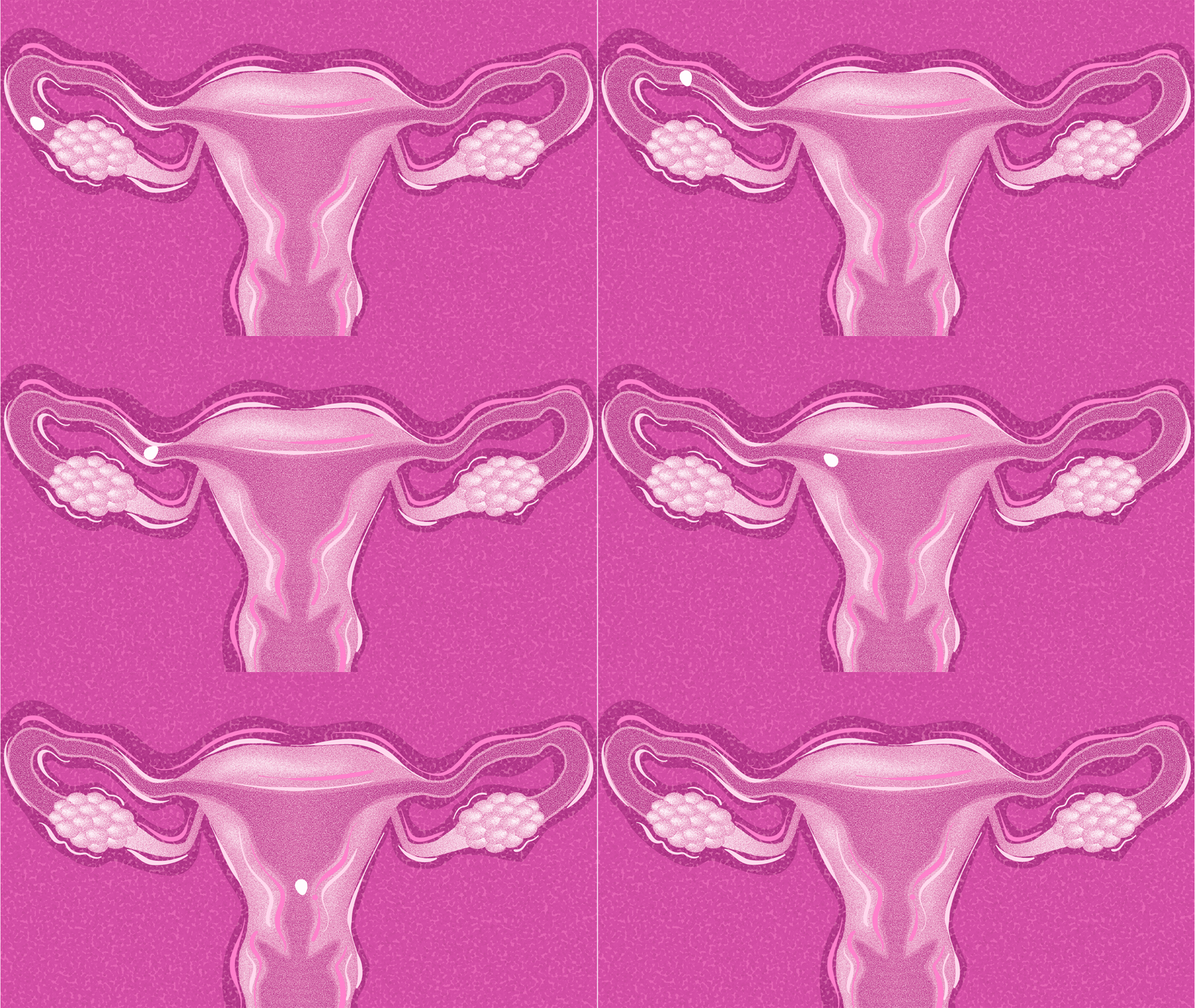
Stentz: The process is essentially the first half of an in vitro fertilization cycle, also known as IVF.
Typically, over about nine to 14 days, a woman takes daily injectable hormone medications.
The goal is to get the ovaries to develop as many follicles, or egg sacs, as possible.
The process culminates in a trigger shot, which starts the ovulation process.
About 36 hours later, the patient undergoes an egg retrieval.
This is a minor outpatient surgical procedure that lasts about 10 to 15 minutes and is performed under anesthesia.
On the day of the retrieval, patients will know how many eggs were retrieved.
Later that day, the eggs are evaluated to determine how many are mature, meaning they are suitable for freezing.
Those mature eggs are then frozen and can remain frozen in high quality essentially indefinitely.
What happens when you’re ready to use your frozen eggs?
Stentz: When a woman comes back to use her eggs, the eggs are thawed and injected with sperm to create embryos.
From there, the process continues into the second part of IVF.
What are the realistic chances of having a baby from frozen eggs?
Cottrell: Eggs are very delicate cells, but our techniques for freezing eggs have greatly advanced.
A technique called vitrification has really transformed the world of egg freezing.
In a solid assisted reproductive technology center, generally 80% or more of eggs survive the thawing process.
But the question of overall success is more complicated. Age is one of the key predictors.
We consider the chances of the eggs surviving thaw, fertilizing with sperm, becoming embryos, and ultimately resulting in a pregnancy.
There are many layers to success, which is why we encourage patients to meet with a reproductive endocrinology and infertility specialist to discuss their individual history and circumstances.
Stentz: Two factors that play into success are the age a woman is when she freezes her eggs and the number of eggs that are frozen.
Being 35 or younger is generally better than being 38 or 40, for example. Number and quality also go together.
A woman who is 30 and freezes 20 eggs may have about a 60% to 70% chance of a live birth.
A 38-year-old woman may want to freeze 30 or more eggs to achieve similar success rates, and it may take more than one egg-freezing cycle to reach that goal.
That’s why there is nuance when we talk about success and why, in general, proceeding at the earliest reasonable age can be helpful.
What are the risks and downsides of egg-freezing?
Stentz: The biggest risk is that egg freezing isn’t a guarantee. A lot of people would love to say that egg freezing is an insurance plan, but it’s not.
Not every egg will survive the freeze-thaw process, not every egg will fertilize, and it is possible not to have a usable embryo at the end of the process.
That said, it is currently the best option we have for fertility preservation.
The other risks are similar to those associated with IVF.
The risk of something serious happening is less than about 1 in 100.
Risks can include bleeding, infection, damage to organs near the ovaries, blood clots and ovarian hyperstimulation syndrome.
What's the biggest misconception about egg freezing that you wish more people understood?
Cottrell: It’s important for patients to have the right expectations and education.
Freezing eggs does not accelerate or shorten someone's reproductive potential, and it does not increase the timeline to menopause.
Eggs will be lost regardless.
Patients are often nervous that if they save, hypothetically, 10 eggs, they will go through menopause sooner. They will not.
There are also a lot of myths that if you freeze your eggs, you are guaranteed the family you want.
Egg freezing gives an individual more options to potentially help build a family later in life if they wish.
It's not a foolproof insurance plan.
Stentz: We do not decrease someone's ovarian reserve by freezing eggs; we take advantage of eggs that otherwise would have gone unused.
There's also nothing we can test at the time of egg freezing that will tell someone whether or when they will be ready to build a family or whether they will ultimately need their frozen eggs.
We cannot predict whether someone will struggle with infertility in the future.
What we do know is that, in general, rates of infertility rise as a person and their eggs age.
If someone does need more advanced technology to build their family in the future, having younger eggs available can provide another option.
How long can eggs safely remain frozen?
Stentz: Currently, eggs can remain frozen essentially indefinitely. They remain high quality over a period of many years.
There are still considerations about when someone ultimately uses their frozen eggs.
The American Society for Reproductive Medicine currently recommends that a woman have her final embryo transfer before her 55th birthday, so decisions about using frozen eggs eventually need to be made.
How should you decide between egg freezing and embryo freezing?
Cottrell: There are a multitude of factors.
One consideration is whether someone has a partner with sperm.
From a personal perspective, I think of egg freezing as investing in oneself, whereas freezing embryos with a partner as investing in that relationship.
From a medical standpoint, egg and embryo freezing are relatively comparable in terms of success.
The difference is that with embryo freezing, you have more information about how many eggs actually fertilized and became embryos.
You may also have information about whether embryos are genetically normal, which can provide more insight into potential outcomes.
Stentz: The benefit of freezing embryos is that you have more information about your ultimate outcome — how many eggs fertilized, became embryos and potentially became genetically normal embryos.
That can give you more precision regarding expected outcomes.
However, some people have concerns about freezing embryos, and for those individuals, depending on their preferences and potentially where they live, freezing eggs on their own can make sense.
What does AOC’s decision to talk publicly about egg freezing mean for the conversation around reproductive health?
Stentz: I give her so much credit for sharing her journey because it is going to do so much to bring this conversation to the front lines.
It can support women in considering egg freezing and hopefully bring more attention to benefits and insurance coverage for fertility preservation.
It's a brave thing to discuss publicly and an important thing to discuss.
Cottrell: AOC’s announcment helps normalize the conversation about reproductive health in general for both men and women.
Age tends to affect women sooner, so having that conversation sooner is important.
Sign up for Health Lab newsletters today. Get medical tips from top experts and learn about new scientific discoveries every week.
Sign up for the Health Lab Podcast. Add us wherever you listen to your favorite shows.

Health Lab
Explore thousands of health news & research stories by visiting the Health Lab homepage for more.
Media Contact

Public Relations
Department of Communication at Michigan Medicine
In This Story

Natalie Clark Stentz MD, MSCE, FACOG
Clinical Assistant Professor
Stay Informed
Want top health & research news weekly? Sign up for Health Lab’s newsletters today!
Featured News & Stories

How donor eggs helped one couple build the family they always hoped for
What causes infertility? A doctor answers common questions and clears up misconceptions
Better prenatal care data could help prevent maternal complications, experts say

Is the United States Lagging Behind Europe in Memory Improvement?

PMOS is the New PCOS