ECT’s Uncertain Future
The FDA is taking public comment on a proposed new classification for electroconvulsive therapy (ECT) equipment. Get insight from an expert on what the changes mean.
8:00 AM
Author |
For decades, people with severe depression, bipolar disorder and other major mental health conditions have benefited from electroconvulsive therapy (ECT), when nothing else helped them.
Thousands of studies have shown ECT's power to ease devastating, even life-threatening symptoms.
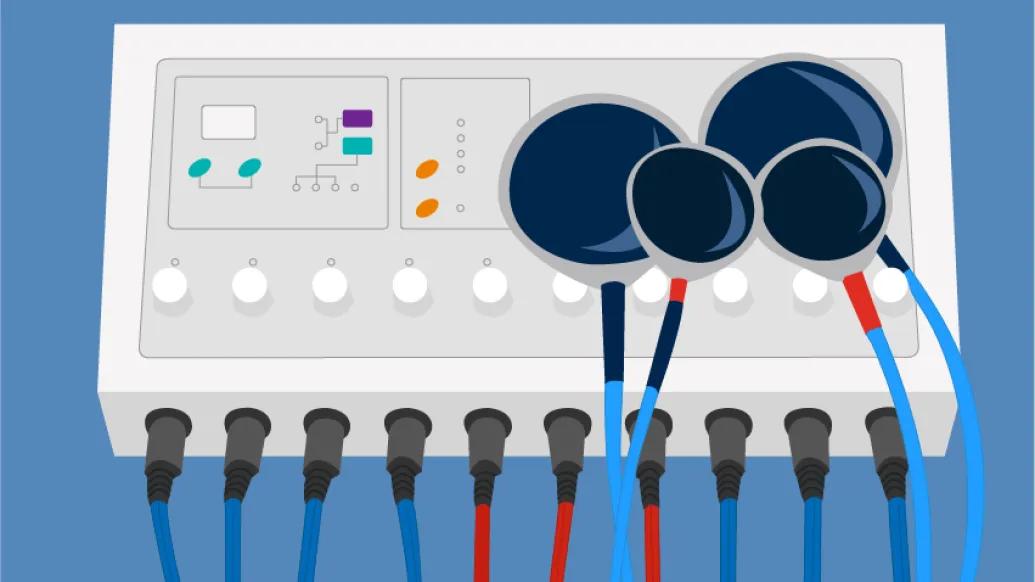
Now, the U.S. Food and Drug Administration has proposed to change the way it regulates the devices that doctors use to deliver ECT treatment.
In some ways, the change could help make the treatment more accessible to people with certain conditions. But in other ways, a top ECT doctor says, the change could put the treatment out of reach for many other patients — including some who have few other options.
The FDA is accepting public comments on the proposed change until March 28, and will take them into account when writing its final decision about the devices.
Anyone who has undergone ECT, or seen a loved one experience its effects, can comment online. So can people who work in mental health care.
But first, a bit more information, from Daniel Maixner, M.D., who directs the University of Michigan Health System's ECT program and treats hundreds of patients with ECT each year.
What's the current state of ECT?
The name "electroconvulsive therapy" may conjure up old movie scenes of psychiatric patients undergoing "shock therapy." But in its modern form, with today's equipment and experienced treatment teams, it's a lot less off-putting.
Basically, ECT induces brief seizures that have numerous biological effects, but in simple terms may "reset" electrical activity between nerve cells in areas of the brain related to crushing depression, uncontrolled mania, deeply disturbed thoughts or catatonic states.
Doctors at U-M and other centers continue to refine ECT's use. A U-M team recently published an analysis of results from 32 studies, which reveals key factors that might help doctors better target ECT to those who can benefit the most.
What change is FDA proposing?
For safety, the FDA regulates ECT equipment under the agency's medical devices authority.
The new proposal would take ECT devices out of a category of equipment (called Class III), which the equipment was "grandfathered" into decades ago, and shift them alongside other devices in a lower-level category called Class II.
The National Network of Depression Centers and other organizations have supported the move. Several years ago the NNDC issued a formal statement in support of the move to Class II. Maixner was a co-author of that statement.
If ECT gear stays in Class III, equipment manufacturers would need to carry out large, expensive clinical studies as if the technology were completely new. That might keep manufacturers from innovating or even put them out of business.
And according to the NNDC, it's doubtful that university hospitals, where such studies would most likely take place, would agree to test ECT against a "sham" or fake form of the technology. It wouldn't be ethical to let people with severe mental health conditions be randomly assigned to a placebo when there's so much evidence that ECT works.
If ECT equipment moves to Class II, there will still be safety oversight from the FDA, including limits on who can provide the treatment, registration of machines and labeling about safe use.
But it's how the FDA proposes to move ECT equipment into Class II that has experts such as Maixner, and mental health advocates, worried.
What does the proposal say?
In short, the FDA is proposing to put ECT equipment into Class II only for people over age 18 who have a severe depressive episode related to major depression disorder and bipolar disorder.
That covers a large portion of the people who receive ECT today, and whose insurance covers it. But it leaves out many others. And if the FDA's final decision doesn't include the conditions the patients have, their insurance companies may have an excuse to stop covering ECT treatment.
"We worry that insurance companies that authorize payment may not approve it for other indications, where there is good evidence for its use — essentially making all other uses off-label," says Maixner.
We worry that insurance companies that authorize payment may not approve it for other indications, where there is good evidence for its use — essentially making all other uses off-label.Daniel Maixner, M.D.
Who's left out?
Maixner lists a few examples:
-
Teens and tweens — For families searching for alternatives because their child's mental health condition hasn't responded to other treatments, ECT can be a lifeline. Families travel hundreds of miles to U-M and other major centers that offer ECT to people under age 18 to get treatment for kids and teens who have exhausted all other options.
-
People who need repeated ECT — For many people who receive ECT, a single course of treatments can give results that last months or even years. But some patients require a longer, tapered course of treatment in a "maintenance" mode to keep their symptoms at bay.
-
People with many other conditions — ECT has been shown to help people experiencing intense mania due to bipolar disorder or other conditions, and people experiencing psychosis or schizophrenia. But they're left out of the current proposed FDA reclassification. So are people in catatonic states due to their mood disorder or psychosis-causing condition, and for them ECT can be the only thing that "brings them back." Also left out: people with severe autism, of any age, for whom ECT can quell self-injury behaviors.
"If you look across the thousands of research citations on ECT, you see that numerous studies have been done in adults, and in children and adolescents, that provide evidence of usefulness in all these patient populations," says Maixner. "We're concerned that the FDA may not fully consider these results."
He points to a 2013 book co-edited by his U-M colleague Neera Ghaziuddin, M.D., and published by Oxford University Press, on ECT in children and adolescents. The first of its kind, it provides guidance on the use of the modern ECT technique in a subgroup of young people with severe psychiatric disorders.
What's more, Maixner says, if the FDA goes ahead with the narrow definition of ECT's treatment use, it will be extremely hard to get the definition expanded later to include these groups.
What might the changes mean?
Insurers don't have to follow the FDA classification when deciding what to pay for, but it's often used as a guide. Any change in a device's classification gives insurers a reason to look again at what they will and won't cover.
If an insurer, for example, doesn't normally cover a treatment for patients of a certain type, but a particular patient's doctor feels it could benefit that individual, the doctor can apply for a waiver to get coverage.
So moving ECT to Class II, with the current proposed limits on whom it's recommended for, could open up a can of worms for patients and doctors alike.
Before that can opens, though, the public has a chance to share their thoughts — until March 28.

Health Lab
Explore a variety of health care news & stories by visiting the Health Lab home page for more articles.
Media Contact

Public Relations
Department of Communication at Michigan Medicine
Stay Informed
Want top health & research news weekly? Sign up for Health Lab’s newsletters today!
Featured News & Stories

LGBTQ+ Aging in America

The Power of Mattering

What is looksmaxxing?

LGBTQ+ people over 50 face more aging-related challenges
AI chatbots spark mental health concerns, including psychosis risk