E-Bikes are everywhere, but most parents say they don’t know enough about them
National report suggests parents see both benefits and risks for teens while calling for helmets, clearer riding rules and age guidance rather than a ban
5:00 AM
Author |
Electric bikes have become a familiar sight in communities across the country, but most parents say they know little about them or where they’re supposed to be used, a national poll suggests.
Just 6% of parents say they’re very knowledgeable about the different types of e-bikes, while about two-thirds say they’re not informed about them, according to the University of Michigan Health C.S. Mott Children’s Hospital National Poll on Children’s Health.
Nearly half of parents also say they do not know where e-bikes are supposed to be ridden.
At the same time, parents are not calling for e-bikes to disappear, with just one in 10 strongly supporting a complete ban.
Instead, parents polled overwhelmingly favor practical steps aimed at making e-bike use safer, including helmet requirements, clearer labeling of e-bike types, better markings showing where e-bikes should be used, age restrictions for the most powerful models and safety training.
“Parents aren’t saying, ‘get rid of e-bikes.’ They’re saying, ‘Help us figure out how to use them safely,’” said Sarah Clark, M.P.H., Co-Director of the Mott Poll.
“E-bikes have arrived faster than the public guidance around them, and parents are being asked to make safety decisions without having the information they need.”
The nationally representative poll includes responses from 1,234 parents with at least one child ages 11 to 18 and was conducted in July.
E-bikes a familiar sight
More than half of parents say they see e-bikes often in their community, while just under a third see them occasionally.
A third of parents say someone in their family has used an e-bike, including one in five who report that a teen has ridden one and 8% who say a pre-teen has used one.
Parents polled see the benefits to e-bikes, with half saying they can provide transportation when a car is not available, while a little under half see them as a source of fun and 45% say they can help get children outside and active.
More than one-third also say e-bikes can give teens greater freedom in where they go.
Still, safety concerns are widespread.
Eighty-two percent of parents identify the risk of injury to the rider as a downside, while 62% are concerned about injuries to pedestrians.
More than half worry about drivers who are not accustomed to seeing e-bikes on the road.
Some risks are related to e-bikes themselves, Clark notes: the ability to travel faster means that riders have less time to react to hazards such as a turning car or a pedestrian stepping out into the road.
Parents aren’t saying, ‘get rid of e-bikes.’ They’re saying, ‘Help us figure out how to use them safely. E-bikes have arrived faster than the public guidance around them, and parents are being asked to make safety decisions without having the information they need."
-Sarah Clark, M.P.H.
Other risks are related to choices that e-bike riders, or their parents, make, such as using an e-bike that is too heavy or tall for the rider, or not wearing a helmet. Unsafe riding practices, such as weaving in and out of traffic or riding too close to pedestrians, also pose risks.
“E-bikes offer families a new way to get around, but they also introduce safety considerations that parents, riders and communities need to understand,” Clark said.
“Knowing the rules of the road, choosing an e-bike that’s appropriate for the rider and using basic safety precautions can go a long way toward reducing the risk of injury.”
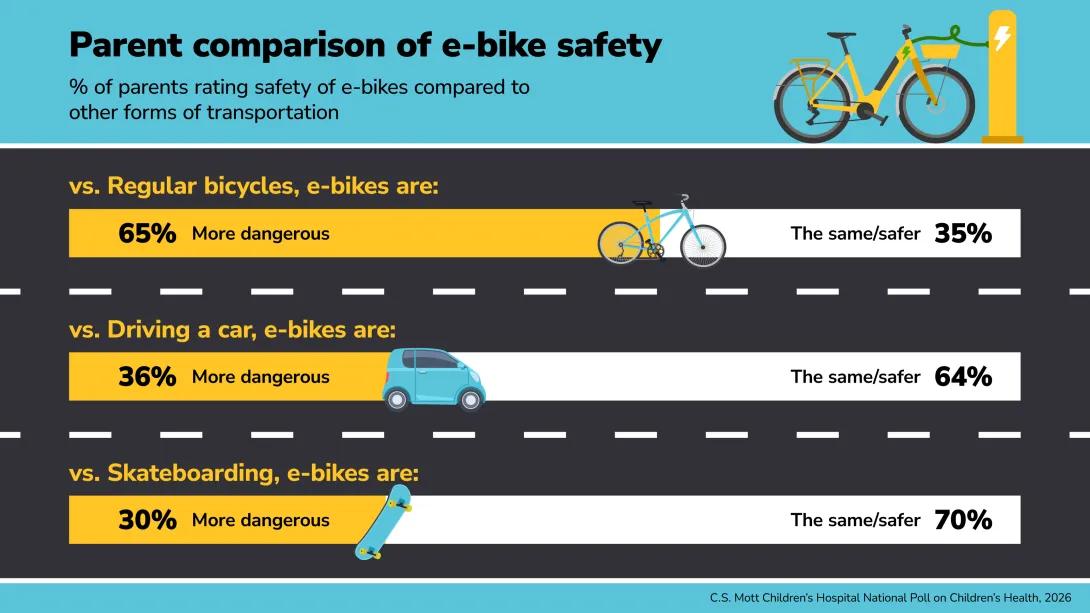
Parents also perceive e-bikes as carrying more risk than traditional bicycles, with 65% saying they’re more dangerous for a typical teen.
But the comparison looks different when parents consider other common activities.
Most parents rate e-bikes as about as safe or safer than teens driving a car, skateboarding or riding an ATV or other off-road vehicle.
“Our poll suggests that parents don’t view e-bikes as uniquely dangerous but as another activity where safety depends in part on how and where they’re used,” Clark said.
“Parents show strong support for policies and regulations that could lead to safer and more appropriate use of e-bikes and approaches that give families practical guidance about the risks and how to help kids and teens ride safely.”
Sign up for Health Lab newsletters today. Get medical tips from top experts and learn about new scientific discoveries every week.
Sign up for the Health Lab Podcast. Add us wherever you listen to your favorite shows.

Health Lab
Explore thousands of health news & research stories by visiting the Health Lab homepage for more.
Media Contact

Public Relations
Department of Communication at Michigan Medicine
In This Story

Sarah J Clark
Research Scientist
Stay Informed
Want top health & research news weekly? Sign up for Health Lab’s newsletters today!
Featured News & Stories

U-M-led consortium to receive up to $52 million in NIH funding to study why viral respiratory infections affect children differently
4 in 5 parents say having a baby is too expensive

What’s the latest on 7-OH and kratom availability and addiction care?

Emergency room intervention pairs smartphone, telehealth counseling to reduce risky firearm behavior

Better prenatal care data could help prevent maternal complications, experts say