Despite Health and Learning Benefits, Half of Parents Against Later School Start Times
The early morning starts of most high schools work against teens’ natural sleep patterns. Experts say change is needed.
7:00 AM
Author |

Leading pediatrics and sleep associations agree: Teens shouldn't start school so early.
Yet University of Michigan research finds parents are split almost down the middle on whether they support delays in school start times that might permit their 13- to 17-year-olds to sleep later on school days.
The results come from a nationally representative survey through the U-M C.S. Mott Children's Hospital Poll on Children's Health. In it, 554 parents whose teens all start school before 8:30 a.m. shared opinions on how much sleep their children need and whether later school start times are a good idea. The study was published in the Journal of Clinical Sleep Medicine, the journal of the American Academy of Sleep Medicine.
"We found that parents underestimated how much sleep their children needed, and only about half agreed with existing recommendations that school start times should be later," says lead researcher Galit Dunietz, Ph.D., MPH, a postdoctoral research fellow in neurology at Michigan Medicine.
School start time recommendations issued by the American Academy of Sleep Medicine and the American Academy of Pediatrics take into account teens' natural circadian rhythms. Teens often have a daily inner clock that runs longer than 24 hours.
This makes it difficult for them to go to sleep when the rest of the family does. And they often find it challenging to get up early and be on time for a school day that starts before 8:30 a.m.
"Many teens would do fine if they could go to bed late and sleep late in the morning," says senior study author and neurologist Ronald Chervin, M.D., M.S., director of the U-M Sleep Disorders Center. "But they can be late to school or become chronically sleep-deprived when classes start early every weekday."
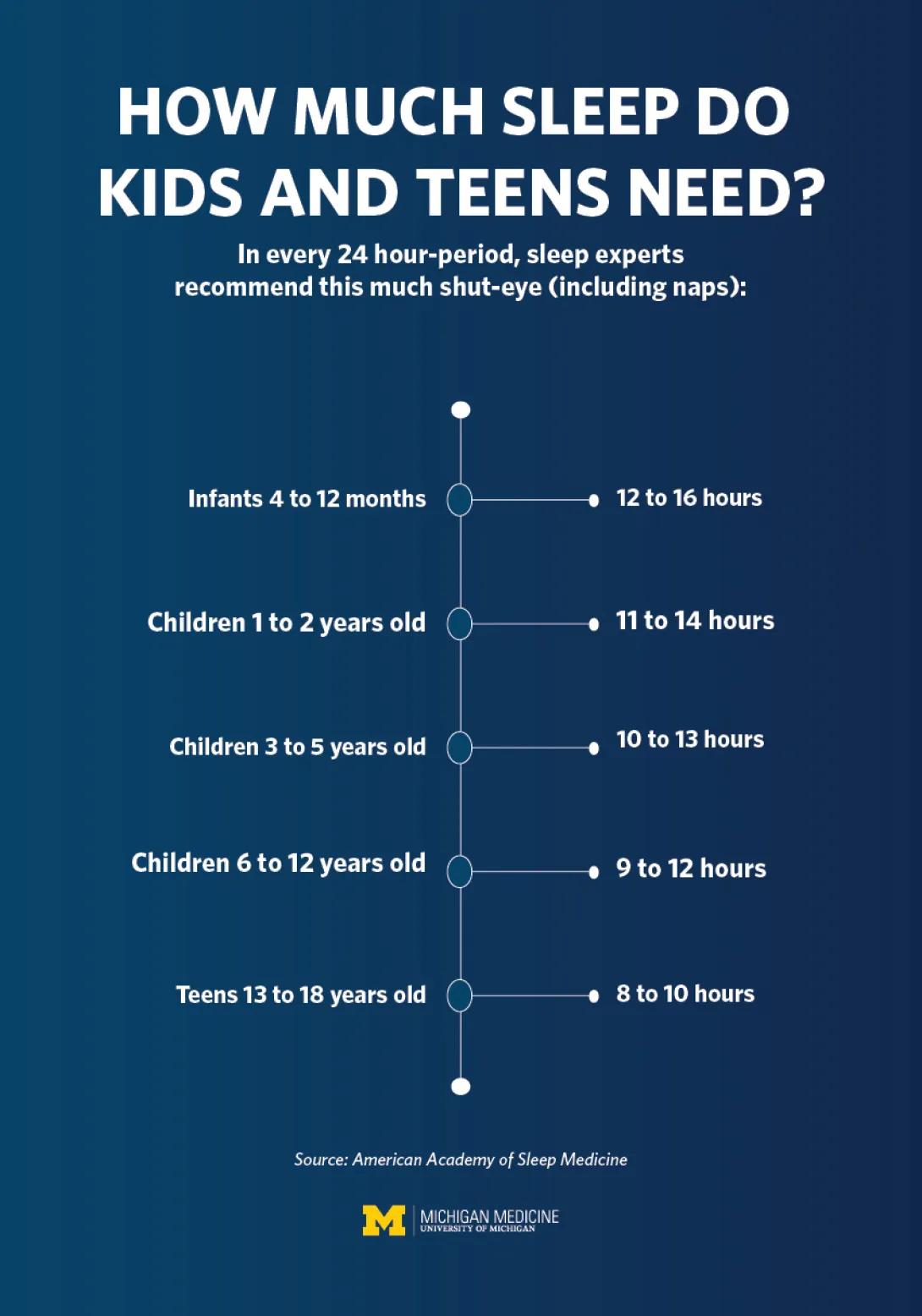
How much sleep teens need
Although surveyed parents thought their middle and high schoolers could function properly on seven hours or less of sleep, teens need much more.
SEE ALSO: School Bedtime Tips Every Parent Should Know
The American Academy of Sleep Medicine recommends teens ages 13 to 18 sleep eight to 10 hours every night. The National Sleep Foundation also recommends eight to 10 hours for most 14- to 17-year-olds.
"If their bodies don't tell them they're tired until 11 p.m. or later and then they have to be at school before 7:30 a.m., many of these teens experience a chronic sleep debt," says Dunietz, also with the U-M Sleep Disorders Center.
And the effects of chronic sleep debt reach far beyond feeling tired in the classroom (though that's also a problem).
A lack of zzz's can result in decreased brainpower — a major issue for high schoolers driving early in the morning — as well as an increased chance of mood disorders (such as depression), obesity and risky behaviors, Dunietz says.
A 50-50 split
In the study, 51 percent of parents supported later school start times.
Among those opposing the shift, Dunietz says, many had logistical concerns with later school starts. Respondents cited transportation issues, as well as worries about fitting in after-school activities and adjusting meal times.
But schools that have pushed back start times report negligible — if any — negative effects, she says.
Parents who thought more sleep would benefit their children's health or academic performance were more likely to support the switch.
Real results
To find support for school start times of 8:30 a.m. or later, Dunietz says to look no further than schools that have made the change. It hasn't happened in a majority of districts, but teens who do have later school start times are sleeping longer and are more alert during the day. Later school start times are reported to have had a positive effect on athletic performance, even when practice times are shorter to accommodate the later end of the school day.
SEE ALSO: When and Why a Teen Should Start Seeing a Gynecologist
"There's evidence that it's a win-win for everyone," she says. "We cannot change teens' biology to have them sleep earlier, so we should push the school start times back, in line with recommendations from the American Academy of Sleep Medicine and the American Academy of Pediatrics."

Health Lab
Explore thousands of health news & research stories by visiting the Health Lab homepage for more.
Media Contact

Public Relations
Department of Communication at Michigan Medicine
Stay Informed
Want top health & research news weekly? Sign up for Health Lab’s newsletters today!
Featured News & Stories

Many hospitals still don’t do enough to prevent UTIs from catheters

C.S. Mott Children’s Hospital named No.1 children’s hospital in Michigan by U.S. News & World Report

Rheumatologist finds contentment and community through family farm
Treating obstructive sleep apnea in children with Down syndrome

University of Michigan Health named Michigan’s top hospital, earns spot on U.S. News honor roll