The dangerous intestinal disease fatal to premature babies and vulnerable infants
A pediatric surgeon answers questions about necrotizing enterocolitis—a dangerous intestinal disease that primarily affects premature and vulnerable infants
4:02 PM
Author |
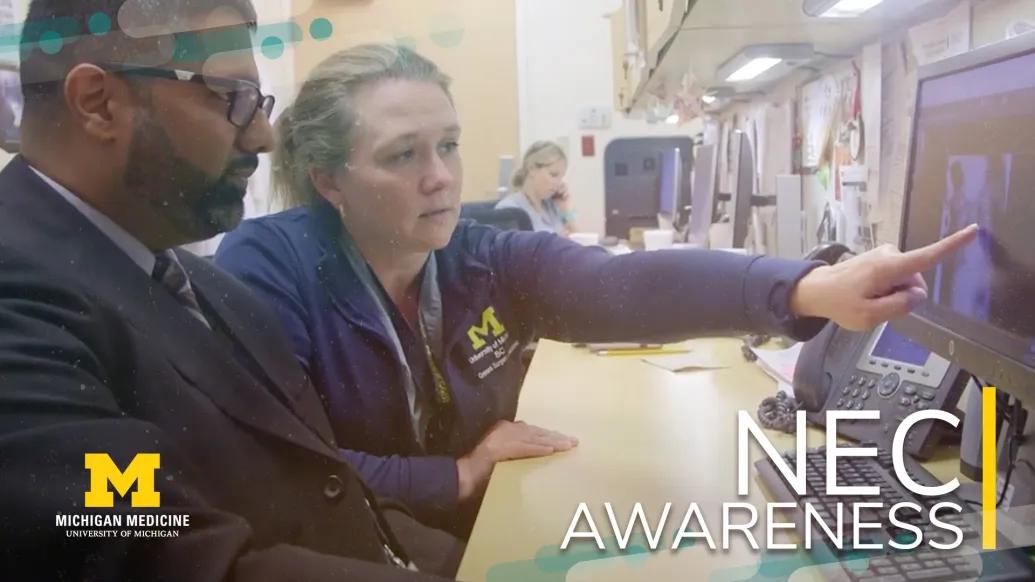
A dangerous intestinal disease is the leading cause of infant mortality but many families – and some health care providers – have never heard of it.
What’s known as necrotizing enterocolitis, or NEC, causes an inflammatory process that can lead to intestinal tissue damage and affects more than 3,500 babies a year.
“This is a really common disease with high morbidity and mortality, meaning a lot of people tend to die as well as develop lifelong consequences,” said Samir Gadepalli M.D., a pediatric surgeon at University of Michigan Health C.S. Mott Children’s Hospital.
The Newborn Intensive Care Unit at Mott sees about 20-25 babies with the condition every year, says Gadepalli, who leads research on the disease and advocates for awareness as a board member for the Necrotizing Enterocolitis Society.
“These babies will be in the intensive care unit for a long period of time trying to recover from it,” he said.
“There probably isn’t a day that you couldn’t walk in the neonatal ICU and see a baby diagnosed with this condition.”
Here he explains more about the condition and what researchers are working to better understand.
What causes necrotizing enterocolitis?
Much about NEC still remains unknown, including its exact cause.
“The thought behind it is that it’s related to the body’s reaction to having feeds,” Gadepalli said.
“Most commonly, it’s with formula feeds, but it can happen with breast milk and donor milk. We don’t know the exact reason, but we do have some pathways that are being researched that are looking at the body’s response.”
The disease is common among premature babies and twins, he says, but there isn’t enough research to determine what factors contribute to this.
How can necrotizing enterocolitis be treated?
Treatments for NEC include antibiotics and surgical intervention, but neither guarantees a full recovery.
Gadepalli explains that there’s currently no targeted therapy available to treat NEC, and that antibiotics don’t only affect the part of the body affected by the disease.
Surgical options involve placing a drain to empty fluid that’s accumulated, or to perform a laparotomy to identify the affected portions of the intestine and remove them.
I’m focused on advocacy. Right now, there’s so much unknown about it.”
Samir Gadepalli M.D.
“The problem is that neither of these options really seem to make a huge difference because the damage has been done,” Gadepalli said.
“The surgery is not a cure.”
Around a third of babies who require surgery for necrotizing enterocolitis die from the disease.
Those that do survive are often left with complications that can be lifelong, he says.
What type of complications arise from necrotizing enterocolitis?
Gadepalli says it’s common for a baby to need IV nutrition after experiencing NEC.
Data has shown that brain function is also impacted, he says, which can affect the child’s development.
Some babies affected by NEC may become septic, which can cause organs, like the lungs and kidneys, to become infected as well.
Mental health can also be affected.
“Many families are blindsided by the diagnosis, due to the lack of public awareness of the disease,” Gadepalli said.
“When a baby is born premature, there’s usually other developmental concerns that take precedence in discussions.”
What’s being done to better treat necrotizing enterocolitis?
Although there’s a lack of knowledge from the general public, the prevalence of NEC is much more common than most would believe, Gadepalli notes.
The focus now amongst the medical community is creating awareness and raising funds for research so that they can better understand what causes NEC as well as developing targeted treatments.
“I’m focused on advocacy, because if I can create awareness and funding, then we can actually have the resources to study the disease,” Gadepalli said.
“Right now, there’s so much unknown about it.”
Gadepalli was the lead author of a research paper in 2020 that highlighted the significant research gaps that can be addressed with adequate funding from the federal government on the prevention and treatment of NEC.
Other research he has been a part of regarding NEC includes ventriculoarterial ventriculoperitoneal shunt malfunction and infection in infants with NEC and parental experiences with necrotizing enterocolitis.

Health Lab
Explore thousands of health news & research stories by visiting the Health Lab homepage for more.
Media Contact

Public Relations
Department of Communication at Michigan Medicine
Stay Informed
Want top health & research news weekly? Sign up for Health Lab’s newsletters today!
Featured News & Stories

Comparing life threatening illness risk between two surgeries for infants with congenital heart disease

More teens are using AI: What parents should know

School night bedtime tips every parent should know

Helping kids with ADHD thrive in school

5 ways to prepare your child for kindergarten