Dangerous Falls in Middle Age: What’s Sight Got to Do with It?
Falls among middle-aged people are an underreported issue, U-M researchers say. Now, they’re probing the connection between falling and poor vision as a way to prevent injury.
1:00 PM
Author |
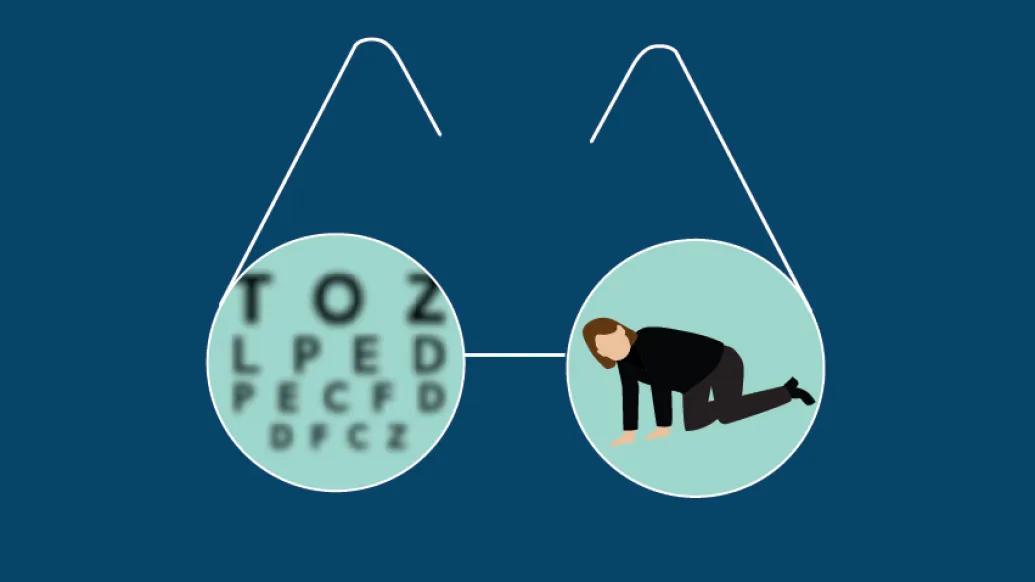
Falls are a major public health issue because of the burden and costs of helping people recover.
But, despite the preconceived notion, researchers at the University of Michigan contend that the problem of falling is not unique to older adults.
MORE FROM THE LAB: Subscribe to our weekly newsletter
"Do we hit the magic number of 65 years old and suddenly become at risk for falls, whereas we are somehow immune before that?" asks Carrie Karvonen-Gutierrez, Ph.D., MPH, an assistant professor at the U-M School of Public Health.
"Certainly not."
In fact, one study found that in the past year, about 1 in 10 adults in their 40s and 50s had a serious fall — reflecting the estimates among the frail, older adults most often considered at risk for falling at home or in public.
Consider the case described by Karvonen-Gutierrez. "My middle-aged colleague fell down a flight of stairs, fractured her femur and took more than a year to fully recover. Now arthritic symptoms force her to walk differently than she did before the fall," she says.
The anecdote points to the bigger story: Not only is there significant burden of falls among middle-aged men and women, but also falling in this life stage might have long-term consequences on health and functioning.
One in 5 women reported falling in just the last six months. If women had vision impairment or contrast sensitivity impairment, their likelihood of falls increased by 40 percent.
Vision as a contributing cause
One possible step toward reducing falls in midlife is to address vision problems, researchers say.
Sight-stealing diseases such as diabetic retinopathy, glaucoma and age-related macular degeneration may not have manifested by midlife, but middle-aged adults can struggle with distance vision, reading fine print and driving at night.
SEE ALSO: Evolving Macular Degeneration Treatment Guidelines for Ophthalmologists
A 62-year-old patient of U-M Kellogg Eye Center ophthalmologist Sayoko Moroi, M.D., for example, came to an appointment with her face covered in bruises. The patient had fallen after tripping over her dog. She needed new eyeglasses.
With the personal and professional experiences in mind, U-M researchers set out to determine the relationship between vision, physical functioning and falls in middle age.
First, to determine the incidence of vision problems in middle age, U-M epidemiology expert and professor of obstetrics and gynecology Sioban D. Harlow, Ph.D., tapped data from the population-based Michigan SWAN study (Study of Women's Health Across the Nation) she leads.
For more than two decades, SWAN has collected information from a group of 543 midlife women about their visual acuity, physical functioning, menopausal status and hormone levels.
When it comes to vision, the data show:
- 19 percent of women ages 42-52 have distance vision impairment, meaning they can't see clearly while driving
- 40 percent of this age group has near vision impairment, which is an inability to read small print
"This level of burden clearly caught our attention and prompted us to consider how these two conditions, vision impairment and falls, both underappreciated in importance for midlife populations, may be related," says Suja Kumar, MBBS, MPH, who worked with Harlow and Karvonen-Gutierrez during her master's degree work and is now a postdoctoral fellow at U-M.
Evolving methods
As an ophthalmologist trained in India, Kumar was up to the task of connecting vision health and epidemiology.
In 2015, the collaboration among Karvonen-Gutierrez, Moroi and Harlow, and others was rewarded by U-M's MCubed, a $30 million research funding program that incentivizes experts from different fields to work together to solve science and health challenges alongside U-M students.
With MCubed support, the vision impairment team was able to transition from vision screening similar to tests given by the Department of Motor Vehicles to more closely study the SWAN study participants' vision through detailed clinical eye exams and testing.
Researchers performed tests and procedures to assess for need for glasses, dry eye, cataract, glaucoma, diabetic eye disease, hypertensive eye disease, age-related macular degeneration and other eye conditions.
"One surprising result in our data was that two-thirds of women had contrast sensitivity impairment, which is impairment in their ability to see shades of gray," says Karvonen-Gutierrez. "This type of impairment is associated with difficulty for nighttime driving.
"One in 5 women reported falling in just the past six months. If women had vision impairment or contrast sensitivity impairment, their likelihood of falls increased by 40 percent."
Filling knowledge gaps
In June 2016, as the team launched the MCubed eye exam project, the United States Preventive Services Task Force released its statement on visual acuity screening in older adults.
The panel concluded that the current evidence was insufficient to make a recommendation on vision screening.
But the U-M team is poised to help fill the gap with further research.
Vision data collected through in-person exams on more than 250 women is complete, and they are in the process of following up with these women about their history of falls and what caused them. They are continuing to pursue funding for their work that could inform the direction of vision testing to improve the health of an aging public and help prevent fall-related injuries.
Falls are complex, Moroi says. Vision problems contribute and one simple variable to correct is providing glasses to help people see better.
The rest will take teamwork to figure out which risks can be modified to prevent falls in middle age.
"What is really motivating us is the anecdotal evidence about falls that we've heard from our participants, patients, friends and family," says Karvonen-Gutierrez. "We know these events are happening earlier than ever before described."

Health Lab
Explore a variety of health care news & stories by visiting the Health Lab home page for more articles.
Media Contact

Public Relations
Department of Communication at Michigan Medicine
Stay Informed
Want top health & research news weekly? Sign up for Health Lab’s newsletters today!
Featured News & Stories

Michigan’s aging brains need more protection, poll shows
A method to prevent falls before they happen
5 hot weather tips that could save an older adult’s life

Rx Kids linked to reductions in preterm births and low birthweights, fewer NICU admissions

LGBTQ+ people over 50 face more aging-related challenges