COVID-19 and Teletherapy May Be Changing How Much You Know About Your Therapist
With the coronavirus risk, many therapy sessions have moved online to video calls.
9:26 AM
Author |
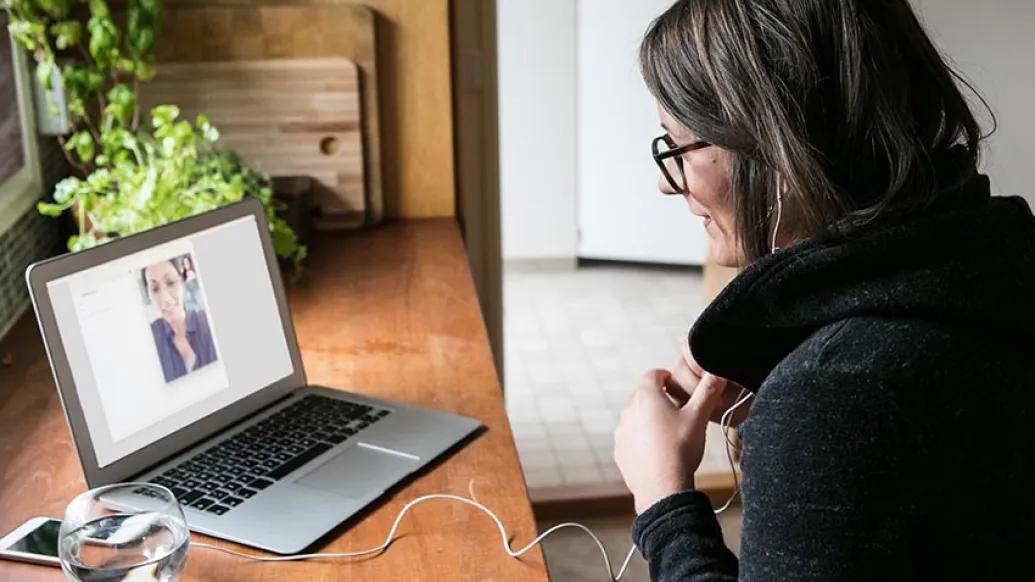
It's the third month of the COVID-19 pandemic, and everyone is homebound. The camera on my laptop picks up my image from an odd angle, exposing a lot of nostril. But this way, my patient sees only my face and the blank wall behind me. She won't see the messy room; toys scattered everywhere, a pile of dirty clothes, and the remains of my unhealthy lunch. Lightning flashes outside, briefly illuminating my face. My patient smiles. "Is it raining there, too?"
It sure is. There are three young children home from school with two working parents. My patient tells me about the struggles of confinement, wearing headphones plugged into her mobile phone. She apologizes for the messy room visible behind her. In many ways, my patient's life is similar to mine. And if I just changed my camera angle, she'd know it viscerally. But, ever-mindful of taboos against therapist self-disclosure, I keep my camera trained safely on the wall.
But why? The fact that the same thunderstorm surrounds us both has brought a smile to her face. Would a glimpse at my messy room decrease her feelings of shame? Or would it just increase mine?
As a clinical psychologist with the Department of Psychiatry at the University of Michigan Medical School, my research and clinical work is bifurcated. As a researcher I explore the work of peer specialists – people who are in recovery from a mental illness and who are trained and certified to help others with similar experiences. As a clinician I provide mainstream psychotherapy.
Peer specialists share personal stories as an essential part of their work; for example, they may describe their recovery in the aftermath of a suicide attempt to inspire hope and decrease shame.
Clinicians share too; in one sample, over 90% of therapists reported using what we refer to as self-disclosure in their practice at least some of the time. But, according to one estimate, therapists self-disclose only about 3.5% of the time. Compare this to the work of peer specialists, who dig deep within themselves each and every day to raise hope through shared experiences. Research suggests that hearing a peer specialist's recovery story promotes a sense of normalcy and hope. One study quotes a peer support recipient as saying, "And, seeing that she has done it … is motivational. She did it … if she can do it, I can do it, you know?"
New opportunities – and risks – in teletherapy
With the advent of COVID-19, video visits have become commonplace practically overnight, with one survey reporting that 76% of respondents now solely provide remote services. For patients and therapists alike, carefully curated self-disclosures can now show cracks when, through their webcams, they enter one another's homes.
With this change comes new opportunities and risks. In the grip of the low motivation that so often accompanies major depression, my patient has stopped cleaning her home. Then again, so have I – perhaps for different, less stigmatized reasons.
In my position as therapist, I can choose to break down the power differential between us; a slight tilt of my camera could illustrate a broader story about how a messy room isn't an indictment of character. In this sense, it would align my own work with that of the peer specialists whose roles and skills are the subjects of my research. I can picture my patient laughing as she sees the actual state of my room.
Should I do it? Or shouldn't I?
No explicit guidance, and research on both sides
Clinicians face contradictory messages and sparse research on self-disclosure. The American Psychological Association does not provide explicit guidance, although ethical codes related to clinical boundaries and dual relationships imply that therapists should self-disclose only if doing so has a clear therapeutic purpose.
The dearth of research on therapist self-disclosure further complicates the matter; little progress has been made toward the perennial question in psychology: What works for whom under what circumstances? If we do not fully understand the effects of self-disclosure, we will struggle to determine the extent of its therapeutic purpose in accordance with our ethical codes.
The various schools of psychotherapy also see the matter differently. While Sigmund Freud's psychoanalysis suggests that the therapist must be a blank screen upon which patients project their thoughts and feelings, Aaron Beck's ever-pragmatic cognitive therapy suggests that much of the clinician's role is to draw on their own experiences to explore potential solutions to life's problems. Behavioral therapies influenced by mindfulness practice, such as acceptance and commitment therapy, take it a step further: A therapist's thoughtful use of self-disclosure can help illustrate that the patient is not "broken," but rather is subject to universal vulnerabilities in the human condition.
Empirical research does begin to suggest that the effect of judicious therapist self-disclosure is largely positive. One study found that revelations about life outside of therapy ("I have kids at home") are associated with improved mental health functioning and an enhanced therapy relationship, and discussions of the therapeutic here-and-now ("I felt sad when you said that") are associated with more openness.
Another study found that while the frequency of self-disclosure was not related to clinical outcomes, self-disclosures that served to humanize the therapist ("I was ill last year") were associated with fewer post-session symptoms than did self-disclosures expressing appreciation or encouragement. It also found that self-disclosures conveying similarity ("I have felt that way too") were associated with fewer post-session symptoms than did self-disclosures conveying neither similarity nor dissimilarity. A study that mined clinician emails to patients found that self-disclosure was associated with better adherence to therapy and lower depressive symptoms.
'Are you one of us?'
In 2011, Marsha Linehan announced publicly that she herself had borderline personality disorder after serving the public for decades as a prominent psychotherapist, researcher and innovator. In a New York Times article describing her self-disclosure journey, she relates a story in which a patient wished to know: "Are you one of us?" and her evading the question by saying: "You mean, have I suffered?" She recalls the patient gently correcting her: "No, Marsha … I mean one of us. Like us. Because if you were, it would give all of us so much hope."
With faded burns and cuts visible on her arms, Linehan could self-disclose without saying a word. Yet she recalls this encounter as having tipped the balance in favor of explicit and public self-disclosure: "I owe it to them. I cannot die a coward." I wonder what she would say in response to my squeamishness about tilting my camera a fraction of an inch to show my patient that in her chaos, she is not alone.
"Will you get to go outside after this storm? Or do you have too much to do at home?" my patient asks as our video visit comes to a close. She sounds wistful.
I can feel the pull: She wants to know about my world. I pause for a moment, considering. "You're wondering how busy I am," I say with a smile, thinking about the horrendous mess behind me. In my mind, I hear an echo: "You mean, have I suffered?" It feels like an opportunity for connection is slipping away as we say goodbye and end the visit.
This article is republished from The Conversation under a Creative Commons license. Read the original article.

Health Lab
Explore thousands of health news & research stories by visiting the Health Lab homepage for more.
Media Contact

Public Relations
Department of Communication at Michigan Medicine
Stay Informed
Want top health & research news weekly? Sign up for Health Lab’s newsletters today!
Featured News & Stories

Major Changes to Medicaid

Sports gambling on the rise among college students

Exploring the mind’s mysteries: 130 years of mental health care & innovation at U-M

How U-M helped bring depression out of the darkness

What’s changing in Medicaid and what can you do?