Couple shares two-year infertility journey
Infertility affects an estimated 1 in 8 couples in the U.S. One new set of parents candidly share their ups and downs of trying to start a family.
5:00 AM
Author |
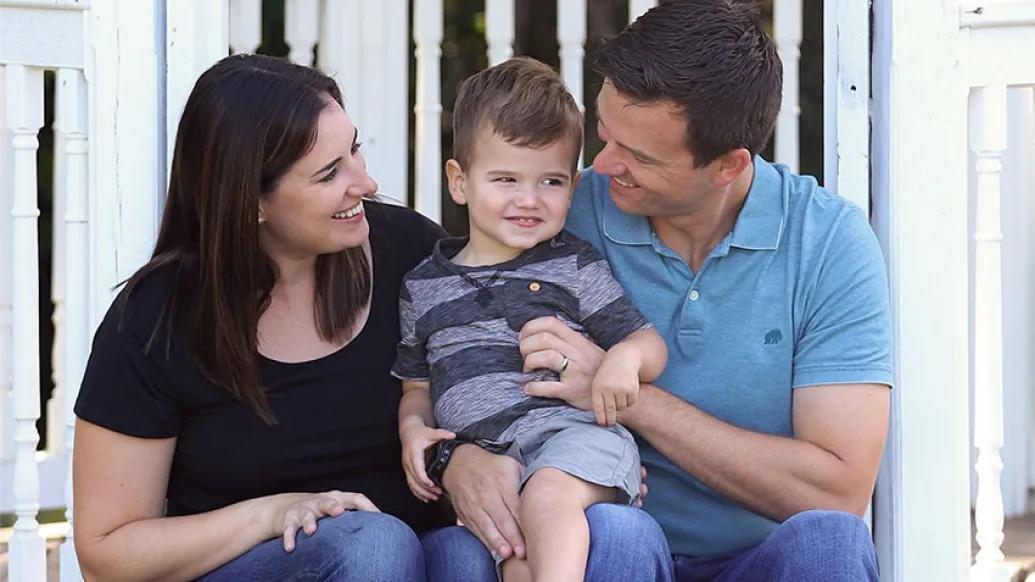
As nurses placed her newborn son on her chest, Jennifer Hewitt remembers feeling disbelief.
"I knew it wouldn't feel real until I was actually holding him in my arms," she said. "I wanted a baby for so long and I finally had one."
She and her husband, Brian, describe the day Carter was born as the perfect "social media moment."
What many didn't see: the two-year journey struggling to conceive that required surgery, fertility drug injections, ultrasounds, two rounds of in vitro fertilization and hormonal ups and downs that came with both emotional and physical pain.
The Hewitts are among an estimated one in eight couples in the United States who face infertility, which is equally attributed to female factors, male factors and a combination of both.
"It's so much more common than you think," Brian Hewitt said. "You don't realize how many people it affects because you're usually just seeing the happy pictures on social media, not what happens behind the scenes. But it's not all roses and baby showers.
"It's important to know that you're not alone."
Today, Carter is a two and half year old with "unlimited energy" and curiosity who loves cars, airplanes and socializing with everyone he meets. And the brown-haired toddler gets promoted to big brother soon, with the couple expecting his baby sister in May.
"There's a lot of stigma and many misconceptions around infertility and it took us awhile to share with people what we were going through," Jennifer Hewitt said. "But once we did open up, we found family and friends had experienced this as well. We want people to know how common this is and also to give others hope."
A shocking discovery
Jennifer Hewitt always knew she wanted to be a mom. And she assumed it would happen the conventional way: get married, start trying, get pregnant.
But after more than half a year of trying to conceive in 2017, the couple consulted with a doctor. Several tests later, they were shocked to learn that Brian had deletions in the azoospermia factor (AZF) region of the Y chromosome, a genetic condition that prevented him from developing sperm. It affects about 5-10% of men who have very low or zero sperm counts.
"It was pretty devastating," he said. "We never thought it would be anything serious. Now we wondered if we'd ever be able to have kids or be able to fulfill that dream.
"That was probably the toughest year we've had together, from the constant barrage of testing and trying to get answers to finally finding hope."
They were referred to the Center for Reproductive Medicine at University of Michigan Health.
"Historically, in many cultures, people assumed that if a couple was having trouble getting pregnant it was because of something on the female side. But we know that for nearly half of couples facing infertility, male factors play a role," said James Dupree, M.D., M.P.H., the couple's urologist at U-M Health.
"It's important to make sure both the man and woman get evaluations when a couple is having trouble conceiving."
The couple opted for Brian to undergo a specialized procedure at U-M known as microsurgical testicular sperm extraction (microTESE) used to try to retrieve sperm.
It meant going under anesthesia and is successful about 40-50% of the time.
For the Hewitts, it worked. Enough sperm was collected to freeze and later be used for IVF.
That's when Jennifer Hewitt began taking regular injections of fertility medication to help stimulate the ovaries to develop and mature enough eggs, which can cause drastic emotional shifts.
"That was hard – the hormones, the injections, the physical and emotional toll of it all. I don't think you can really prepare for it," she said.
They underwent two rounds of IVF, and in January 2019, doctors implanted an embryo.
Then they waited.
About two weeks later, Jennifer Hewitt got the call. She was pregnant.
"We were in a parking lot, and it was so cold our teardrops were freezing up," she said. "They said they had good news, but I still couldn't believe her."
Still, the couple was hesitant to celebrate.
"Wherever you are in this journey, whether you're still trying to get pregnant, are already pregnant or are getting close to a due date, there's still anxiety," Brian Hewitt said. "It doesn't end once you're pregnant. You can be happy but nervous at the same time."
"When (Carter) was finally here it was almost surreal."
Advice for others
The Hewitts say sharing their story has been helpful. While they've found supportive communities along the way, they've also learned that no couple faces the exact same issues. And even between the two of them, there were different experiences.
"Even in a support group you can feel like an outsider if your specific situation is different," Jennifer Hewitt said. "But social workers at U-M were really helpful in putting things in perspective and helping Brian and I work as a team and not against each other."
"You have to have patience with each other. Even though it's a shared issue, you can't always understand what the other person is going through."

It was also important to be there for each other to prevent strain from impacting their relationship. Brian Hewitt made it to as many appointments as possible, recognizing that even though fertility treatment impacted his wife's body the most, it was their journey as a couple.
Removing triggers was sometimes necessary, too. At one point, the couple even limited TV viewing to baking shows to reduce the chances of seeing storylines involving babies and kids.
"Building a family is a really common desire, and it can be understandably very emotionally difficult to not have it go the way you expected," Dupree said. "It's important to remind families they're not alone and that they have resources through medical professionals and supportive communities. Doctors and social workers are here to help with the process."
"It's also important to remember that it's not your fault that this is happening."
Today, the Hewitts are soaking up all the everyday moments with Carter, like exploring the outdoors and playing with their cockapoo, Hazel.
"The best part is experiencing life again through his eyes," Jennifer Hewitt said. "It takes me back to my childhood. He's intrigued and amazed by everything and is just so innocent. I just think it's the sweetest thing."
"I'm excited to watch Carter become a big brother and to see how alike they are and how they grow up and interact together," she added.
The couple implanted another embryo in late 2021, leading to their current pregnancy.
"There were many times along the way where we could've said this is too much. We're not going to do this," Brian Hewitt said. "Once we got past the barriers and fears and consulted with doctors and shared more with others, we learned about all of the options. It's not how we originally planned it, but it was worth it."

Health Lab
Explore thousands of health news & research stories by visiting the Health Lab homepage for more.
Media Contact

Public Relations
Department of Communication at Michigan Medicine
Stay Informed
Want top health & research news weekly? Sign up for Health Lab’s newsletters today!
Featured News & Stories
Better prenatal care data could help prevent maternal complications, experts say

What’s changing in Medicaid and what can you do?

PMOS is the New PCOS
PCOS has a new name
A tragedy and a trial shine a spotlight on new moms’ mental health