Could a Brain ‘Growth Chart’ Spot Attention Problems Early On?
Imaging to measure the development of a child’s brain networks might someday help predict who’s at risk for ADHD.
11:00 AM
Author |

Growth charts may someday help doctors keep track of more than just a child's height and weight. They could also be useful for spotting issues with attention abilities or seeing if ADHD treatments are working.
New research from the University of Michigan Medical School, published in JAMA Psychiatry, suggests it might be possible to create a growth chart for brain networks that could identify early signs of attention difficulties — improving diagnoses and patient outcomes along the way. The idea could extend to other psychological conditions, such as autism or schizophrenia, which are also thought to involve "miswired" brain networks.
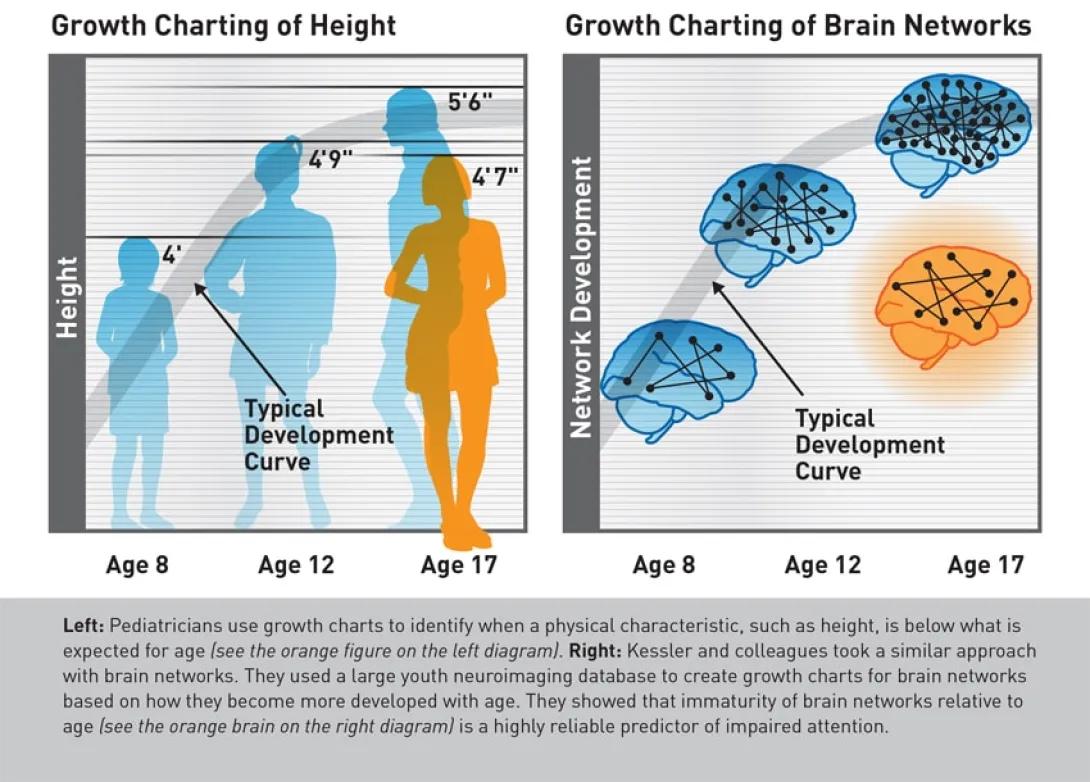
"Growth charts enable a family and their physician to quickly spot problematic development, and when necessary, intervene appropriately," says team leader and U-M psychiatrist Chandra Sripada, M.D., Ph.D. "In the future, we want to provide clinicians with the same sort of guidance about brain development that we can about things like height and weight."
Traditional growth charts show a child's height and weight as points on curves that are based on data from hundreds of thousands of children, and indicate normal, near-normal and problematic development.
Building on this idea, the researchers mapped the development of brain networks in more than 500 children and teens to create an experimental growth chart. They found that key networks involved in external focus and internally directed thought ("daydreaming") were underdeveloped in those with attention difficulties.
Although it's far too soon to start offering such charting to families, future development of the technique could mean better chances for children to get a firm diagnosis of ADHD sooner. It could also help track whether ADHD treatment is improving attention functioning.
In the future, we want to provide clinicians with the same sort of guidance about brain development that we can about things like height and weight.Chandra Sripada, M.D., Ph.D.
The link between maturing networks and attention
The U-M team launched the brain growth-charting research after noticing a gap in the state of the science.
Lead author Daniel Kessler explains: "We knew that the ability to sustain attention for an extended time increases dramatically during childhood and adolescence. We also knew that over the same time period, there are big changes in brain networks involved in attention. We came up with the idea of growth charting as a way to test if these two patterns were related: Would children with underdeveloped brain networks also have more difficulty with attention?"
Along with colleague Michael Angstadt, MAS, the researchers used data from 519 children and teens who had genetic testing, brain imaging and tests of their cognitive development as part of the Philadelphia Neurodevelopmental Cohort based at the University of Pennsylvania.
The researchers created growth charts that reflected the configuration of what are called intrinsic connectivity networks — important units of functional brain organization. The way these networks interact may hold the key to healthy attention.
For example, one called the default mode network seems to be involved in daydreaming and inwardly focused thought, whereas another set of networks is involved in cognitively demanding tasks.
As we grow from children into adults, these two systems become more defined and separate, working in tandem like pistons: When one is on, the other turns off. But in children and those with attention difficulties, the "pistons" often misfire. The default mode network turns on and interrupts the other networks, thereby interrupting attention.
Attention functioning was measured with a standard test in which children responded to a sequence of letters and numbers on a computer screen. Researchers then compared the brain development seen on the scans to attention functioning. From there, they could predict how well a child would do on the attention test based on their place on (or off) the brain network growth chart. The children with ADHD symptoms, and those with the lowest performance for their age on the attention tests, were the furthest off the curve of brain network development.
"These brain network growth charts show real promise," says Sripada. "But they are far away from being ready for clinical use."
Future research paths
The research used advanced MRI imaging, but Sripada and his colleagues hope to develop ways to track network maturity using less-expensive techniques such as electroencephalography, or EEG.
They're working with other U-M researchers, led by Mary Heitzeg, Ph.D., and Robert Zucker, Ph.D., to see if the growth charting method will be useful in the Adolescent Brain Cognitive Development study (ABCD), which will involve 10,000 teens over several years.
"The ABCD study is unprecedented in size and provides a real chance to develop definitive growth charts for brain networks," explains Sripada. "We have the opportunity to understand how brain network development relates to a variety of outcomes, including cognition, emotion, personality and behavior."
The research was funded by the National Institutes of Health (AA020297 and MH107741) as well as the U-M Center for Computational Medicine and the John Templeton Foundation.
Reference: JAMA Psychiatry, doi:10.1001/jamapsychiatry.2016.0088

Health Lab
Explore thousands of health news & research stories by visiting the Health Lab homepage for more.
Media Contact

Public Relations
Department of Communication at Michigan Medicine
Stay Informed
Want top health & research news weekly? Sign up for Health Lab’s newsletters today!
Featured News & Stories

Better prenatal care data could help prevent maternal complications, experts say
Pain, psychological factors and physical function closely linked in people with systemic sclerosis

E-Bikes are everywhere, but most parents say they don’t know enough about them

A tragedy and a trial shine a spotlight on new moms’ mental health

How to improve mental health safety on social media – not just for young people