Children who suffer cardiac arrest more likely to survive at ECMO capable hospitals
Multi-specialty structure at hospitals equipped with ECMO life support associated with better outcomes among critically ill children with heart failure
5:00 AM
Author |
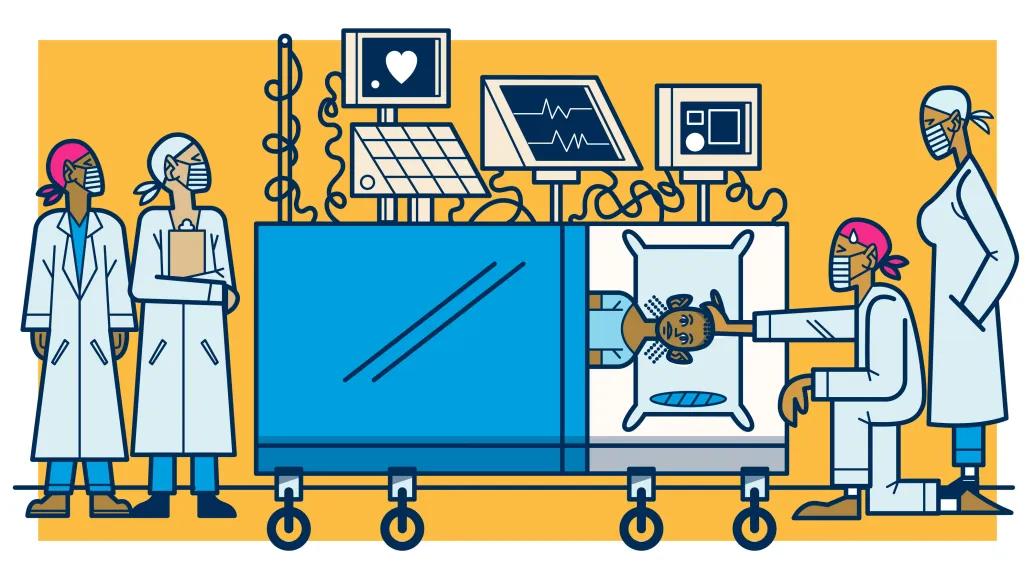
Children who experience cardiac arrest are one and a half times more likely to survive at a hospital capable of providing the life support system called ECMO, research suggests.
But the reason behind better outcomes may have less to do with being saved by the heart and lung support machine itself and more to do with the care team structure at hospitals capable of ECMO, suggests the findings in Resuscitation.
Michigan Medicine researchers analyzed a national cohort of 1,276 cardiac arrest hospitalizations for children and teens 18 and younger between 2016 and 2018.
Less than half of patients survived, with half of the survivors at ECMO-capable hospitals and nearly a third at non-ECMO hospitals.
But just 11 % of surviving patients at ECMO hospitals actually used ECMO – or extracorporeal membrane oxygenation – which provides temporary support after severe cardiac or respiratory failure.
“A hospital’s ECMO capability was associated with higher in-hospital survival among children suffering cardiac arrest, but the majority of these young patients did not require the use of ECMO support during their hospitalization,” said lead author Blythe Pollack, M.S.N., R.N., who provides pediatric critical care at University of Michigan Health C.S. Mott Children’s Hospital.
“This leads us to believe the multi-disciplinary team structure and care delivery at ECMO capable hospitals benefit the treatment and recovery for this critically ill population.”
Authors theorize the complex and comprehensive coordination, communication and treatment approach required across specialties in order to support young patients on ECMO could carry over to benefit all children needing critical care.
“Supporting patients on ECMO requires continuous discipline to maintain strong relationships across multiple specialty teams in acute, high pressure, high stress situations,” said senior author Joseph Kohne, M.D., Mott pediatric critical care medicine physician and researcher.
A hospital’s ECMO capability was associated with higher in-hospital survival among children suffering cardiac arrest, but the majority of these young patients did not require the use of ECMO support during their hospitalization.” Blythe Pollack, M.S.N., R.N.
“This study is the first step in answering the most important question: how do we best care for kids after cardiac arrest?” he added.
“We will need more research to better understand care delivery differences and other organizational factors in pediatric cardiac arrest needed to improve outcomes.”
A big limitation in this research, Kohne notes, is it only focused on hospital mortality. Further work can hopefully expand findings on other outcomes, such as neuropsychological and physical outcomes after getting home from the hospital.
Researchers also found children who received treatment at ECMO-capable hospitals were younger and more likely to have a complex chronic condition, specifically congenital heart disease.
Unsurprisingly, hospital stays were also longer and medical costs were higher at ECMO hospitals.
The findings reinforce previous research also suggesting associations between ECMO capability and better outcomes in different patient populations.
Pollack says she was driven to pursue this research after caring for children facing uphill challenges following cardiac arrest.
“Every child should have the same chance at the best possible outcome regardless of where they live, their background or their family’s income,” Pollack said.
“We need to take a deeper look at the care practices of hospitals with better outcomes and seek ways to apply these changes to every health system caring for critically ill children.”
Additional authors include Ryan Barbaro, M.D., M.Sc.; Stephen Gorga, M.D.; and Erin Carlton, M.D., of Michigan Medicine, and Michael Gaies, M.D., M.P.H., of Cincinnati Children’s Hospital.
Study cited: “Hospital ECMO capability is associated with survival in pediatric cardiac arrest,” Resuscitation. DOI: 10.1016/j.resuscitation.2023.10985

Health Lab
Explore thousands of health news & research stories by visiting the Health Lab homepage for more.
Media Contact

Public Relations
Department of Communication at Michigan Medicine
Stay Informed
Want top health & research news weekly? Sign up for Health Lab’s newsletters today!
Featured News & Stories

Many older adults make Medicare decisions quickly and most don’t change plans, poll finds

What’s the latest on 7-OH and kratom availability and addiction care?
Better prenatal care data could help prevent maternal complications, experts say
Many hospitals still don’t do enough to prevent UTIs from catheters

Digital alerts support timely treatment decisions of critically ill cardiac patients