Can talking to kids during TV time buffer screen time effects on development?
Study suggests association between higher curiosity at kindergarten and greater frequency of parent conversation during shared television viewing, especially for children from lower income families.
10:05 AM
Author |
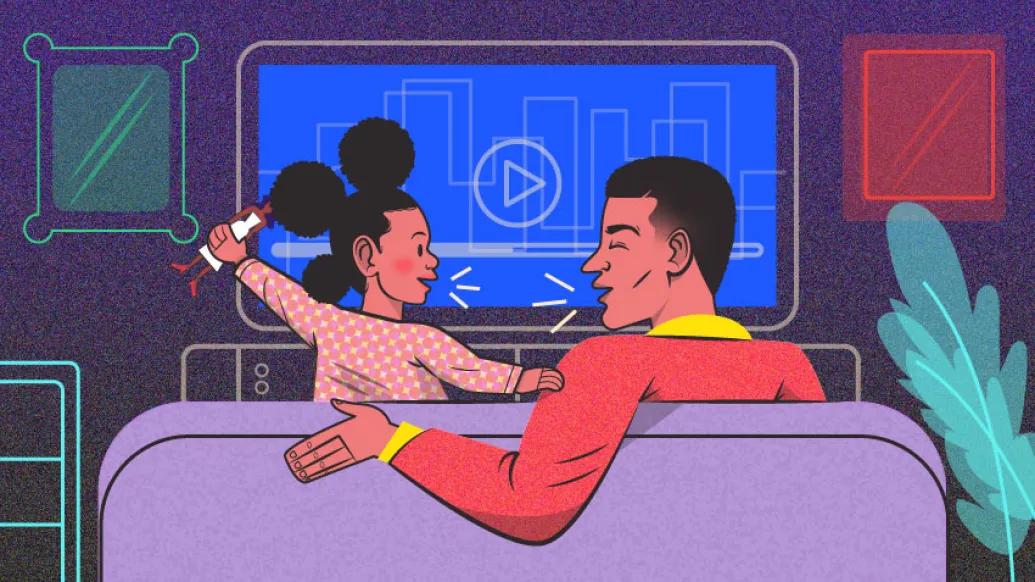
Increased television time for young children has been linked with poorer progress in some areas of development.
One possible way to counter those negative effects – talking while watching the screen.
The more parents engaged in conversation with preschoolers during shared TV time, the more likely those children were to have higher curiosity levels when they reached kindergarten, a new study suggests. This was particularly true for children with socioeconomic disadvantages.
"Our findings reinforce the importance of parent conversation to promote early childhood development and curiosity, especially for children from under-resourced families," said lead author Prachi Shah, M.D. M.S., a developmental and behavioral pediatrician at University of Michigan Health C.S. Mott Children's Hospital.
"We know that more frequent parent-child conversation is promotive of several areas of early child development, and this could be true for promoting a child's curiosity as well."
Sitting in front of the TV alone or while parents are on their phones? Perhaps not so beneficial.
Like Podcasts? Add the Michigan Medicine News Break on iTunes, Google Podcasts or anywhere you listen to podcasts.
But watching a show, movie or other content with parents while talking together could be associated with fostering a preschoolers' curiosity, Shah says.
Researchers assessed hours of daily television exposure and frequency of parent screen-time conversation among 1,500 preschoolers, and then measured early childhood curiosity in kindergarten. The findings appear in PLOS ONE.
The study specifically focused on curiosity levels, which Shah's previous research has found is associated with enhanced learning and higher academic achievement in reading and math at kindergarten, and behavioral-developmental benefits, especially for children from families with lower socioeconomic status.
"Curiosity is an important foundation for scientific innovation, joy in learning and numerous positive outcomes in childhood," Shah said. "We want to better understand what fosters curiosity in early childhood, which could potentially identify ways to help mitigate the achievement gap associated with poverty."
"Parent-child conversation facilitates children's thinking, learning and exploration – all behavioral indicators of curiosity," she added.
Despite tablets and phones, TV remains dominant in home media consumption
Researchers analyzed data from the Early Childhood Longitudinal Study, Birth Cohort. The cohort is a nationally representative, population-based study sponsored by the United States Department of Education that has followed thousands of children since birth in 2001.
Curiosity was measured through parent questionnaires asking about characteristics of curiosity, such as eagerness to learn new things, a drive for novelty, an openness to new experiences, imagination and adaptability to new situations among other behaviors.
Our findings reinforce the importance of parent conversation to promote early childhood development and curiosity.Prachi Shah, M.D. M.S.
While many young children are now growing up with digital media exposure through mobile devices like tablets and phones, televisions remain a dominant screen activity, accounting for 72% of all screen time.
"TVs are in 98% of all homes, keeping television exposure a relevant developmental context in young children," Shah said.
Children are reportedly exposed to an average of one to four hours of television per day, with higher exposure in children who are economically disadvantaged.
Excessive media exposure, including television, can displace exploratory activities such as play and parent-child interactions, which are believed to be key to cultivating curiosity in kids, Shah says.
"Our findings suggest the importance of parents finding opportunities to foster conversational exchanges in daily routines with their young children – including while watching television," Shah said.
Additional authors include Katherine Rosenblum, Ph.D., Kristen Harrison, Ph.D., Heidi Weeks, Ph.D., and Niko Kaciroti, Ph.D., all of University of Michigan, as well as Kathy Hirsh-Pasek, Ph.D., of Temple University, Todd Kashdan, Ph.D. of George Mason University; and Priya Singh, M.D., of University of Cincinnati Medical School.
Paper cited: "Daily television exposure, parent conversation during shared television viewing and socioeconomic status: Associations with curiosity at kindergarten," PLOS. DOI: 10.1371/journal.pone.0258572

Health Lab
Explore thousands of health news & research stories by visiting the Health Lab homepage for more.
Media Contact

Public Relations
Department of Communication at Michigan Medicine
Stay Informed
Want top health & research news weekly? Sign up for Health Lab’s newsletters today!
Featured News & Stories

Many hospitals still don’t do enough to prevent UTIs from catheters

E-Bikes are everywhere, but most parents say they don’t know enough about them

C.S. Mott Children’s Hospital named No.1 children’s hospital in Michigan by U.S. News & World Report

Talent show brings joy to kids at children’s hospital

C.S. Mott Children’s Hospital first in country to implant expandable heart valve during FDA review phase