
Bringing Prenatal and Infant Care to Underserved Communities
The Luke Clinic brings free prenatal and obstetric services to Detroit.
1:00 PM
Author |
When it comes to accessing health care in the United States, deep-seated disparities among marginalized populations continue to exist. And while there are nearly 1,400 free clinics throughout the country to help offset these inequities, the uninsured and underinsured continue to struggle with obtaining the care they so often need.
"Many free clinics serve as a critical safety net for vulnerable populations, as they provide more than six million patient visits on a yearly basis," says Katherine J. Gold, M.D., M.S.W., M.S., an associate professor in the Department of Family Medicine at Michigan Medicine. "However, of these clinics, only 7% offer prenatal and obstetrical services to their communities."
When it comes to Michigan counties and overall health outcomes, Wayne County, where the city of Detroit resides, ranks second to last, coming in at 82. Despite efforts to improve maternal and children's health care, preterm birth rates in Michigan have risen five years in a row, with Detroit ranking nearly at the bottom when compared to the other 100 largest cities in the U.S.
"As you can imagine, many women of color report experiencing racial disparities and marginalization in their daily lives, but also while receiving health care, which often leads to a significant distrust of the health care system, overall," says Gold. "Immigrants are sometimes fearful of deportation or being denied a green card and may choose to avoid care entirely, while mortality rates for black and Hispanic infants are significantly higher than those of their white counterparts."
In order to address the high rates of infant mortality in Detroit alongside other largescale health disparities, Brad Garrison, a pharmacist and pastor, founded the Luke Clinic with his wife, Sherie Garrison, a high-risk labor and delivery nurse at Michigan Medicine.
Brad now serves as the clinic's executive director, while Sherie serves as the clinical care coordinator. Their clinic and its model of care were recently featured in the Maternal and Child Health Journal.
"The Luke Clinic provides free prenatal, postpartum and infant care (through one year of life) to any family in the Detroit metro area," says Gold, who also serves as the clinic's medical director and has since its opening in 2016. "We hold clinic on two half-days a month and also offer patients other free services around a variety of things, including social work, insurance navigation, childcare, breastfeeding support and language interpretation."
Like Podcasts? Add the Michigan Medicine News Break to your Alexa-enabled device or subscribe for updates on iTunes, Google Play and Stitcher.
In 2019, Michigan Medicine's Department of Family Medicine formally partnered with the Luke Clinic and began providing services from four physicians on a monthly basis to help staff clinic hours. In addition, the department's residents now rotate at the clinic and many of their patients choose to deliver their babies at Michigan Medicine's Von Voigtlander Women's Hospital, therefore increasing their continuity of care.
"Our partnership with the Luke Clinic is quite significant," says Gold. "Michigan Medicine obstetrician-gynecologist Carrie Louise Bell, M.D. serves on the clinic's board of directors and two of our maternal-fetal medicine physicians offer consultations to high risk patients."
Gold adds that numerous nurses, nurse-midwives and administrative staff from Michigan Medicine also volunteer at the clinic, as well as Michigan Medicine C.S. Mott Children's Hospital pediatrician, Adrienne Musci, M.D.
Care during COVID-19
Many of the Luke Clinic's high risk patients possess medical and social risk factors that contribute to struggles with mental illness and substance abuse. And many of these individuals found themselves without care at the beginning of the COVID-19 pandemic.
"When the coronavirus hit, we were receiving multiple calls a week from people who were reporting that other Detroit clinics were closed to new prenatal patients," says Gold. "We also lost access to most of our onsite support services, including the Detroit Health Department's immunization services, our social work staff, insurance navigators, doulas and lactation consultants."
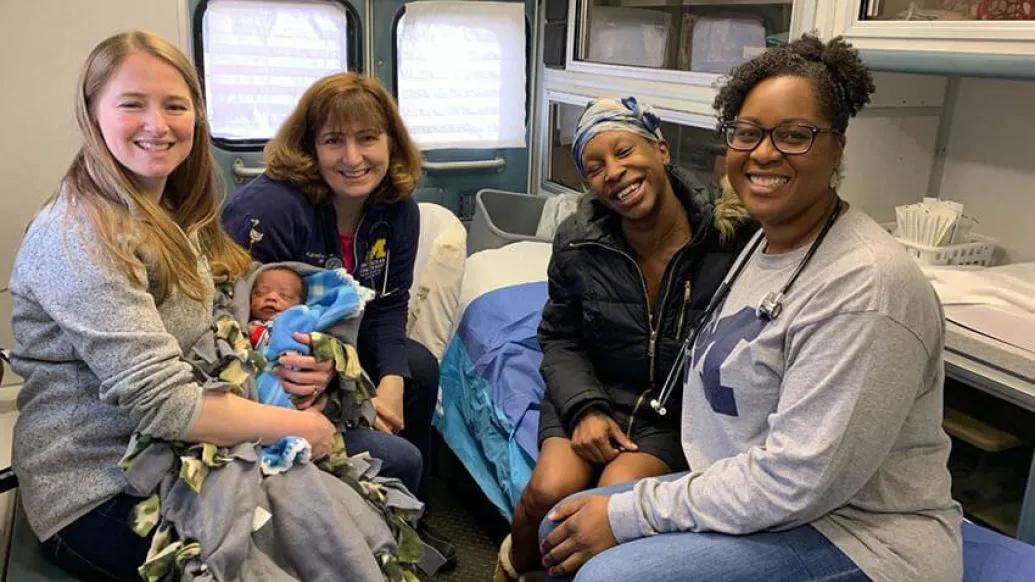
Gold further adds that while the unexpected pandemic led to huge gaps in care and social support for these vulnerable families, in February, the clinic had received funding from Blue Cross Blue Shield of Michigan to test an outreach vehicle for antenatal testing and newborn care.
"This newly funded vehicle has become a lifeline for many patients in Detroit during the time of COVID-19," says Gold. "The MATU (mobile antenatal testing unit) has been particularly helpful since the pandemic started due to our own service reductions."
Gold notes that the MATU typically sees between three to five patients per day, once a week. Staff drive to a patient's home or workplace for testing, prenatal care, postpartum check-ups and newborn care. Typically, they have two nurses, an ultrasonography and a driver on staff.
"More recently, I've been able to provide video visits to our clinic team and patients, reviewing fetal heart monitoring strips remotely, which allows me to participate in patient care," says Gold. "We focus on our highest risk moms for the visits, as many of them already have existing medical problems like diabetes, high blood pressure, obesity or advanced maternal age or teen pregnancy."
MORE FROM THE LAB: Subscribe to our weekly newsletter
Gold adds that sometimes, the clinic is the only place of respite for these patients.
"We have found that many of our patients have limited support from friends and family and may be in violent or abusive relationships with their partners," says Gold. "Knowing that they can trust us helps provide some stability in their lives, as well as a place to turn to when they are scared or need resources."
Evaluating care
In order to assess the Luke Clinic's quality of care, Gold and her team have been tracking patient risk factors and outcomes.
"We saw almost 200 patients in our first two years of service, and another 139 in the third year," says Gold. "We have noted some significant pregnancy outcomes in patients receiving our care."
Even though most of the clinic's patients have extremely high levels of medical, social and behavioral risk factors, they have shown lower rates of preterm delivery than the city of Detroit, which takes into account patients with health insurance.
"Our preterm delivery rate is about 10.4 per 1,000 live births, compared with 14.3 per 1,000 live births in Detroit," says Gold. "We also have lower rates of low birth weight infants, 6.2 per 1,000 live births compared with 14.6 for Detroit. We are proud of the care we can provide these vulnerable families, as well as the diverse range of services we offer our patients."
Paper cited: "A Novel Model for a Free Clinic for Prenatal and Infant Care in Detroit," Maternal and Child Health Journal. DOI: 10.1007/s10995-020-02927-1

Health Lab
Explore thousands of health news & research stories by visiting the Health Lab homepage for more.
Media Contact

Public Relations
Department of Communication at Michigan Medicine
Stay Informed
Want top health & research news weekly? Sign up for Health Lab’s newsletters today!
Featured News & Stories

Redesigning Prenatal Care During the COVID-19 Pandemic

5 ways to manage politically induced stress
High dose oxytocin protocol linked to lower postpartum hemorrhage rates

Top 7 tips for choosing Medicare prescription drug coverage for 2027

U-M-led consortium to receive up to $52 million in NIH funding to study why viral respiratory infections affect children differently

