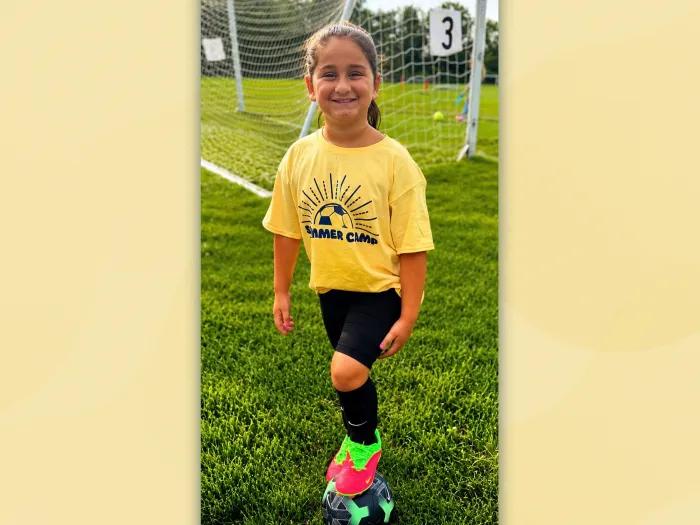
Born under a pound: Two newborns beat extraordinary obstacles in the NICU
Born at 22 and 25 weeks, two extremely premature girls spent months in the hospital supported by a coordinated care team
5:00 AM
Author |
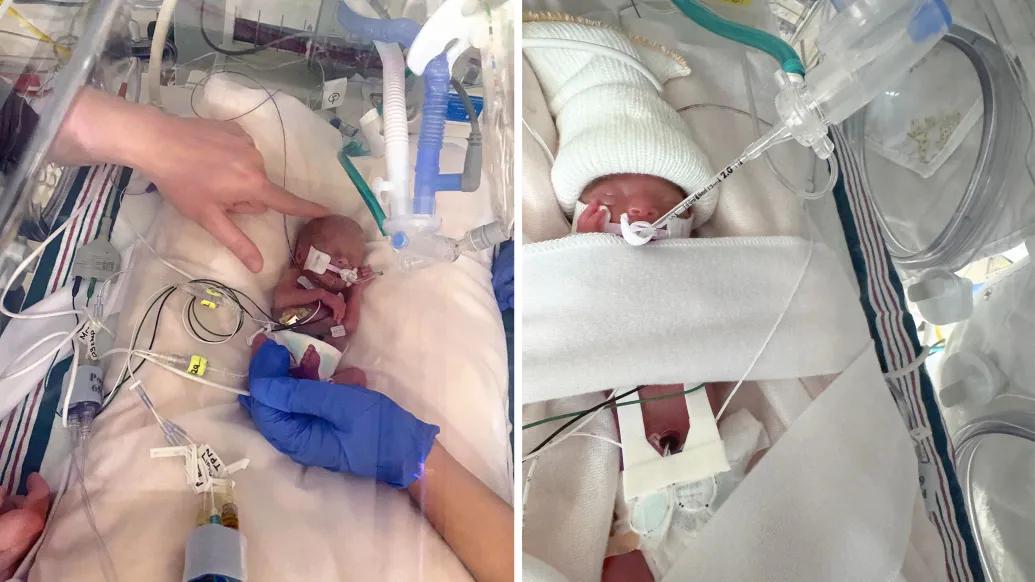
Just hallways apart in the Brandon Newborn Intensive Care Unit at University of Michigan Health C.S. Mott Children’s Hospital, two newborn girls spent their first months fighting to overcome extraordinary odds.
Both arrived more than 14 weeks early and weighed under a pound – and about the size of a soda can.
Both relied on complex, minute-to-minute, highly specialized care.
Sage Allen was born at 22 weeks and three days at 13.2 ounces, spending 175 days in the hospital.
Baela Harten arrived at 25 weeks and six days, weighing 12.9 ounces with a NICU stay of 250 days.
Their due dates were in July and August, but they had April birthdays instead.
And after their long journeys, both Sage and Baela were able to graduate from the NICU in time to celebrate the holidays at home.
“These are two of the smallest and most premature babies we’ve ever cared for. We’re in awe of Sage and Baela and of their families for how they’ve defied the odds,” said Rebecca Vartanian, M.D., a neonatologist in the division of neonatal-perinatal medicine at Mott.
“Cases like theirs carry low statistical chances of survival because of the significant medical challenges. Our teams approach these tiny babies with the mindset that they can and will survive, but sadly, not all do. It is so remarkable to see these two grow and thrive after all they’ve been through.”
Extremely premature babies like Sage and Baela face steep obstacles: lungs and organs too underdeveloped to function on their own, equipment that often isn’t built for such small bodies and high risks of brain injury, feeding difficulties and infection.
At C.S. Mott Children’s Hospital, a comprehensive team that includes neonatologists, maternal-fetal medicine specialists, nurses, respiratory, occupational and physical therapists, pharmacists, social workers and dieticians collaborate to tailor every element of care — from monitoring development and adjusting medications to helping ensure skin-to-skin contact during long hospital stays.
Now, the families reflect on their journeys as the two girls reach long-awaited milestones.
Sage’s story: “She never quit”
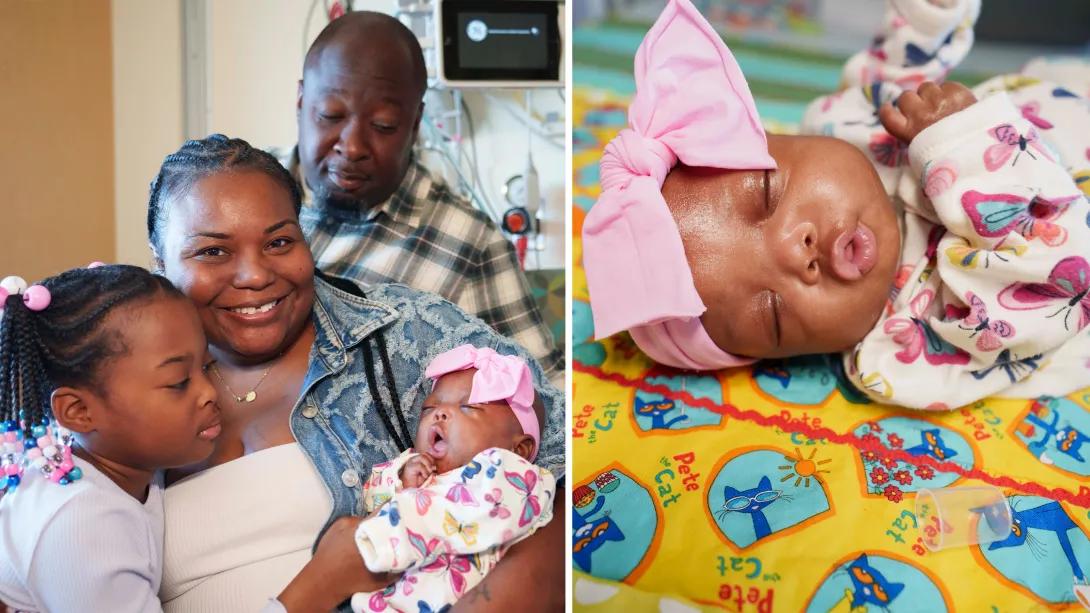
Sarah Allen had barely passed her 22nd week of pregnancy when her water broke.
It was one of her greatest fears. She’d previously delivered two premature babies, including her older daughter, Eden, who was born at 24 weeks and needed heart surgery and intensive care after birth.
“I was crying, thinking about the worst because I’d been through this already and didn’t want to go through it again,” she said.
“But I believed in her. I’d watched Eden be a warrior and knew Sage would be too. I knew it would be a hard road, but we had to give her a chance. We knew we had to go to Mott.”
Allen was admitted to U-M Health Von Voigtlander Women’s Hospital, given antibiotics to prevent infection and closely monitored. But within days, doctors could no longer delay delivery.
With dozens of health professionals in the delivery room, Sage arrived weighing 375 grams and measuring ten inches long.
“She came out beet red, moving her arms and kicking,” her mom recalled.
“We were relieved.”
Sage was immediately intubated and taken to the Newborn Evaluation Stabilization and Treatment area, or NEST, to be stabilized before transferring to the NICU.
After an emotional reunion with her daughter later that night, Allen felt immediate comfort when she saw the familiar faces of several nurses.
They were the same ones who had cared for her older daughter, now in first grade, years earlier.
“I kept looking at them until we recognized each other and just hugged and cried,” she said.
“I knew these were people who would protect my daughter, and I knew I was in the right place.”
Among them was Crystal Feathers, who Allen says played a meaningful role for both her daughters.
“Her calm presence, skill and compassion helped carry us through some of Sage’s most critical moments and our family will always be grateful for the care and love she showed our daughter,” Allen said.
But Sage’s early days were full of hurdles.
She struggled to breathe and required a ventilator and then CPAP to support her underdeveloped lungs.
She developed a hole in her intestines, needing surgery to resect and reconnect sections of her bowel.
She also battled necrotizing enterocolitis, a life-threatening intestinal disease.
“She never quit and the teams never quit on her,” Allen said. “She kept proving us all wrong.”
After six months in the Mott NICU, Sage went home in October at seven pounds without breathing or feeding support.
And Allen, her husband, Roddrell, and big sister Eden, 6, were able to celebrate Sage’s first holiday season together.
They’re also enjoying something simple they couldn’t do for months: holding and cuddling Sage freely.
“She’s still a tiny little nugget and getting so much love from her family,” her mom said. “It was a stressful road, but we leaned on each other to get through it.
“I tell her I’m so thankful for her—for her resilience, for her will to live, for choosing me to be her mom,” she added. “She’s brought so much joy to our lives. I want her to know how much I admire her strength, that she’s beautiful and whole and healthy.
“Nothing inspires me more than my two daughters. I don’t know anybody who came into the world fighting this hard. They’ve persevered and beaten every odd.”
Baela’s story: “Fighting her whole life”
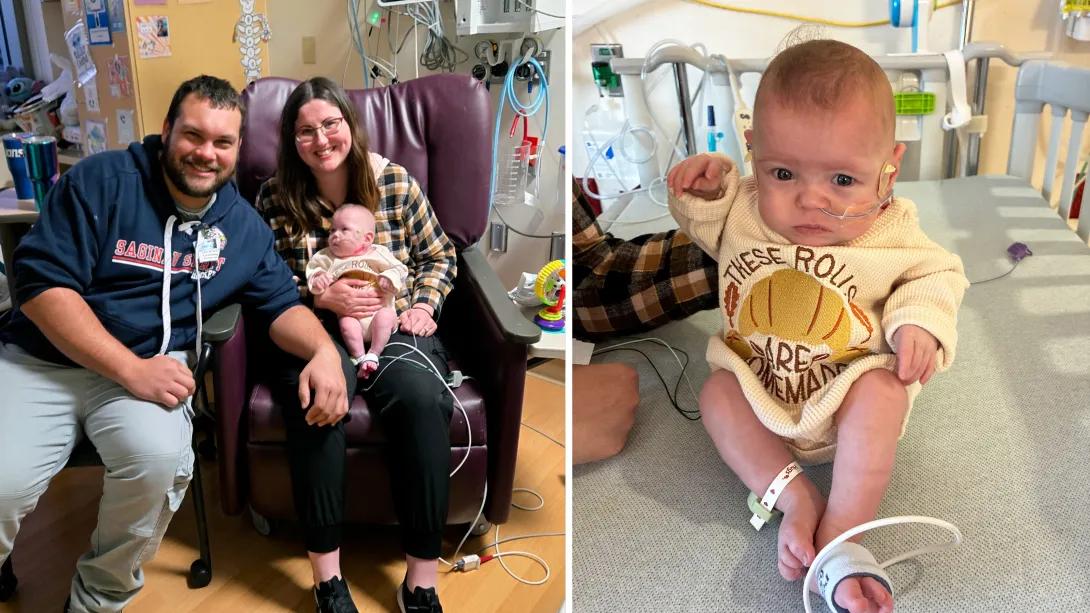
Everything about Katie Harten’s pregnancy felt typical until the 20-week anatomy ultrasound.
She knew something was wrong when she got a call just a couple of hours later.
Doctors explained that the fetus was measuring unusually small and recommended seeing maternal–fetal medicine specialists at U-M Health Von Voigtlander Women’s Hospital.
Over the next several visits, the picture grew clearer and more concerning.
Usually, a placenta has two arteries and a vein, but specialists believed Harten’s only had one artery, causing Baela to not get enough blood flow and restricting her growth.
A neonatologist walked Harten through every possible outcome, including the very real risk of miscarriage.
She started medications to support the baby’s lung development and offer neuroprotection but was also trying to prepare for the terrifying what-ifs.
Just a couple of weeks later, at 25 weeks gestation, that uncertainty became urgent. Monitoring showed the baby’s heart rate and oxygen levels falling.
Doctors also noticed reverse blood flow and recommended an emergency cesarean.
“I was so scared and just bawling,” Harten recalled. “I remember asking my nurse if we could wait until my fiancé could get there because I didn’t want to do this alone. I was so nervous, but the team was so wonderful and supportive.”
After the delivery, nurses rushed tiny Baela to the NEST to place a breathing tube.
A few hours later, Harten and her then fiancé, Brandon, finally met their daughter.
“I was in pain, but I didn’t care. I needed to see her,” Harten said.
“It was surreal. I’d never seen a baby that small before. It was shocking.”
The first week was a blur of conversations with doctors and worrying over monitors.
Baela spent her first month and a half on a ventilator before transitioning to a CPAP.
She needed phototherapy for jaundice, IV medications and treatment for necrotizing enterocolitis.
At times, her oxygen levels plummeted dangerously.
Before she was even a month old, an echocardiogram also revealed a blood clot in her atrial septum.
“There were moments that were just heartbreaking,” Harten said.
“You know the teams are doing everything they can, but it’s completely out of your control. And then she’d fight through it, and it felt like a miracle. She’s been fighting her whole life.”
These are two of the smallest and most premature babies we’ve ever cared for. We’re in awe of Sage and Baela and of their families for how they’ve defied the odds.”
-Rebecca Vartanian, M.D.
One of the family’s greatest sources of stability came from the Ronald McDonald House on the hospital’s 10th floor.
Staying there for several months allowed them to remain just steps from Baela’s bedside.
“The teams here have been absolutely amazing and so patient,” she said. “We had a million and one questions, and the doctors explained everything in a way we could understand.”
Another key source of great comfort: Baela’s nurses.
Harten says all of Baela’s primaries, including Lynn Detloff, Andrea Marta, Sam Berry, Taylor Pelletier and Alisha McCormick “made a lifelong impact from day one.”
It took longer for Baela to come off her nasogastric feeding tube and supplemental oxygen.
But just five days before Christmas, she was able to finally go home in time to celebrate the holidays outside the hospital.
Today, she weighs over 10.5 pounds, smiles easily, and is, in her mom’s words, “feisty.”
“To see things turn around for her and to be where we are now, it’s incredible,” Harten said.
During Baela’s long hospital stay, her parents were also inspired to take another step for their family: to get married.
They officiated their nuptials right at Baela’s bedside in the NICU.
“She was the reason,” Harten said. “Her dad and I decided that we didn’t need a big wedding. The three of us being together was enough.”
Baela went home to the blue Lilo-and-Stitch-themed nursery waiting for her, filled with stuffed animals, books and a customized pink elephant ornament her parents picked out for her first holiday season.
“When I think about Baela being one of the smallest babies to survive this level of prematurity, it really puts everything into perspective,” Harten said.
“It just makes you grateful.”
Sign up for Health Lab newsletters today. Get medical tips from top experts and learn about new scientific discoveries every week.
Sign up for the Health Lab Podcast. Add us wherever you listen to your favorite shows.

Health Lab
Explore thousands of health news & research stories by visiting the Health Lab homepage for more.
Media Contact

Public Relations
Department of Communication at Michigan Medicine
In This Story
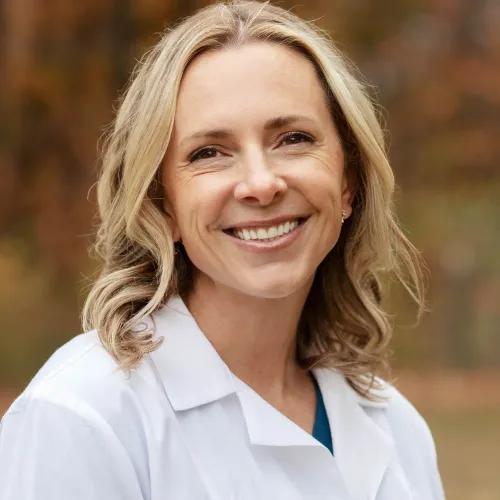
Rebecca Vartanian, MD
Clinical Associate Professor
Stay Informed
Want top health & research news weekly? Sign up for Health Lab’s newsletters today!
Featured News & Stories

Depression in OBGYN residents needs more attention, study suggests

A pediatric epilepsy fundraiser that changes lives

Better prenatal care data could help prevent maternal complications, experts say

What’s changing in Medicaid and what can you do?

PMOS is the New PCOS