Are 988 and other mental health crisis lines missing people over 50?
Poll finds 31% of older adults don’t know of any crisis line, and 69% haven’t heard of 988; lowest awareness is among men and Hispanic adults, who have high or rising suicide rates
8:00 AM
Author |

In the four years since the launch of the 988 Suicide & Crisis Lifeline, the nationwide service for mental health and substance misuse crisis support, Americans have dialed, texted or chatted online with the service over 26 million times.
The addition of 988 to the nation’s mental health crisis options makes it easier to get immediate counseling and access other help if needed.
But a new University of Michigan poll shows that many middle-aged and older adults still aren’t aware of these free services, or aren’t sure about using them.
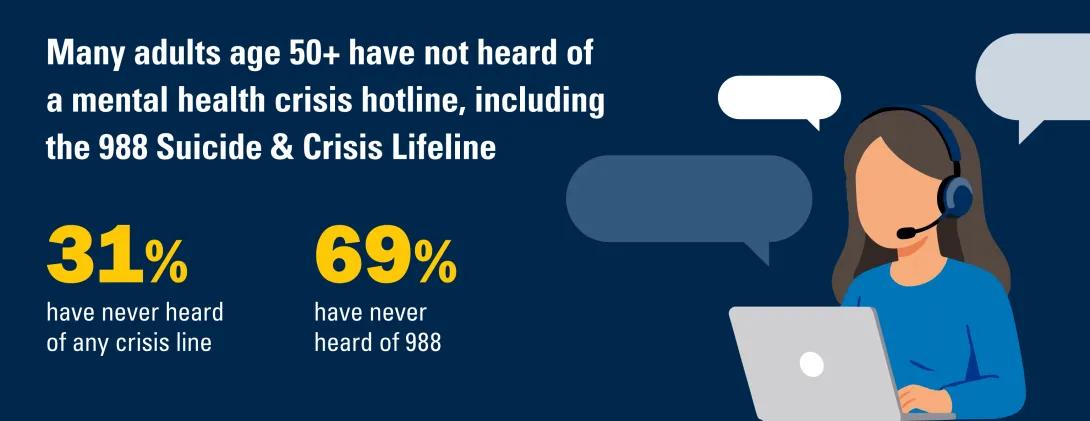
Among people aged 50 and over, 31% have never heard of any mental health crisis line, according to a new report from the National Poll on Healthy Aging, based at the University of Michigan Institute for Healthcare Policy and Innovation.
The majority of those polled (69%) had never heard of 988. But this includes 38% who had not heard of 988 but had heard of another mental health crisis line.
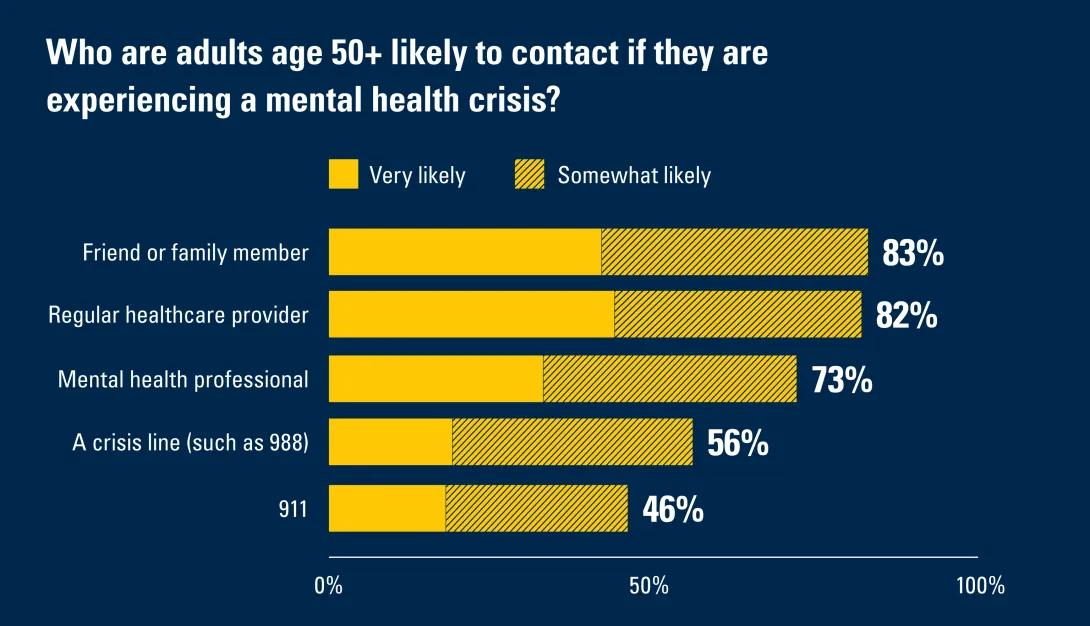
Asked what they would do in case of a mental health emergency, 56% of people aged 50 and over said they are very or somewhat likely to use a mental health crisis line.
And 46% also said they would be very likely or somewhat likely to call 911, which is intended for life-threatening situations, medical emergencies and crimes in progress, though it can send appropriate calls to 988.
“These data show a clear need to focus awareness-raising efforts on people over 50,” said Kevin Saulnier, Ph.D., an Assistant Professor in the U-M Department of Psychiatry and a clinical psychologist at the VA Ann Arbor Healthcare System who worked with the poll team. “No matter which crisis line they choose, they and those who love them should know that there’s someone available to talk, text or webchat with them at any hour of any day, for free.”
He notes that the 988 service also provides one-touch access to the Veterans Crisis Line, whose counselors specialize in helping veterans and current members of the military.
The poll is supported by Michigan Medicine, U-M’s academic medical center.
In addition to the national poll, the team also created a Michigan-specific report and data dashboard based on findings from Michigan adults aged 50 and over for the Michigan Poll on Healthy Aging, supported by the Michigan Health Endowment Fund.
On nearly all poll questions, older Michiganders had similar responses to their peers in other states, with one notable difference: If they were experiencing a mental health crisis, Michigan adults aged 50 and older were slightly more likely to say they would contact 911 (52% in Michigan vs. 46% in the rest of the U.S.).
The national 988 Lifeline is run by a nonprofit organization through federal grants; states and the federal government have provided temporary funding for the organizations that handle most of the 988 calls in each state, but most states including Michigan have not yet established ongoing sources of funding.
Differences in awareness and willingness to call
Men and people of Hispanic ethnicity were less likely than women and non-Hispanic white adults, respectively, to say they had heard of at least one mental health crisis line.
In fact, 46% of all Hispanic adults over 50 said they were not aware of any mental health crisis hotline.
The 988 Lifeline is available in Spanish as well as English and offers services for those who are deaf or hard of hearing and those who prefer to connect in other languages.
After asking about general awareness of 988 and other mental health crisis lines, the survey explained 988 to all respondents, then asked how comfortable they would be contacting 988 if they or a person they knew were experiencing a mental health crisis.
In all, 75% of all people aged 50 and older said they would feel at least somewhat comfortable contacting 988 once they received this explanation.
But men were much less likely than women to say they would feel comfortable reaching out to 988, at 68% vs. 81%.
Saulnier and fellow U-M and VA psychologist and mental health researcher Mark Ilgen, Ph.D., find these gaps especially concerning.
“Men in general have almost four times the suicide death rate as women, and the suicide rate among Hispanic adults has risen in recent years,” said Ilgen, who is a Professor of Psychiatry at U-M and a clinical psychologist at the VA Ann Arbor Healthcare System. “Suicide rates among all people over 50 are now higher than the rates among teens and young adults. Better awareness of what to expect when contacting a crisis line could be key to increasing use of such services, and might reduce the toll of suicide in this age group.”
Among adults aged 50 and older who had heard of 988, 4% said they had contacted the service since it launched. The percentage was higher among those aged 50 to 64 (6%) than among those age 65 and over (1%). Half of those who had contacted 988 said they had done so to get help themselves, and half said it was to help someone else.
Saulnier and Ilgen point to a recent Harvard University study that showed that suicide death rates among teens and young adults dropped faster than expected in the first two and a half years after 988 launched.
That study also looked at suicide trends among adults over 65 as a comparison. While it showed a drop after 988’s launch, it was much smaller than the drop among the people aged 15 to 34.
A role for healthcare professionals and others
The poll results suggest key roles in mental health crisis response for people who provide physical, mental and spiritual care to people over 50, and for their friends and relatives.
Most adults aged 50 and over said that in a mental health crisis, they would be very likely or somewhat likely to turn to a friend or family member (83%), their regular healthcare provider (82%), a mental health professional (73%), or someone in their religious community (37%).
A third of those polled (32%) said they had taken at least one action in the last year regarding their mental health, including 21% who had talked with a friend or family member about a mental health concern, 16% who had talked with their regular healthcare provider, 12% who had seen a mental healthcare professional, and 3% who had talked with a person in their religious community.
“Those of us who care for people over 50 in any capacity should look for opportunities to share information about 988 and other crisis services, because anyone can have a mental health crisis, or encounter a friend or family member who is having one,” said poll director Jeffrey Kullgren, M.D., M.S., M.P.H., Associate Professor of Internal Medicine at the U-M Medical School and a primary care physician at the VA Ann Arbor Healthcare System.
Confidentiality and privacy are paramount in healthcare, mental health services and spiritual care, he said, and a similar theme emerged in the poll data.
Half (49%) of the survey respondents expressed at least one concern about contacting 988, with privacy the most common, mentioned by 26%. Asked what might make them more likely to contact 988, 40% of all older adults mentioned the ability to remain anonymous.
Kullgren notes that 988 is confidential, in that it only collects the information shared by those who contact it and does not pinpoint their location. Its counselors get consent before sharing information with anyone, but like all healthcare providers they must follow state laws requiring reporting in situations where there is imminent risk of harm.
Saulnier, Ilgen and Kullgren are members of the VA Center for Clinical Management Research, and of IHPI. Saulnier and Ilgen are members of the U-M Eisenberg Family Depression Center.
About the poll
The 2025 poll findings come from a nationally representative survey conducted by NORC at the University of Chicago for IHPI and administered online and via phone in September 2025. The survey module on 988 went to 2,379 respondents age 50 to 95 from the AmeriSpeak panel. The Michigan-focused analysis includes 1,265 Michigan adults aged 50 to 93, including a non-probability oversample. Results are weighted to reflect each respective population.
Read past National Poll on Healthy Aging reports and Michigan findings, and learn about the poll methodology.

Health Lab
Explore thousands of health news & research stories by visiting the Health Lab homepage for more.
Media Contact

Public Relations
Department of Communication at Michigan Medicine
In This Story
Kevin Saulnier
Assistant Professor
Mark A Ilgen, PhD
Professor
Jeffrey Todd Kullgren, MD, MS, MPH
Professor
Related

How to help someone, or yourself, in a mental health crisis
1 in 3 older adults still experience loneliness and isolation
Featured News & Stories
Top 7 tips for choosing Medicare prescription drug coverage for 2027

Many older adults make Medicare decisions quickly and most don’t change plans, poll finds
What’s the latest on 7-OH and kratom availability and addiction care?

Depression in OBGYN residents needs more attention, study suggests
Pain, psychological factors and physical function closely linked in people with systemic sclerosis