AI supports home-based balance training
New machine learning model draws data from wearable sensors to predict how a physical therapist would assess balance training performance
2:20 PM
Author |
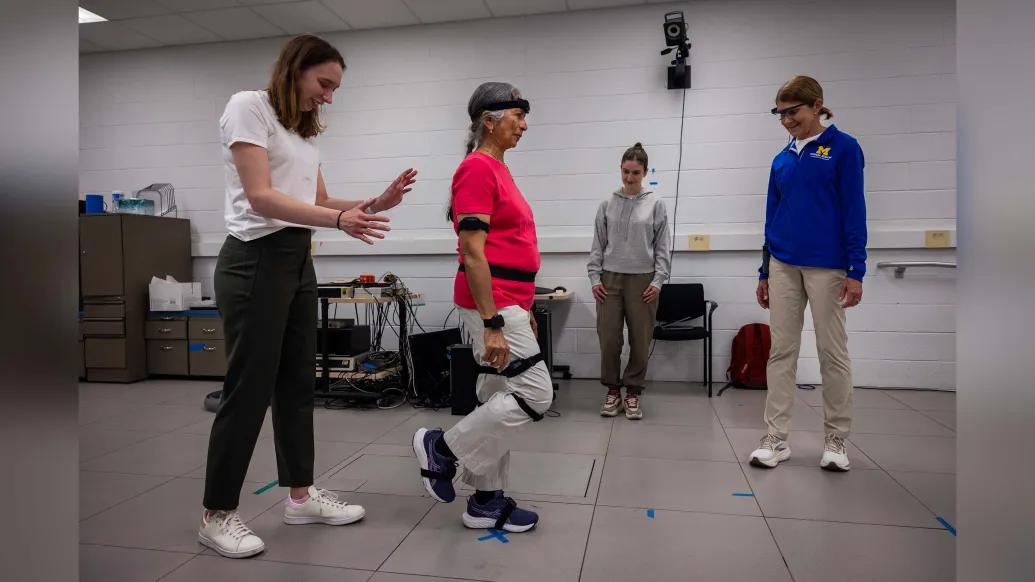
Balance training patients may soon be able to get AI feedback during home exercises, with four wearable sensors and a new machine learning model developed at the University of Michigan.
The team hopes that their technology could help patients make faster progress during physical therapy and maintain their abilities after the end of their prescribed sessions. It could also help physical therapists to make healthcare decisions.
“Our machine learning model used data from wearable sensors to predict how physical therapists would rate patients’ performance on balance exercises, providing a basis to make recommendations about the most appropriate set of exercises to perform next. This type of AI-based support would be helpful in between appointments or after people complete their insurance-reimbursed sessions with a clinician,” said Kathleen Sienko, an Arthur F. Thurnau Professor of mechanical engineering at U-M and senior author of the study in the Journal of NeuroEngineering and Rehabilitation.
The model was built from sensor data combined with analysis from physical therapists, and its development was funded by the National Science Foundation and U-M AI & Digital Health Innovation.
Balance training helps reduce the risk of falls, helping older adults and those with sensory and motor impairments live independent lives for longer.
Typically, physical therapists assess the amount of difficulty patients experience while balancing by observing them during in-clinic sessions.
The next exercise they suggest must be sufficiently challenging—balance improvements only happen when the neuromuscular system is pushed beyond current abilities—while keeping the patient safe.
In addition to supporting the care of patients with local access to physical therapists, the researchers are also exploring the possibility of providing rural patients with remote care, lifting the burden of long drives while keeping a clinician in the loop.
“Understanding what the patient and the therapist need has to be part of the algorithms we put together. I'm excited to merge different types of data to create a decision support system for both parties,” said Leia Stirling, a professor of industrial and operations engineering and robotics at U-M and co-author of the study.
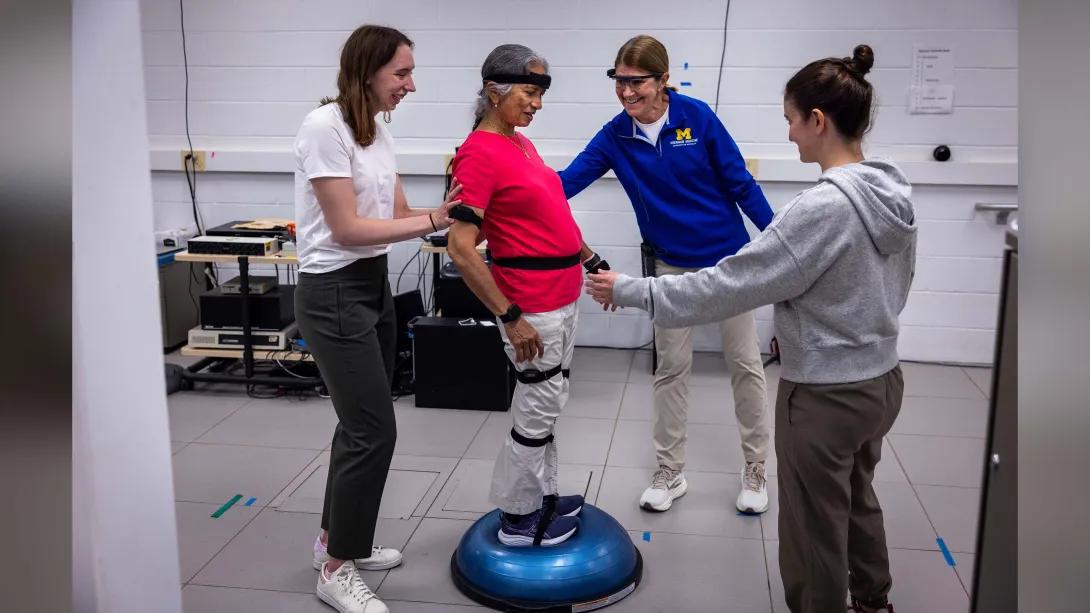
To build the model, researchers filmed participants doing standing balance exercises at various levels of difficulty while wearing 13 sensors attached with velcro straps.
The sensors, called inertial measurement units, measure acceleration and rotational motion to detect sway and movements of the major body segments.
Physical therapist study participants watched the videos to evaluate how hard the balancing participants were working on a scale from one to five for each exercise.
Using the sensor data, the research team trained convolutional neural networks—a class of machine learning models that learn spatial features from image data—to predict balance difficulty.
Then, they compared the machine learning model's prediction with the physical therapists’ average score for each balance participant.
The team’s model predicted patients’ balance ratings with nearly 90% accuracy, which is within a point of expert ratings on the same scale.
While the study tested 13 sensors, a sensitivity analysis found just four sensors—placed on each thigh, the low back and upper back—were sufficient to maintain model performance.
“It is very important to understand both the strengths and potential failure modes of machine learning in physical therapy, where people’s well-being is directly at stake. For example, an overfitted model may perform poorly with new patients, leading to mispredictions and unsafe exercise recommendations. To protect patients, these systems should be validated on real-world data and used with therapist oversight so unexpected or risky suggestions can be caught before harm,” said Xun Huan, associate professor of mechanical engineering at U-M and co-author of the study.
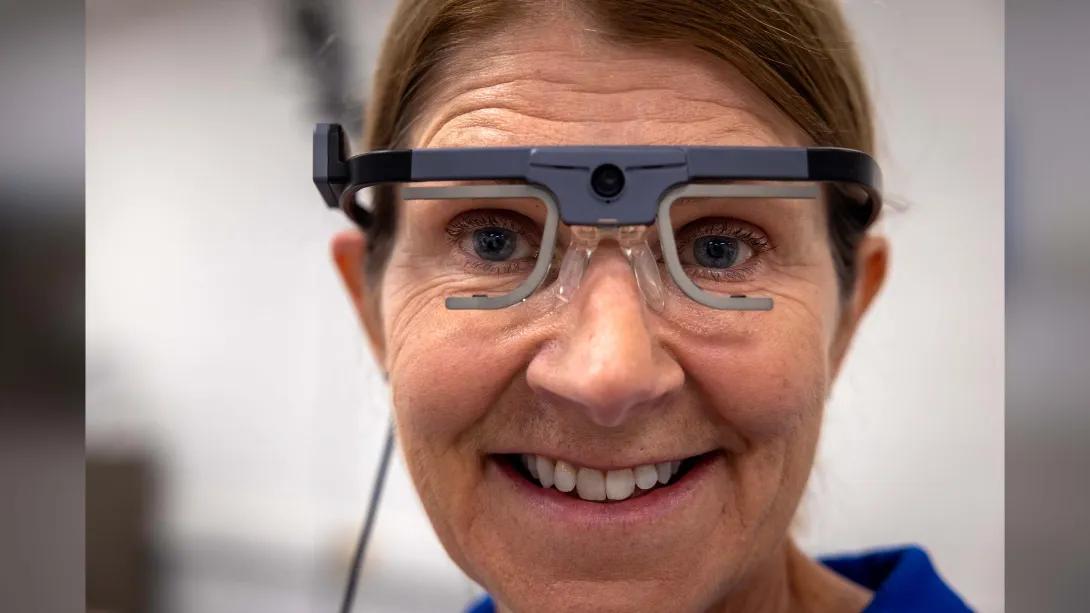
In a second related study, published in IEEE Transactions on Neural Systems and Rehabilitation Engineering, physical therapists wore eye tracking glasses and provided explanations of their assessments while the participants performed these standing balance exercises.
Analyzing where physical therapists focus attention as exercises become more difficult helped researchers understand their decision-making process.
“It was interesting to see how complicated the physical therapists’ balance assessments are and to consider how best to capture the factors they consider in our models,” said Emma Nigrelli, a doctoral student of mechanical engineering at U-M and lead author of the eye tracking study.
Moving forward, the team hopes to contribute the technical grounding and background for machine-learning-assisted balance training technology to be widely available.
“In some regions, access to physical therapists specializing in balance rehabilitation may not be possible,” Sienko said.
“I was excited by the possibility of developing something that could expand access to services like balance training—not only for people in rural areas across the U.S. who may lack regular access to physical therapists, but also for individuals globally.”
The team is seeking partners to bring the technology to market.
Additional authors: Safa Jabri, Jeremiah Hauth and Lauro Ojeda of U-M mechanical engineering; Wendy Carender of the Michigan Medicine Department of Otolaryngology; and Jenna Wiens of U-M computer science and engineering also contributed to this research.
Funding: This research was funded by the National Science Foundation (CMMI-2125256; 2125256) and the University of Michigan.
Paper cited: "Automatic multi-IMU-based deep learning evaluation of intensity during static standing balance training exercises." DOI: 10.1186/s12984-025-01760-3

Health Lab
Explore thousands of health news & research stories by visiting the Health Lab homepage for more.
Media Contact

Public Relations
Department of Communication at Michigan Medicine
Stay Informed
Want top health & research news weekly? Sign up for Health Lab’s newsletters today!
Featured News & Stories

The AI is listening: Implications of machine generated clinical notes on health care

U-M Board of Regents approves construction of Nathan and Catherine Forbes Sports Medicine Institute

Emergency room intervention pairs smartphone, telehealth counseling to reduce risky firearm behavior

Digital alerts support timely treatment decisions of critically ill cardiac patients

Rural-urban disparities in head and neck cancer