4-year-old’s sudden cardiac arrest reveals life-threatening heart arrythmia
Ireland never showed any symptoms of her rare congenital heart condition until it caused her to collapse after playing outside.
5:00 AM
Author |
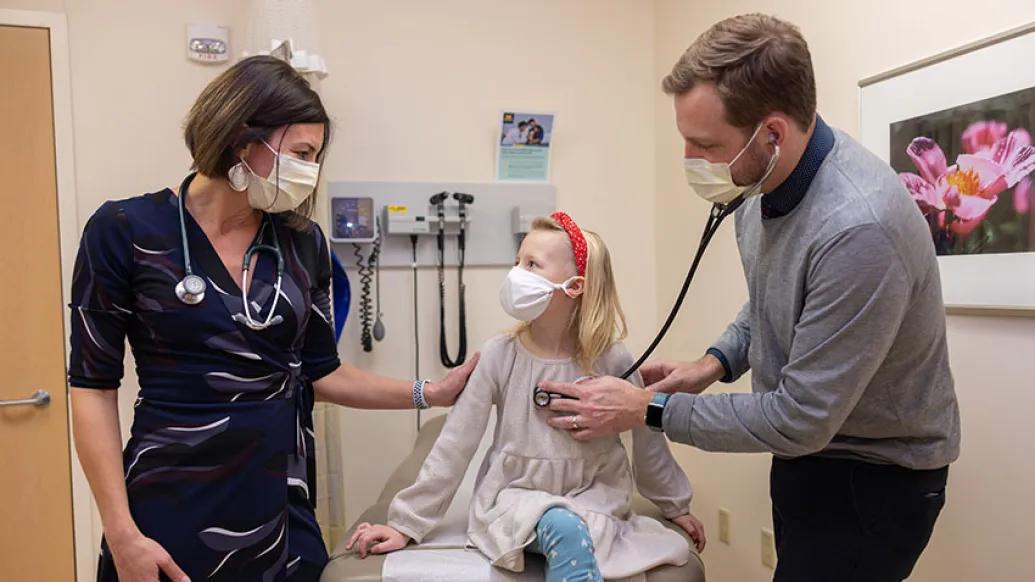
From the outside, all of Ireland Nagorsen's organs appeared healthy and thriving.
Fetal scans showed a vibrant heartbeat. Newborn screening tests came back all clear.
But unbeknownst to her family, their baby girl was in fact born with a rare, life-threatening congenital heart condition that's unlikely to be detected before or after birth. Its symptoms often strike unexpectedly and without warning.
And for Ireland, that day was August 30, 2020 when she had a sudden cardiac arrest at four years old.
It was a hot summer afternoon, and the preschooler was with her two sisters and neighbors at her South Lyon home, playing in the yard, alternating between jumping on a trampoline and splashing around an inflatable water slide.
Suddenly, she raced into the house. Her dad, Ryan, followed her inside to find her lying on the floor. He thought maybe there'd been a sibling squabble, or she was upset about something.
But he knew it was much more serious when his youngest daughter turned blue.
Ireland's hidden, irregular heart rhythm had caused her to collapse.
"We thought she was choking," her mom Karla remembered. "I ran to get a new neighbor who I'd heard was a nurse. I said 'aren't you a nurse? My daughter isn't breathing.'"
The neighbor, Nicole Mancha, R.N. – now a close family friend – was in fact a labor and delivery nurse at University of Michigan Health Von Voigtlander Women's Hospital. She rushed over and immediately began performing CPR on Ireland. When the paramedics arrived, they hooked Ireland up to an automated external defibrillator, or an AED, which delivers electrical shocks to help the heart re-establish an effective rhythm.
"They had to shock her several times both at the house and in the ambulance to bring her back to life," Karla said. "I was just numb. I couldn't feel anything. It was so surreal."
A cardiac arrest is often the first sign of illness, which is what makes it so difficult to prevent and treat.Benjamin Hale, M.D.
Ireland was taken to University of Michigan Health C.S. Mott Children's Hospital where she crashed yet another time in front of her parents.
In order to support her unstable heart rhythm, care teams put Ireland on extracorporeal membrane oxygenation, or ECMO, so the machine could temporarily perform the work of her heart and lungs, taking the strain off her own organs while she recovered. She stayed at the hospital for two weeks.
Learning about catecholaminergic polymorphic ventricular tachycardia
That's when the Nagorsens first learned their daughter had a heart arrythmia known as catecholaminergic polymorphic ventricular tachycardia, or CPVT, caused by the heart's electrical system not working properly. Many people with the condition may not experience any symptoms until adolescence or adulthood, and some may never see any signs at all.
"This is a dangerous and life threatening arrythmia that can be triggered by exertion, adrenaline, emotion, stress or excitement," said Benjamin Hale, M.D., a pediatric electrophysiologist at the Mott Congenital Heart Center who sees Ireland. "A cardiac arrest is often the first sign of illness, which is what makes it so difficult to prevent and treat."
While Ireland was the first in her family to have it, CPVT is hereditary and people with the condition have a high chance of passing it to their children. Once someone is diagnosed with CPVT, their parents, siblings and even extended family are encouraged to undergo genetic counseling and testing.
If family members do discover they too have the gene mutation, Hale says, the information helps them and their doctors make treatment decisions to prevent a cardiac arrest. At Mott, a genetic counselor specializing in inherited heart problems is part of the comprehensive integrated arrythmia congenital heart team, as well as electrophysiology experts.
CPVT is also among several conditions that can lead to Sudden Arrhythmia Death Syndromes (SADS), genetic heart diseases that may cause sudden death in young, apparently healthy people. An estimated 210,000 Americans of all ages die suddenly and unexpectedly due to SADS every year, according to the American Heart Association.
"By the time symptoms appear, it could be fatal. That's why recognizing signs of cardiac arrest and knowing CPR are critical," said Brynn Dechert-Crooks, N.P, who sees Ireland at Mott and serves on the Board of Trustees for the SADS Foundation, a non-profit advocacy and networking group that raises awareness about warning signs of heart rhythm abnormalities and provides resources to both families and physicians.
"These conditions are rare but can lead to sudden cardiac arrest. The best way to prevent a tragic outcome is knowledge and preparation in the community. The use of CPR and AEDs can save lives."
Ireland's parents have also since become CPR trained and joined the SADS Foundation.
"We never could have imagined something was wrong with her heart," Karla said. "There were no signs of any health issues, and she could always keep up with the best of them."
"If we would have waited any longer to get her help, she could have had brain damage or other long-term impacts," she added. "She could have not been here at all. Our life could be completely different."
Feisty and thriving
Now six and in kindergarten, Ireland is back to being a regular active kid.
Her mom describes her as feisty and full of "future CEO" qualities. She loves dressing up like princesses, wearing high heels, "being in the spotlight" and playing with sisters Harper, 11 and Hazel, 9.

She takes medication to prevent overexertion and has an implantable loop recorder under the skin of her chest to help her care teams continuously monitor her heart rhythms.
Treatment allows Ireland to safely participate in favorite activities like ballet and jazz dance, and her family is even taking their first vacation to Disney World this year.
"We've learned to slow down and appreciate the little things because you just never know," Karla said.
"We're so thankful she was taken to Mott where we know she got the best care possible," she added. "Ireland's been able to live a full happy life and have all of these moments with us. You'd never know she has a heart condition. She's totally thriving."

Health Lab
Explore thousands of health news & research stories by visiting the Health Lab homepage for more.
Media Contact

Public Relations
Department of Communication at Michigan Medicine
Stay Informed
Want top health & research news weekly? Sign up for Health Lab’s newsletters today!
Featured News & Stories

Lung health expert weighs in on Zyn and other nicotine pouches
Many young adults may not be ready to manage their own health care

E-bikes are faster than ever. Are families prepared for the risks?
Beyond the White Coat: Global & Local Health Experiences
Aortic valve replacement: Understanding TAVR and SAVR