3-D Printing Helps Surgeons Sharpen Their Craft
Printed simulations of lifelike body parts allow surgeons-in-training the opportunity to practice complex surgeries before assisting with the real thing.
1:00 PM
Author |
Cher Zhao recently had the rare opportunity to practice skills belonging to the most advanced surgeons: reconstructive cartilage grafting.
The setting, however, was fitting for the University of Michigan Medical School resident.
MORE FROM THE LAB: Subscribe to our weekly newsletter
Scalpel in hand, Zhao sat at a table and carved precise measurements out of realistic material designed to mimic the texture of human cartilage.
In the real world, these shapes would be cut from a patient's rib for grafts used for airway or ear reconstruction. In these procedures, then, it's vital that the pieces are carved exactly right.
The tool providing Zhao and her peers this immersive experience? Three-dimensional models based on real human cases.
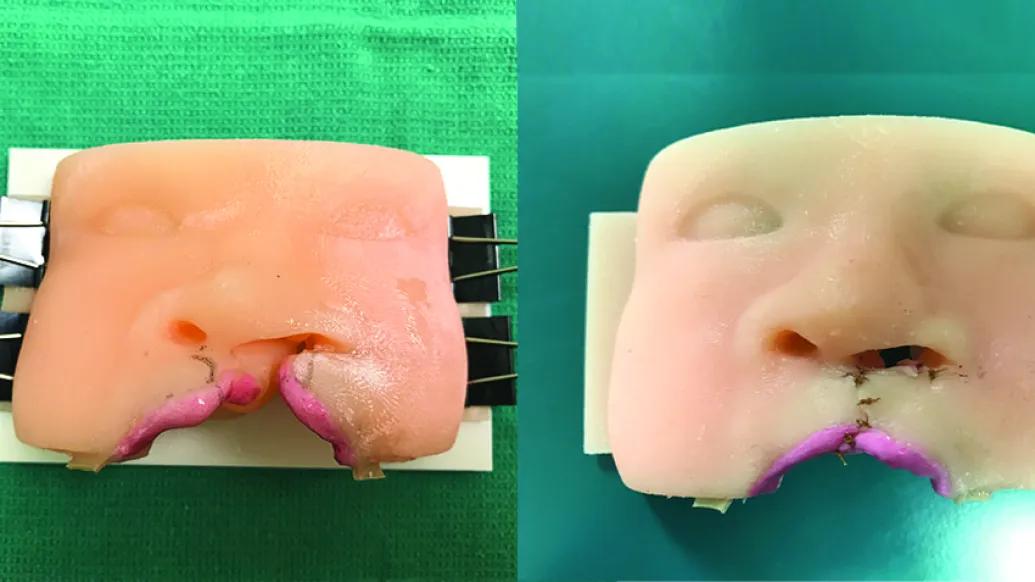
Surgical training is one more way U-M researchers are using 3-D printing to advance the quality of care. The lifelike printed replicas provide a cost-efficient tool to improve practical experience for more trainees such as Zhao, U-M researchers say in an article published in Otolaryngology–Head and Neck Surgery.
Historically, a surgeon's skills have been acquired in live patients, anesthetized animals or human cadavers, but authors say surgical simulation is increasingly recognized as a vital educational tool.
"3-D printing is bringing a whole new meaning to hands-on experience for surgeons-in-training," says David Zopf, M.D., the article's senior author and a pediatric head and neck surgeon at the University of Michigan C.S Mott Children's Hospital.
"Hands-on experience is critical for acquiring and improving surgical skills, especially of new and complex procedures," adds Zopf, who keeps a laser 3-D printer in his office. "This is an exciting tool that not only offers trainees exposure to opportunities they otherwise wouldn't have, but that also allows them to demonstrate proficiency of skills before being performed on children."
Endless potential
Mott teams have used 3-D printing for almost six years, with the ability to now produce models at a low cost and a much faster rate. The models are based on computer designs of CT scans.
The technology can be applied in many ways.
Groundbreaking 3-D printed splints made at U-M have helped save the lives of babies with severe tracheobronchomalacia, which causes the windpipe to periodically collapse and prevents normal breathing. Mott has also used 3-D printing on fetal models to plan for potentially complicated births.
It also has been applied to complex cases involving surgical tumor removal, including using the full replica of a young patient's skull to plan a best course of action.
Such breakthroughs are particularly valuable in pediatric surgery when there are few alternative options for hands-on training.
"Airway reconstruction for specialized cases is a technically demanding procedure that often involves carving cartilage to support and expand a reconstructed trachea," says Zopf, who has helped develop high-fidelity models for ear reconstruction, cleft lip and mandible surgeries.
"Currently, a surgeon in training has scarce opportunity to carve cartilage graft for this type of procedure. We want to see if 3-D printing can accelerate and enhance surgical training."
Practice makes perfect
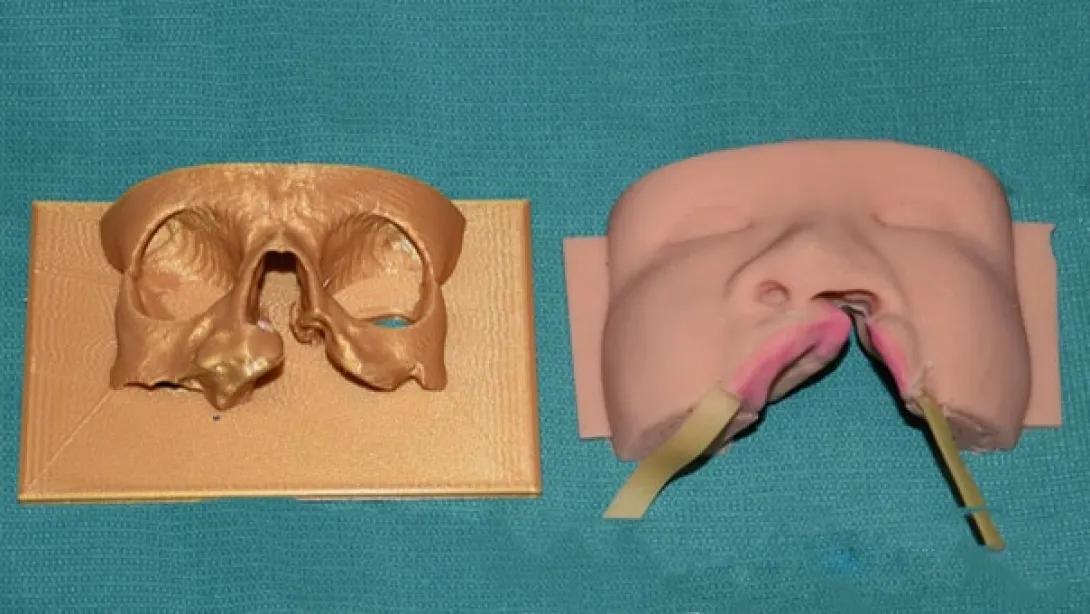
Eighteen surgical trainees in a U-M otolaryngology head and neck surgery dissection course, including Zhao, participated in the exercise last year. They practiced carving on a 3-D printed model of a harvested human cartilage graft created through a CT scan of a pediatric patient's rib. The mold was filled with cornstarch and silicone to give it the feeling and texture of cartilage.
SEE ALSO: How Printing a 3-D Skull Helped Save a Real One
Most participants said that the exercise was a relevant training tool and that the replicas were useful in demonstrating their skills to teachers.
Zhao says the experience may bolster medical training, especially for doctors-to-be like herself who plan to specialize in pediatric otolaryngology treating children with airway disorders.
"You only get one chance to carve a harvested graft from a patient's rib, so you have to do it perfectly the first time," she says. "It takes years of practice to learn the technical skills to do it. This was a very realistic experience, and what's great is you can keep printing dozens of these models at a time so you can practice over and over again."

Health Lab
Explore thousands of health news & research stories by visiting the Health Lab homepage for more.
Media Contact

Public Relations
Department of Communication at Michigan Medicine
Stay Informed
Want top health & research news weekly? Sign up for Health Lab’s newsletters today!
Featured News & Stories

High dose oxytocin protocol linked to lower postpartum hemorrhage rates

4 ways to teach your teen safe driving habits

Continuing the legacy of a doctor’s doctor

Top 7 tips for choosing Medicare prescription drug coverage for 2027
U-M-led consortium to receive up to $52 million in NIH funding to study why viral respiratory infections affect children differently