12-year-old shares journey with sickle cell anemia on Capitol Hill
As a young child, E’Shon was frequently hospitalized but emergency visits have become rare following a lifechanging procedure
5:00 AM
Author |

For E’Shon Guy, frequent and spontaneous medical crises meant spending birthdays in the hospital, missing school regularly and needing emergency care more than two dozen times throughout his childhood.
The 12-year-old recently took his story to Washington, D.C., sharing with lawmakers how specialized treatment transformed his life with sickle cell disease.
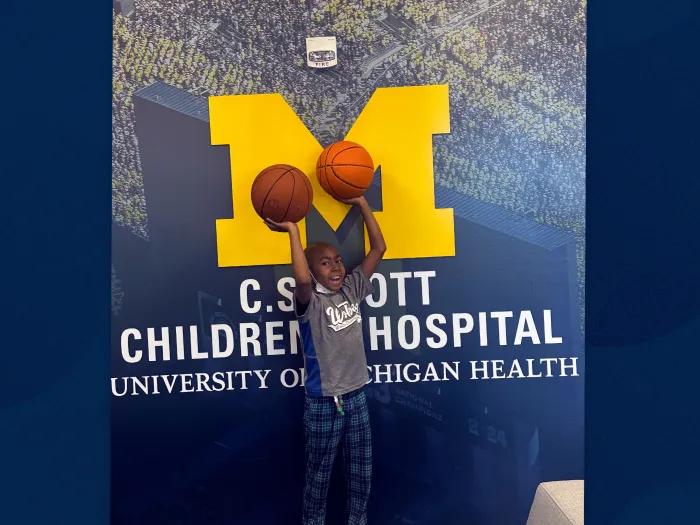
E’Shon and his parents spoke with members of Congress about the challenges of growing up with the chronic condition and how a procedure at University of Michigan Health C.S. Mott Children’s Hospital helped him regain a more normal childhood.
“It’s important to keep kids healthy and make sure they get the best medical care,” E’Shon said.
As part of the Children’s Hospital Association’s Family Advocacy Day, E’Shon and his family traveled from their home in Lansing to the nation’s capital to advocate for children’s health.
“No kid deserves to be sick. We wanted government leaders to understand how grateful we are for E’Shon’s excellent medical care and the health coverage that made it possible for him to get the treatment he needed so he could just be a kid,” said E’Shon’s mother, Virona Guy.
“We always knew how much the doctors and nurses truly cared about E’Shon and that they were committed to finding the best answers for him. Without the incredible care E’Shon received and the expert team that supported him, my son might not be here.”
Living with severe sickle cell disease
Shortly after E’Shon’s birth, newborn screening revealed he had Hemoglobin SS, or HbSS, the most common and severe form of sickle cell disease.
The inherited blood disorder causes red blood cells to become rigid and crescent-shaped instead of their normal round, flexible form.
These misshapen cells can become trapped in small blood vessels, leading to blockages, severe pain and complications such as organ damage, stroke and anemia.
Children with sickle cell disease often require regular blood transfusions to increase the number of healthy red blood cells and help manage symptoms.
Starting at nine months old, E’Shon would experience unpredictable medical emergencies caused by sickled cells becoming trapped, leading to dangerous drops in hemoglobin levels and blood volume.
His family lived with the constant uncertainty of not knowing when the next crisis would occur. Each episode typically required a hospital stay of at least five days.
No kid deserves to be sick. We wanted government leaders to understand how grateful we are for E’Shon’s excellent medical care and the health coverage that made it possible for him to get the treatment he needed so he could just be a kid."
- E'Shon's mother, Virona Guy
“There’s no rule book for raising a kid with sickle cell disease because every child is different,” E’Shon’s father, Eric Guy, said. “But you know your child and you know when they’re sick. As a parent you just want to fix it. You don’t want them to be in pain.”
Since infancy, E’Shon has received care through the pediatric hematology team at C.S. Mott Children’s Hospital at UM Health-Sparrow.
When he was in elementary school, his family was referred to U-M Health C.S. Mott Children’s Hospital in Ann Arbor where specialists consulted with colleagues across the country to determine the best treatment approach.
After a thorough review of his case, the team recommended a partial splenectomy, a procedure that removes part of the spleen to prevent recurrent blood trapping while preserving the organ’s important immune function.
At age eight, E’Shon underwent the procedure at Mott. Since then, emergency room visits have become rare. He’s been able to enjoy family vacations and spend more time doing the things he loves, including playing basketball, riding his dirt bike and fishing.
“For E’Shon, a partial splenectomy was life changing because he kept having recurrent episodes of splenic sequestration, in which his sickled red blood cells would get stuck inside his spleen, trapping his blood and leading to life-threatening situations,” said David Svilar, M.D., Ph.D., pediatric hematologist-oncologist at UM Health-Sparrow.
“It has been so rewarding to see him go from a situation in which he was frequently hospitalized and needing recurrent blood transfusions to now rarely needing hospitalization.”
New advances offer hope for patients with sickle cell disease
Sickle cell disease is the most common inherited blood disorder in the United States, affecting approximately 100,000 Americans, including an estimated 3,500 Michigan residents, and millions more worldwide.
Treatment options for the condition continue to advance. U-M Health recently began offering mesenchymal stem cell therapy, which received FDA approval in December 2024.
The treatment helps regulate immune system activity and repair damaged tissues.
SEE ALSO: Expert Q&A: Reeves on the state of Sickle Disease in Michigan
The health system also offers groundbreaking gene therapies for sickle cell disease, including CRISPR-based gene editing treatments for patients whose disease cannot be adequately managed through traditional therapies.
While these therapies represent exciting advances, they still carry significant risks and potential side effects, Svilar notes.
He said his team works closely with specialists at Mott to identify patients who may be eligible for and benefit from potentially curative treatments.
Meanwhile, the Michigan Department of Health and Human Services recently awarded U-M Health funding to support pediatric patients as they transition to adult care through the new Comprehensive Adult Sickle Cell Disease Program.
The program is led by Lauren Shevell, M.D., clinical assistant professor of hematology and internal medicine, and Jennifer Jones, M.D., clinical assistant professor of blood banking pathology, internal medicine and hematology at Michigan Medicine.
Shevell and Jones say the new clinic aims to support a seamless continuum of care to help improve health outcomes and quality of life for adults living with sickle cell disease across southeast Michigan.
Bringing a patient perspective to policymakers
Children’s Hospital Association’s Family Advocacy Day brings together patients and parents from more than 50 children’s hospitals across the country to encourage lawmakers to support policies that protect children’s access to health care.
During their visit, the Guys had the chance to meet with Congresswoman Hillary Scholten, Congresswoman Debbie Dingell and Congressman Tom Barrett, as well as staff members from the offices of Congressman John Moolenaar and Congressman Tim Walberg.
“Part of what is amazing about E’Shon going to Washington, D.C., as a sickle cell advocate is the fact that so many of us have known him since he was a baby,” said Cindy Meteyer, CPNP, CPHON, nurse practitioner with the pediatric hematology-oncology team at UM Health-Sparrow.
“It’s an honor to be part of E’Shon’s story, and we are grateful for the trust he and his family place in our care.
“We caregivers can talk all day about the effect that sickle cell disease can have on kids and their families, but nothing is more impactful than hearing it from patients with lived experience,” she added. “We could not be prouder of E’Shon for representing the local sickle cell disease community.”
Sign up for Health Lab newsletters today. Get medical tips from top experts and learn about new scientific discoveries every week.
Sign up for the Health Lab Podcast. Add us wherever you listen to your favorite shows.

Health Lab
Explore thousands of health news & research stories by visiting the Health Lab homepage for more.
Media Contact

Public Relations
Department of Communication at Michigan Medicine
Related
First U-M patient receives newly FDA-approved stem cell therapy for sickle cell anemia
Stay Informed
Want top health & research news weekly? Sign up for Health Lab’s newsletters today!
Featured News & Stories
First U-M patient receives newly FDA-approved stem cell therapy for sickle cell anemia

Better prenatal care data could help prevent maternal complications, experts say

FDA-approved drug offers hope for patients with polycythemia vera, a rare bone marrow disorder
Pediatric patient treated for rare kidney cancer

E-Bikes are everywhere, but most parents say they don’t know enough about them