What to Know About Monkeypox
An outbreak of a pox virus, not typically found in Europe and North America, has many on alert.
Transcript
Host (00:00):
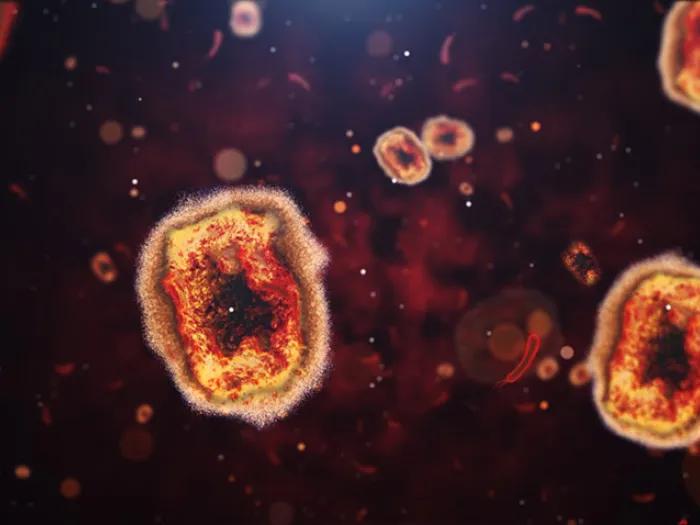
Welcome to the Michigan Medicine News Break, your destination for news and stories about the future of healthcare. Today, Monkeypox: how to protect against the rare viral threat. An outbreak of a pox virus not typically found in Europe and North America has many on alert. Infectious disease and public health specialists have raised an alarm as cases of monkeypox have spread throughout Europe and the United States. Monkeypox is a member of the orthopox family of viruses, related to smallpox virus, which was eradicated through vaccination in 1980. In today's episode, we'll be sharing insights from infectious disease specialist, Dr. Sandro Cinti, as he answers some basic questions about monkeypox and how to protect yourself.
Host (00:54):
First question, how does monkeypox spread? Dr. Cinti says monkeypox does not spread like flu or COVID. It spreads via close personal contact, including during sexual encounters. At the moment, it's been spreading mostly among men who have sex with men, but it can also be transmitted among family members who are in close contact, though not very efficiently. This is not an extremely transmissible disease, nowhere near the level of COVID or influenza. Contact usually requires more than three hours of exposure within six feet, and usually direct contact with lesions rather than respiratory droplets. It can also spread via contaminated linen and clothing.
Host (01:45):
The World Health Organization is currently saying this does not constitute a global public health emergency and has not widely spread within the community. If there begin to be more cases spreading in a way that is different, including droplet transmission, Dr. Cinti thinks the WHO might revisit it as an emergency.
Host (02:08):
Question number two, how would you recognize if you had monkeypox? Dr. Cinti notes the lesions are not subtle and are bigger than chicken pox. They can be on the face, hands, and the trunk or your abdomen, and for the first time we are seeing them sexually transmitted and so lesions can be on the genital or perianal area as well. People who have these lesions should avoid sexual contact. People can also experience fevers, chills, and lymph node swelling. Sometimes that occurs before the rash appears. However, in this outbreak, those symptoms have been less frequent. Some clinicians may not recognize the lesions, which can sometimes look like a pimple, skin ulcer, and sometimes be with a divot in the center. Any unusual skin lesions should be investigated.
Host (03:06):
Question number three, how widespread is this current outbreak? Dr. Cinti says this outbreak is so far relatively small at more than 7,594 cases worldwide, and more than 700 cases in the United States. But it is notable because it is transmitting outside of West Africa, where it is endemic and is spreading among people in other countries and people with no contact with West Africa.
Host (03:36):
Question number four, what is the best way to protect yourself from monkeypox? Dr. Cinti says have protected sexual contact and avoid touching someone with skin lesions. If someone has been infected, they should contact their public health department to determine how to reduce the risk of transmission. A person with a monkeypox infection should wear a mask and avoid close contact with others until the skin lesions are completely healed, which can take up to two weeks.
Host (04:08):
It is a long course for people who get infected. Dr. Cinti wants to stress that the risk to the public is very low. Most of the cases have been transmitted through sexual contact. If you have been exposed to monkeypox, whether that's through a close family member or a sexual partner, please contact your physician or public health.
Host (04:32):
Last question. Are there any treatments for monkeypox? Dr. Cinti notes there are antiviral therapies for people with severe cases, but monkeypox will resolve without any treatment. Very few people have been hospitalized and no one has died, which is good news, and there is a vaccine available, but most people won't qualify for it. However, if someone has had a significant exposure, there is a possibility of receiving the vaccine to prevent illness. Having said that, the general population does not need vaccination.
Host (05:09):
For more on this story and for others like it, visit uofmhealth.org/healthblogs and find the Michigan Medicine News Break wherever you listen to podcasts.

Health Lab Podcast
Listen to more Health Lab podcasts - a part of the Michigan Medicine Podcast Network.
Related
Monkeypox: How to protect against the rare viral threat
Featured News & Stories

Got cyclosporiasis? How to take care of yourself and others
NASCAR star’s death shows how sepsis can kill anyone if not caught
Hantavirus: Do we need to worry about this rare infection?
Measles: 10 things to know about immunization and prevention
Why aren’t more older adults getting flu or COVID-19 shots?