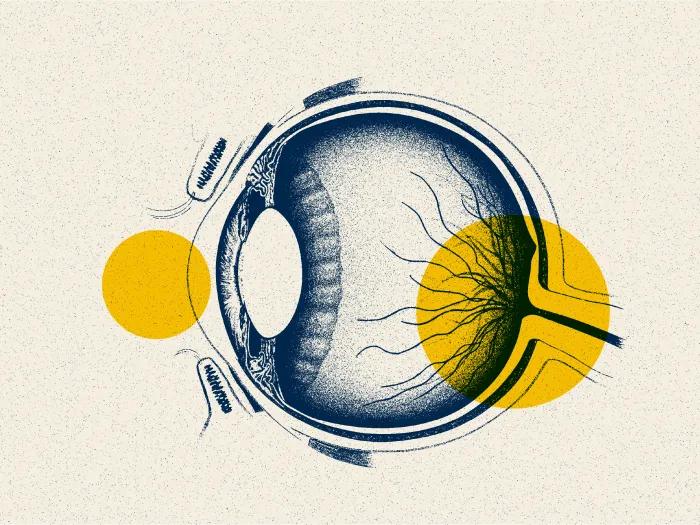
How rescuing dying cells may help preserve vision loss
Cell death in photoreceptor cells is reversible, study finds
8:00 AM
Removal of damaged mitochondria can rescue dying photoreceptor cells. Read the full article here.
Transcript
Host:
Welcome to Health Lab, your destination for news and stories about the future of healthcare.
Today: A new study finds that cell death in photoreceptor cells is reversible, and that removal of the damaged mitochondria can rescue dying photoreceptor cells.
Photoreceptors are specialized cells in the eye that convert light energy into neural signals.
Several diseases that cause irreversible vision loss, such as age-related macular degeneration, retinitis pigmentosa and retinal detachment, are associated with dying photoreceptors.
While there are many molecular pathways that result in cell death, there are also many that try to keep the cell alive.
In a new study published in Cell Death & Disease, a team of researchers from the University of Michigan found that functional mitochondria are key to the recovery of dying photoreceptor cells.
Apoptosis is the main pathway by which cells die, and this process was traditionally viewed as irreversible.
Researchers have recently found that cells can recover from activation of the apoptotic process if the signal that triggered it is removed.
In the study, the team used cell lines from mice to see if the same results were also seen in photoreceptor cells.
Using chemicals or low oxygen conditions that mimic stressors, researchers were able to stimulate the cells to undergo apoptosis.
When they removed the stress, regardless of how far the cells had been in the death process - the cells recovered.
Dr. David Zacks, M.D., Ph.D., Professor of Ophthalmology and Visual Sciences and member of the Caswell Diabetes Institute says, “These results were exciting because even if we can’t cure the underlying disease, we can try to activate those survival pathways and keep cells alive.”
Mitochondria, the cell’s batteries, play an important role in apoptosis.
During this process, the formation of dysfunctional mitochondria triggers more pathways that result in cell death.
The researchers found that the mitochondria in mouse cell lines recovered when the apoptotic stress was removed.
This recovery was aided by mitophagy, the process by which cells remove dysfunctional mitochondria.
Dr. Zacks says, “It’s like having a corroding battery in the cell that is leaking toxins. Mitophagy gets rid of those bad batteries.”
The team is working on understanding what pathways help the photoreceptor cells recover and which retinal diseases can benefit from the recovery process.
A reminder that all Health Lab content including health news, best practices and research insights are for informational purposes only, and are not a substitute for professional medical guidance. Always seek the advice of a health care provider for questions about your health and treatment options.
For more on this story and for others like it, visit michiganmedicine.org/health-lab where you can also subscribe to our Health Lab newsletters to receive the latest in health, wellness and medical research information to your inbox each week. Health Lab is a part of the Michigan Medicine Podcast Network, and is produced by the Michigan Medicine Department of Communication. You can subscribe to Health Lab wherever you listen to podcasts.

Health Lab Podcast
Listen to more Health Lab podcasts - a part of the Michigan Medicine Podcast Network.
Featured News & Stories

Medical students develop novel technological solutions for unmet patient needs

The Kidney Warning Signs You’re Missing— And Why Waiting is Dangerous

The Power of Mattering
Susan J. Lane: Gratitude and Giving

Beyond the White Coat: Balance, Burnout and Being Human in Med School