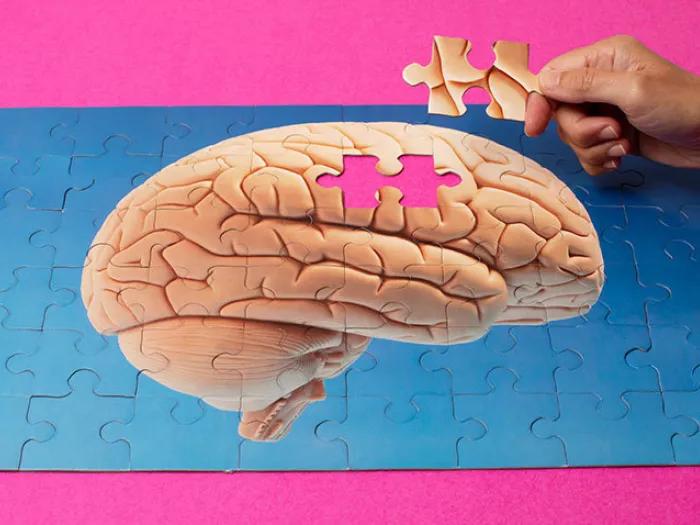
Evidence of Conscious-like Activity in the Dying Brain
A study finds intriguing brain wave patterns in comatose patients who died following cardiac arrest.
Transcript
Host:
Welcome to the Michigan Medicine News Break, your destination for news and stories about the future of healthcare. Today: Evidence of conscious-like activity in the dying brain. A study finds intriguing brain patterns in comatose patients who died following cardiac arrest.
Reports of near-death experiences--with tales of white light, visits from departed loved ones, and hearing voices, among other attributes—capture our imagination and are deeply engrained in our cultural landscape.
The fact that these reports share so many common elements begs the question of whether there is something fundamentally real underpinning them—and that those who have managed to survive death are providing glimpses of a consciousness that does not completely disappear, even after the heart stops beating.
A study published in the Proceedings of the National Academy of Science, provides early evidence of a surge of activity correlated with consciousness in the dying brain.
The study, led by Jimo Borjigin, Ph.D., associate professor in the Department of Molecular & Integrative Physiology and the Department of Neurology, and her team is a follow up to animal studies conducted almost 10 years ago in collaboration with George Mashour, M.D., Ph.D., the founding director of the Michigan Center for Consciousness Science.
Similar signatures of gamma activation were recorded in the dying brains of both animals and humans upon a loss of oxygen following cardiac arrest.
“How vivid experience can emerge from a dysfunctional brain during the process of dying is a neuroscientific paradox. Dr. Borjigin has led an important study that helps shed light on the underlying neurophysiologic mechanisms,” said Mashour.
The team identified four patients who passed away due to cardiac arrest in the hospital while under EEG monitoring. All four of the patients were comatose and unresponsive. They were ultimately determined to be beyond medical help and, with their families’ permission, removed from life support.
Upon removal of ventilator support, two of the patients showed an increase in heart rate along with a surge of gamma wave activity, considered the fastest brain activity and associated with consciousness.
Furthermore, the activity was detected in the so-called hot zone of neural correlates of consciousness in the brain, the junction between the temporal, parietal and occipital lobes in the back of the brain. This area has been correlated with dreaming, visual hallucinations in epilepsy, and altered states of consciousness in other brain studies.
These two patients had previous reports of seizures, but no seizures during the hour before their deaths, explains Nusha Mihaylova, M.D., Ph.D., a clinical associate professor in the Department of Neurology who has collaborated with Borjigin since 2015 by collecting EEG data from deceased patients under intensive care unit treatment. The other two patients did not display the same increase in heartrate upon removal from life support, nor did they have increased gamma activity.
Because of the small sample size, the authors caution against making any global statements about the implications of the findings. They also note that it’s impossible to know in this study what the patients experienced because they did not survive.
“We are unable to make correlations of the observed neural signatures of consciousness with a corresponding experience in the same patients in this study. However, the observed findings are definitely exciting and provide a new framework for our understanding of covert consciousness in the dying humans,” she said.
Larger, multi-center studies including EEG-monitored ICU patients who survive cardiac arrest, could provide much needed data to determine whether or not these bursts in gamma activity are evidence of hidden consciousness even near death.
For more on this story and others like it, visit michiganmedicine.org/health-lab. The Michigan Medicine News Break is part of the Michigan Medicine Podcast Network, and is produced by the Michigan Medicine Department of Communication. You can subscribe to the Michigan Medicine News Break wherever you listen to podcasts.

Health Lab Podcast
Listen to more Health Lab podcasts - a part of the Michigan Medicine Podcast Network.
Featured News & Stories
Preparedness for Teen Cardiac Emergencies in Schools and Communities

Extreme temperature changes increase number of out-of-hospital cardiac arrests, model finds
Brain cancer digital twin predicts treatment outcomes
Using a microfluidic device to monitor glioblastoma treatment outcomes
The faces of epilepsy: finding strength in hope