Rogel Cancer Center
Richard and Susan Rogel’s $150M gift — the largest ever to Michigan Medicine — furthers their mission to boost innovative research while developing the next generation of cancer pioneers. The cancer center has been named in their honor.
Authors |

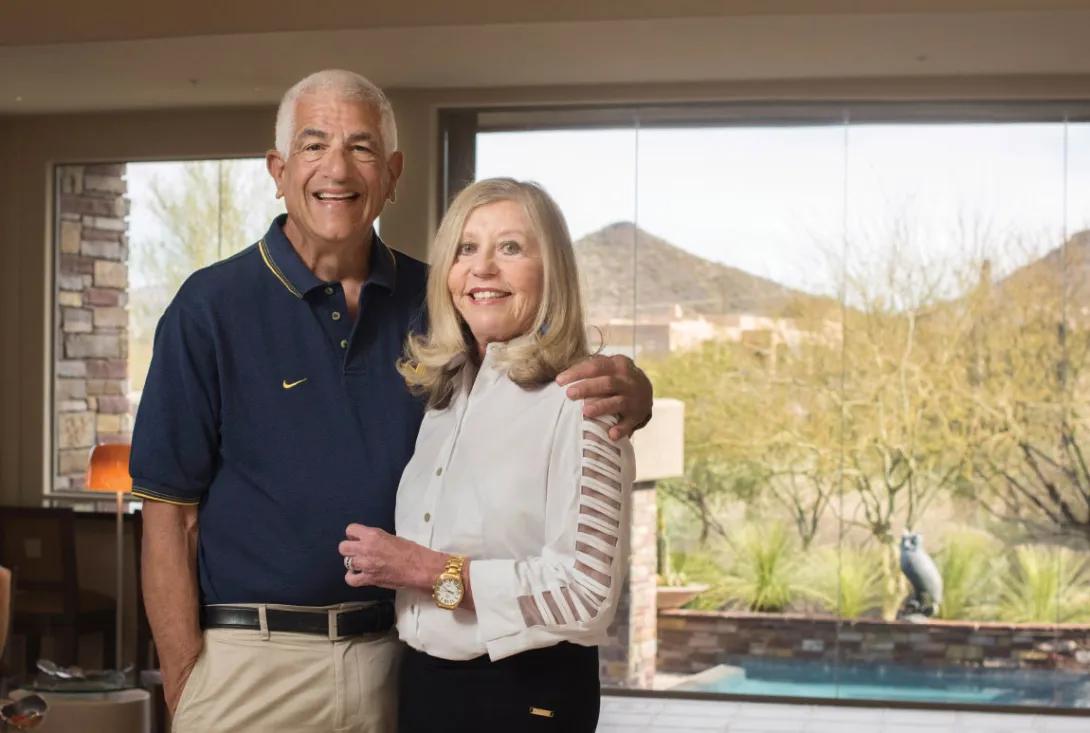
It wasn't a single moment that led Richard and Susan Rogel to commit $150 million to the U-M cancer center, but rather a series of interconnected heartbreaks and hopes. Five and a half years ago, Susan Rogel's 50-year-old daughter, Ilene, died from an aggressive form of lung cancer. Few options were available to Ilene, a non-smoker, which "made us want to do more to help with the fight against cancer," says Richard Rogel. "It's as simple as that."
Both of Susan Rogel's parents died of cancer many years ago. Richard's father died of pancreatic cancer, which is difficult to detect and often incurable. He hopes that a device created in U-M's Biomedical Engineering Department, which can capture metastatic cancer cells before they spread to the rest of the body, will continue to show promise as a prevention and detection tool for patients with the disease.
Another personal connection led them to make the transformative gift: their deep ties to the University of Michigan. Richard Rogel was valedictorian of his 1970 class at what is now the U-M Stephen M. Ross School of Business, and he received an honorary doctor of laws degree in 2009. He serves as a vice chair of the Victors for Michigan National Campaign Leadership Board, while Susan serves on multiple campaign leadership councils at Michigan Medicine. They have given generously to a variety of schools, colleges, and programs around the university.
Richard Rogel also has been treated at Michigan Medicine many times and praises the care he received, as well as the complementary therapies that helped with his recoveries, such as having a harpist perform in his room.
He has spoken extensively with cancer center researchers and clinicians about their work, as well as families affected by it. When touring the lab of Sofia Merajver (M.D. 1987, Residency 1991, Fellowship 1993), Ph.D., he was struck by her research on the genetics of breast and ovarian cancer. He was also profoundly moved by a story about a patient given six months to live, whom Merajver helped keep alive for 18 years. "I'm always touched by how personable and caring our researchers are," Richard Rogel says.
Another Michigan trait that he admires is the willingness of researchers to work together. "I call Michigan 'Collaboration U' because so many different units work together to solve problems," Richard Rogel says. "We have the advantage of 97 graduate departments rated in the top 10 in the country. Putting all this brain power and excitement together is going to help us find a cure for cancer.
"It will make people's lives better," he says. "That's the most important thing."
Bigger Horizons
The Rogels' commitment to the cancer center of $150 million, including $40 million that was announced previously, is the largest gift ever to Michigan Medicine and one of the largest in U-M's history. The gift makes Richard Rogel — president of the investing firm Tomay Inc.; and founder, as well as the former chairman and CEO, of the Preferred Provider Organization of Michigan, which was the first in the country of this type of health insurance plan — and Susan Rogel the second largest individual donors to U-M.

"I'm hoping our gift will allow them to reach bigger horizons," Susan Rogel says.
The gift to what is now called the U-M Rogel Cancer Center focuses on six components that will develop promising scientists and leverage the university's broad and deep strengths in science, medicine, and innovation:
- Pioneering cancer research and technology Provide competitive grants to collaborative research teams developing new approaches and technologies to advance early cancer detection, monitoring, and treatment.
- Collaborative networks Establish a signature program that brings international luminaries in the cancer field to U-M for six to 12 months. They will develop new projects that will continue after they leave, creating a collaborative network focused on advancing and applying cancer knowledge.
- Cutting-edge scientists Provide support to retain or recruit dynamic researchers to pursue high-risk, high-reward projects.
- Scientific freedom Create a suite of endowed professorships in cancer research, tied to research funds that will convey U-M's commitment to discovery and innovation.
- Promising new researchers Support the development of independent research careers for a cohort of highly motivated, advanced postdoctoral cancer research scientists whose work shows signs of great promise.
- Scholarship support Offer scholarships to enable medical students and other predoctoral trainees to develop the skills and knowledge they need to make lasting contributions to the health of individuals and populations, including those with cancer.
Eric R. Fearon, M.D., Ph.D., the Emanuel N. Maisel Professor of Oncology and director of the Rogel Cancer Center, says the gift "brings major new opportunities for our cancer center to dramatically increase the pace of generating new advances in the cancer field.
"We will be able to develop and apply selected discoveries for new approaches to reduce the burden of cancer and improve quality of life for cancer patients and survivors, as well as assist in building the careers of the next generation of cancer researchers and clinicians," Fearon says.
"Their wonderful gift will further elevate the life-changing impact of our cancer center, while advancing the amazing work of our faculty and students and inspiring new hope for millions of patients around the globe," says U-M President Mark Schlissel, M.D., Ph.D.
The Rogels hope the gift inspires more philanthropy to benefit cancer research and clinical practice at U-M. "I think other donors motivate donors to give," Richard Rogel says.
The Rogel Cancer Center already has a history of significant research discoveries. Those include identifying a genetic alteration seen in 50 percent of all prostate cancers, which is now helping oncologists direct treatment; developing new potential treatments for graft-versus-host disease; creating mouse models that are used to help understand cancer biology; and many more. And now, the Rogels' transformational gift will allow for greater and faster breakthroughs, at a university that means so much to them.
"My reason for being these days is to help Michigan," Richard Rogel says. "It's my new career."
The Rogels' Deep Ties to U-M
The Rogels, who split their time between Avon, Colorado, and Scottsdale, Arizona, have given and pledged $188.5 million to at least 17 areas of the university to date. Their giving has supported the Kenneth G. Lieberthal and Richard H. Rogel Center for Chinese Studies in the College of Literature, Science, and the Arts; the Rogel Medical Scholars at the Medical School; and the Rogel Award for Excellence, providing need-based support for more than 540 undergraduate students since 2000.
Richard Rogel chairs the Michigan Medicine Victors for Michigan campaign and the Victors for Michigan Global Student Support Committee that has raised more than $1 billion. In addition, Richard serves on numerous other boards across the university, including the Development Advisory Board for the University of Michigan-Shanghai Jiao Tong University Joint Institute and the Leadership and Development Council for the Joint Institute for Translational and Clinical Research between Michigan Medicine and Peking University Health Science Center. Previously, he chaired the U-M Michigan Difference campaign, and received U-M's inaugural David B. Hermelin Award for Fundraising Volunteer Leadership in 2004 and the national Ernest T. Stewart Award for Alumni Volunteer Involvement from the Council for Advancement and Support of Education in 2011.
Susan Rogel serves on the steering committee of the Victors for Michigan National Campaign Leadership Board, the C.S. Mott Children's Hospital and Von Voigtlander Women's Hospital National Campaign Leadership Council, and the U-M Depression Center Campaign Council. She has served on the Alumni Association Campaign Committee.
Read more about how philanthropy helps fill the gaps created by tight federal funding.
Featured News & Stories
Small comforts make a world of difference
Continuing the legacy of a doctor’s doctor
Family’s gift honors wife and mother, supports nephrology nurses

Comprehensive DNA sequencing reveals hidden drivers of cancer
‘Molecular glue’ stabilizes protein that inhibits development of non-small cell lung cancer and uterine cancer