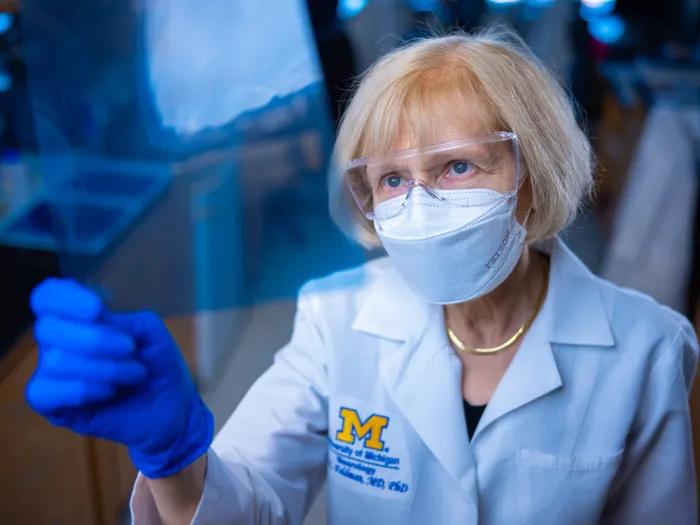
Clinic Q&A: The Power of Social Work with Darla Goulet
Few professions match the powerful impact of striving to empower and improve the lives of those around them the way social work can. There is a very special person who has been filling this crucial function for the past seven years at the Pranger ALS Clinic and the University of Michigan Health’s Department of Neurology, Darla Goulet, MSW.
We sat down recently with Darla Goulet, MSW, to learn more about the woman behind the magic.
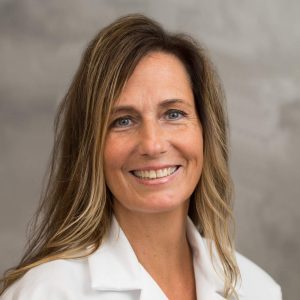
Darla Goulet, MSW
What inspired you to become a social worker?
I guess I have always been a bit of a social worker, even before I knew that was what I was going to do.
However, I wasn’t driven to go back to school to become one until my mom was diagnosed with cancer and was moved into hospice. That was back in the ‘80s when the idea of hospice was new, and she was one of the first people in all of Michigan to be moved there. I was blown away by the impact of her social workers, and how they not only helped my mom, but our family as well.
What do you like best about what you do?
I really love to educate, and for social work, education is huge. Social workers are always teaching and helping people to understand what is happening and understand the resources available to them. The role of the social worker is unique within medicine because we are not trying to fix anyone. We are giving people the strategies and tools to help themselves. I like that I can help people find their strengths and be able to navigate some pretty powerful stuff on their own, with just a little bit of help. I think it’s great to see people, even in a really tough position, become advocates for themselves.
You first came to U-M through the Pranger ALS Clinic. Why ALS?
Pretty much all my work in social work has been focused on end-of-life care, terminal illness, and that kind of thing. So, it seemed like a good fit. At the time I didn’t know much about the disease, but it was something I was interested in.
What is the role of a social worker in a multidisciplinary clinic like the Pranger ALS Clinic?
I would say that there are two roles for a social worker at any multidisciplinary clinic, the primary one being to assist patients and their families, not just with resources, but with navigating a difficult system. Our health system is complicated in so many ways.
For those affected by ALS and other fatal diseases, there is also the end-of-life piece, which changes a lot in life, sometimes in unexpected ways. We talk a lot in the clinic about anticipatory grief and how a progressive disease specifically affects the lives of patients and those close to them.
I have heard patients describe this change in a way that is spot on — before the disease their lives were big and broad, but with ALS everything gets narrower. Their identity changes, relationships change, and roles change.
There is a lot of discussion surrounding that adjustment. I also have conversations about hospice and what that means, along with palliative care.
People often ask me what it is like to die from this disease. There are a lot of tough conversations surrounding death as it relates to ALS.
How do you handle those difficult conversations?
I hope that empowering patients with information will help take away some of the fear because, as you can imagine, there is always some fear associated with death. After we speak, oftentimes they say: “Okay, I feel better,” “I didn’t know it would be like this,” or “I didn’t know hospice could provide this.” I think that it is often a relief to be given a safe place to ask those questions.
A key part is letting patients drive the conversation and ask questions. Some people don’t want to know the details, and that’s okay.
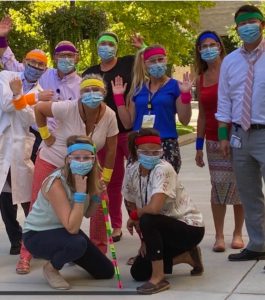
Part of the Pranger ALS Clinic team, ready to run
You mentioned you have two roles, what is the second?
The other role of social work in any multidisciplinary clinic that works with such a complex population is to support my colleagues. It’s a tough job, and there is a lot of compassion fatigue. So, I also spend time talking to the staff.
What do you wish everyone knew about ALS?
People have heard of Lou Gehrig’s disease or ALS, but not a lot of them truly know what it is, in part because it isn’t common.
I would like people to learn what the disease is about and what it means to have it.
There is the functional decline, but there is also all the grief and pain that goes along with it. ALS has emotional, spiritual, and, sometimes, physical pain, which affects not only the patient but everyone who loves that person.
What are some of the biggest challenges you see for those suffering from ALS?
Over the years, I often hear that patients and families feel isolated. They get the diagnosis, and maybe friends and family are right there in the beginning, but as time goes on, people start to fall off until no one is coming around.
It ends up being a really isolating journey.
The other piece is the limited resources for those with ALS. Don’t get me wrong, there are some great resources, but they are limited.
I think one of the biggest challenges people face is not having enough caregiving at home, which can be an expensive cost
How can those who know someone or a family dealing with ALS best support them?
I think it is incredibly important for people living with ALS and their families to have support because, as I said, ALS can be very isolating. That support can look very different depending on the situation. It can be hands-on care, it can be asking what tasks need to be done around the house, and it can be grocery shopping. It can be asking, “Can I call you to just offer support?” Or, if they are spiritual, “Can I sit and pray with you?”
The important piece is making the patient not feel alone. People can be very uncomfortable when someone they know is diagnosed with such a disease, so this is where education comes in again. Helping people learn about the disease will allow them to feel more comfortable in providing support.
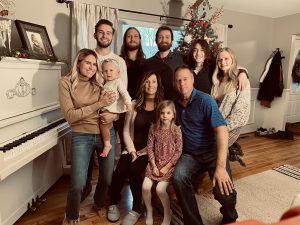
The Goulet Family, including her husband, five kids, one son-in-law, and two granddaughters
What do you like best about working in the Pranger ALS Clinic?
We have an amazing team and amazing providers.
I am truly inspired by their knowledge, their empathy, the compassion they show, and just their desire to help the folks we serve. I think if we didn’t have such an incredible team, it would be hard to stay because this is a tough job. I’ve been here for seven years! This team makes all the difference.
I also love working with patients and their families. Not only do I get to teach them, but they teach me, which is awesome. Anytime I have clinic, I learn something new and am inspired. Honestly, I think people with ALS and their families are some of the most resilient people. They readily adapt to everything.
Our brains like time to adjust to loss, and they don’t have that, but they adapt. Of course, they have bad moments, but the majority of our folks find peace in the journey and live life to the fullest. It is very inspirational to be part of this. I mean, what an honor to be allowed into their lives, for them to share with someone who was initially a stranger, and allow me to be part of their journey. It is incredible.
Featured News & Stories

Six U-M medical research teams picked for virtual science tournament
Researchers develop models to help diagnose ALS earlier through blood biomarkers
How virus-like proteins shape a cell’s stress response

ALS diagnosis and survival linked to metals in blood, urine
Journal Cover Features Latest ALS Research