Bo Schembechler: Heart of a Champion Research Fund
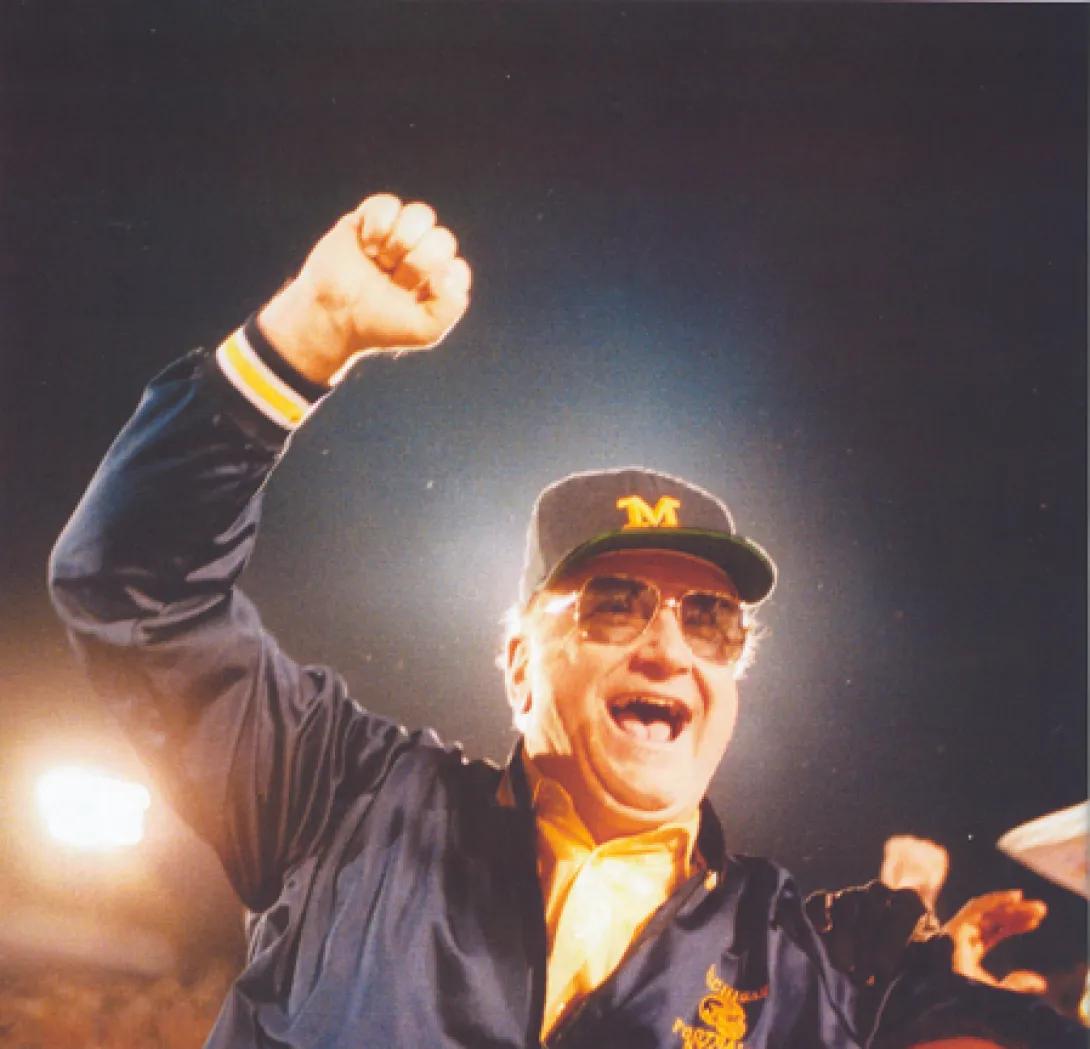
Bo Schembechler is the winningest coach in U-M football history, his 21-season legacy still a major point of pride for Wolverines young and old. After Bo led the U-M football team to 13 Big Ten Conference titles, he worked tirelessly to do the same for heart health.
Bo's serious heart disease led to his first heart attack, the night before his Rose Bowl debut on New Year’s Eve 1969. A successful quadruple bypass operation was performed on Bo in 1976, with a second in 1987, following his second heart attack. His was a battle fought in the public eye and in close partnership with another winning team — the cardiovascular experts at U-M, led by Dr. Kim Eagle.
Bo recognized that scientific advances in medicine allowed him to live a longer, healthier life. With an entirely new game plan in mind, he and his wife, Cathy, established the Bo Schembechler Heart of a Champion Research Fund at the University of Michigan Samuel and Jean Frankel Cardiovascular Center. From making groundbreaking research possible, to attracting the leaders and best to Michigan, the Heart of a Champion Research Fund has the potential to revolutionize cardiovascular medicine.
An ambitious goal was set: raise $10 million to fund an endowment that would provide $450,000 annually in perpetuity for the support of cardiovascular research. His vision was to create an ongoing means for investing in research that pushes the boundaries of current thought in prevention, diagnosis and treatment of cardiovascular disease. Understanding the importance of teamwork, Bo also felt strongly that the fund should support collaborative research efforts, bringing together investigators of varied disciplines to view cardiovascular challenges in new ways that would foster breakthrough discoveries.
Realizing the vision of Bo Schembechler and his fund will take time. The fate of it depends on the generosity of those who understand the devastating impact of cardiovascular disease and who seek to improve the lives of people now and into the future. Donor support of the endowment fund named in Bo's honor allows the Frankel Cardiovascular Center to award grants annually to support critical research projects that show promise of significant improvements in quality of life and longevity.
To date, the fund has granted awards to nine impressive investigators. Their work already has begun to have a substantial impact on cardiovascular research at Michigan. Their examples epitomize the vision that drives the fund.
The fund is a fitting legacy for such a remarkable man. It provides a unique opportunity for others to make a significant difference. In line with something Bo once famously said, "Those who stay will be champions" — those who give will be champions, too.
How to Give
You can join "Bo's Team" with a $10,000 (or more) donation to the fund.
Bo Schembechler proved that a diagnosis of cardiovascular disease need not be a death sentence if you can build a team to help put a game plan together to beat it. As a member of Bo's Team, you will receive a bronze miniature of the statue that is located in the clinic lobby of the U-M Frankel Cardiovascular Center, and you will join the Heart of a Champion team in Bo's truest sense of the word. Together, you share Bo's hope that supporting cardiovascular research will yield new observations in prevention, diagnosis and treatment of cardiovascular disease, which will help others in the same way that a series of medical and surgical advances benefited Bo. Like Bo, team members are passionate about facilitating research breakthroughs that ultimately will help many of us win in our own medical battles. To learn more about Bo's Team, contact Ryann Eff at (734) 998-6044 or [email protected].
Featured News & Stories

E-bikes are faster than ever. Are families prepared for the risks?

Scientists discover that bacteria use an understudied polymer found in all life to protect cell functions during stress
Gratitude inspires gift to improve survivorship care
Beyond the White Coat: Global & Local Health Experiences
Aortic valve replacement: Understanding TAVR and SAVR