National Poll: More Teens Participating in Protests Against Racism
The majority of parents support teen’s involvement with demonstrations about racism and police reform, but some may need to expand conversations in advance, expert says.
5:00 AM
Author |

Across the country, young people have made the news for their role in protests against racial injustice, from a 4,000-person protest led by three high schoolers in metro Detroit to a youth-led 10,000-person demonstration in Nashville.
And a new national poll confirms that a growing number of demonstrators taking to the streets to stand up against police brutality and racism are teenagers. One in 12 parents say their teen has attended one of these events this year, according to the C.S. Mott Children's Hospital National Poll on Children's Health at Michigan Medicine.
LISTEN UP: Add the new Michigan Medicine News Break to your Alexa-enabled device, or subscribe to our daily updates on iTunes, Google Play and Stitcher.
"Parents are seeing their teens show a more complex interest in the world around them as demonstrations against racism continue in their communities and around the country," says Mott Poll co-director Sarah Clark, M.P.H.
"While most parents support their teen's involvement in this movement, they also have some reservations about their child's readiness to move from talking about demonstrations to participating in them."
And when it comes to these concerns and conversations among families regarding the protests, the Mott Poll report indicates significant racial differences between Black and white parents.
"Families' different lived experiences and perspectives will likely shape parents' views on their teens' involvement with demonstrations," Clark says.
Clark discusses more of the findings and takeaways from the nationally-representative poll, which is based on 1,025 responses from parents of teens ages 13-18.
Having the conversation
Three quarters of parents say they've talked with their teen about the ongoing protests. But Black parents are more likely than white parents to report in-depth discussions and to say their teen has attended an event about racism.
MORE FROM MICHIGAN: Sign up for our weekly newsletter
Meanwhile, 43% of parents surveyed have had some discussion with teens and 27% say they've had minimal or no conversations about the demonstrations with their kids.
"Many families are engaging around the topic of racism and what's been happening in the country over recent months, with one in three white parents and two in five Black parents having deep conversations about the protests with their teens," Clark says.
These exchanges are important, Clark says, because they allow parents to tap into how issues in the news are affecting their kids and help provide an outlet for those reactions.
"Parents can look for opportunities to open a conversation, such as during a news broadcast about demonstrations. Ask teens if they've been talking about it in school or with their friends and then step back and let the teen talk," Clark says.
Racial differences in safety fears, emotional response
The majority of parents whose teen attended an event about systemic racism supported their teen's involvement, with 55% showing enthusiastic support and 38% having some reservations. But 5% of parents disapproved and 2% did not know about the teen's attendance, according to the poll.
White parents are nearly twice as likely than Black parents (57% vs 31%) to believe teens do not belong at these demonstrations.
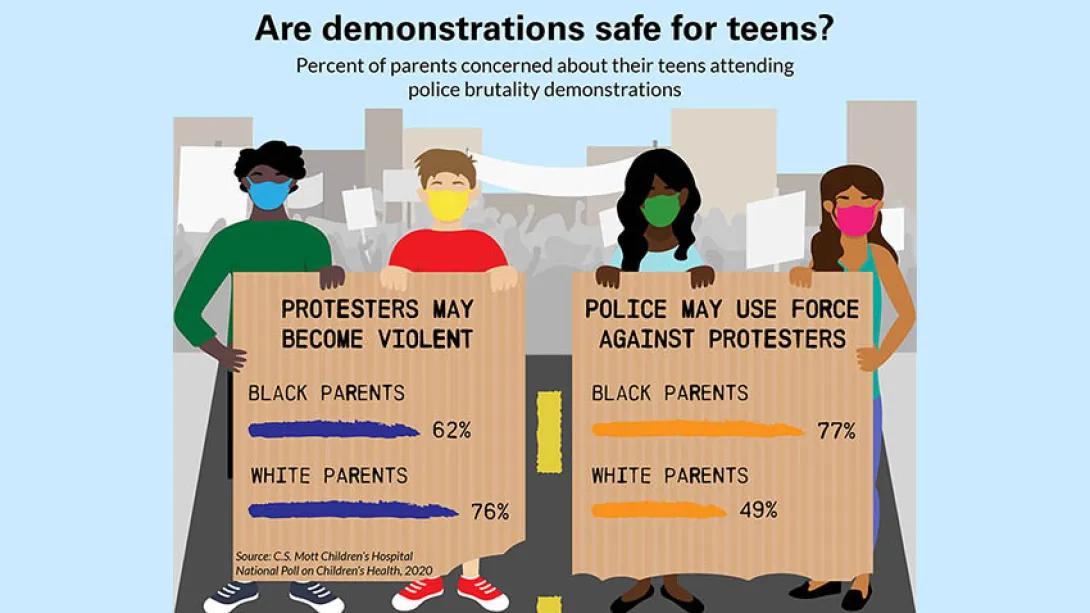
Safety ranked highest on parents' list of worries. But concern about demonstrators becoming violent was higher among white parents (76% vs 62%), while concern about police use of force was more common among Black parents (77% vs 49%).
"We saw substantial racial differences involving views on who might instigate violence at a demonstration," Clark says. "This may reflect parents' own experiences, as well as the influence of media portrayals of the demonstrations and the events leading up to them."
Black parents were also more likely to say the topic is stressful for their teen. Half of Black parents say thinking about police brutality and racism causes stress for their child compared to a quarter of white parents.
"Stress may show as fear that they may be victims of police brutality or as outrage about injustice done to someone else," Clark says.
"The higher stress level reported by Black parents is understandable," she adds. "The demonstrations highlighted numerous Black victims of police violence, and Black teens may see themselves at risk. Many Black parents have difficult conversations with their children from early on about how racism may impact their lives."
Preparing teens for protests
Many parents worry that teens aren't mature enough to handle protests, the report finds. In addition to safety concerns, half of parents also didn't think their teen understood the risks of participating in demonstrations, including the concern that teens could get arrested and not know their legal rights.
Clark recommends parents talk to teens about potential scenarios and how to stay safe ahead of attendance.
SEE ALSO: Raising Race-Conscious Children: How to Talk to Kids About Race and Racism
"It can be overwhelming to attend a large demonstration. Parents should encourage teens to look for opportunities to participate with a small group through a school, community organization or place of worship," she says.
Parents may also want the small group to include an adult chaperone, particularly for younger teens.
This allows teens to have familiar people to help with problem-solving for routine issues, such as finding a restroom, or potentially serious issues, such as observing illegal activity or feeling unsafe.
Teens should also share plans about where the group will meet if they become separated, and go over logistical preparations, such as bringing water bottles, masks for COVID-19 protection, and charged cell phones. It's reasonable for parents to ask teens to check in periodically by text or a phone call, and to leave the demonstration as evening approaches, Clark says.
In attempting to identify unsafe situations, parents may also ask their teens to show them announcements about the demonstrations, and to look together on social media to see if there are threats of violence from any groups or individuals. They should also discuss their constitutional rights and steps they can take if there are interactions with law enforcement.
Encouraging youth activism
Some families may think it's easier to ignore difficult conversations about race or forbid teens from attending demonstrations. But Clark says this negates an opportunity for the teen to talk through – and therefore reduce – their fear or outrage. Skipping the conversation also removes parents from the process of planning for participation, limiting their ability to offer guidance and direction, she says.
Parents should also remember that young people have led movements throughout history that have helped prompt significant social changes in the world. If children show interest in activism, Clark says, parents should consider nurturing their youthful energy and desire to be a part of change.
"Being engaged gives teens a way to relieve their stress and to turn their fear or outrage into positive action," Clark says.
"These opportunities will likely expose teens to a broader set of experiences to help them expand their world view, help them develop lifelong attitudes about citizenship, and reinforce the importance of voting and how every person can make a difference."
Like Podcasts? Add the Michigan Medicine News Break on iTunes or anywhere you listen to podcasts.

Health Lab
Explore thousands of health news & research stories by visiting the Health Lab homepage for more.
Media Contact

Public Relations
Department of Communication at Michigan Medicine
Stay Informed
Want top health & research news weekly? Sign up for Health Lab’s newsletters today!
Featured News & Stories
From patient to artist: A project close to her heart
Missed feedings in 10-day-old infant led to rare infantile botulism diagnosis
A gift for Michigan’s most vulnerable babies
After 13 years of IV nutrition, teen finds freedom to just be a kid
Small Pauses, Bigger Impact: Mindfulness in Action