Complex epilepsy surgery helps 7-year-old live a seizure-free life
Maddie’s non-stop seizures resisted medicine. So at age 4, she underwent a specialized procedure to remove the brain tissue causing them.
9:55 AM
Author |
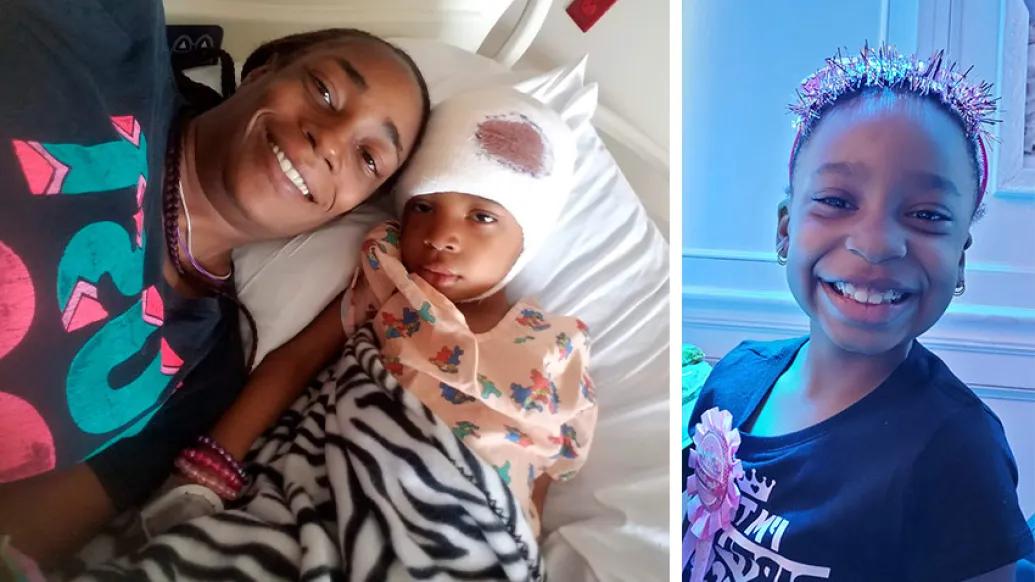
LaToya Johnson remembers watching helplessly as her daughter Madisyn "Maddie" would suddenly stiffen her tiny body, drop her toy and gasp as she temporarily lost consciousness.
What had started as infantile spasms as a newborn gradually evolved into ruthlessly persistent seizures. By the time Maddie was almost two, they'd hit nearly every 10 minutes, lasting seconds to over a minute long, from the time the toddler woke up until the time she went to bed.
"It felt like she was having seizures more often than she was playing. There were so many we lost count. Her little body was just so tired," Johnson said.
"They could be really scary, especially if it happened when she was walking or standing because she could fall. I couldn't work or let her go to any kind of school or daycare because I needed to be with her at all times."
Nearly three fourths of pediatric patients who suffer from epilepsy are successfully treated with antiepileptic drugs. But for others, like Maddie, the disease remains stubbornly drug resistant.
MORE FROM MICHIGAN: Sign up for our weekly newsletter
Doctors diagnosed her with refractory focal epilepsy, caused by unusual cell formation in the brain and one of the most difficult types to treat with medicine. Her form of epilepsy also stemmed from the parietal lobe, which is near the back and top of the head and is central to processing sensation, such as touch, making surgery difficult.
The Detroit family opted to take her to University of Michigan Health C.S. Mott Children's Hospital where she was put on a new medication regimen that helped slow down seizures. But after two years of treatment, Maddie qualified for a complex, highly specialized surgery at Mott.
It would involve surgically placing electrodes in her brain to identify the exact locations where seizures began. Then, surgeons would make a horseshoe sized cut and remove the culprit brain tissue through resective epilepsy surgery.
Her type of epilepsy is extremely challenging to localize and successfully treat with surgery … Her outcome is quite remarkable.Erin Fedak Romanowski, D.O.
There were no guarantees, but it was the only chance of reducing the non-stop, disruptive seizures.
"We were terrified. They were removing part of her brain. Just thinking about the risks if something went wrong made us so nervous. But we wanted her to have a better life," Johnson said.
So that October, Maddie underwent the six-hour surgery at Mott, led by pediatric neurosurgeon Hugh Garton, M.D., M.H.Sc. Two days later she was cleared to go home.
A new life without seizures
"She hasn't had a seizure since," Johnson said. Over the next few months, Maddie started talking more and became increasingly social. She was able to play for longer periods of time, eventually discovering her love for Barbies, unicorns, singing and dancing. She was less tired during the day since she could go off all medications.
"It's like we got a brand-new kid. This girl had a ball of energy like I'd never seen before," Johnson said. "We knew it was in there somewhere, but she was always a bit sleepy from all of the medicine. Her personality just blossomed."
Just a few months after surgery, Maddie even got on her first plane ride for a vacation to Disney World with her mom, dad, Eddie, and brothers Dylan, now 9, and Donovan, now almost 18.
"Her type of epilepsy is extremely challenging to localize and successfully treat with surgery," said her pediatric neurologist, Erin Fedak Romanowski, D.O., of the Mott Comprehensive Pediatric Epilepsy Program. "Most patients have to remain on medications and are not usually seizure free without them, even after surgery. Her outcome is quite remarkable."
Today, the seven-year-old is still seizure free, "full of sass and loves all things that bling," her mom said. She's known for turning every sentence into a song, often begging to paint fingernails, addressing people as "sweetie," and starting full conversations with strangers in the grocery aisle.
Her Christmas wish list reflects some of her passions: sparkly shoes, fashion dolls and ballet lessons.
Maddie continues physical therapy for issues related to low muscle tone and sees her Mott neurology team every year. Despite some physical and cognitive challenges related to experiencing severe seizures during early childhood, her parents say she's living her best life so far.
"Our little girl has come so far. We still can't believe she's completely off all the medicines. We didn't think that would ever be possible," Johnson said. "She's able to go to school now, play and fight with her siblings and have the energy to do all the regular kid things. It's been such a joy watching her learn new things every day."
Like Podcasts? Add the Michigan Medicine News Break on iTunes or anywhere you listen to podcasts.

Health Lab
Explore thousands of health news & research stories by visiting the Health Lab homepage for more.
Media Contact

Public Relations
Department of Communication at Michigan Medicine
Stay Informed
Want top health & research news weekly? Sign up for Health Lab’s newsletters today!
Featured News & Stories
Continuing the legacy of a doctor’s doctor
U-M-led consortium to receive up to $52 million in NIH funding to study why viral respiratory infections affect children differently
4 in 5 parents say having a baby is too expensive
A pediatric epilepsy fundraiser that changes lives
Many hospitals still don’t do enough to prevent UTIs from catheters